Robotica
Colmare il divario cinematico: perché la robotica umanoide ha bisogno di motion capture ad alta precisione

Haruki Nakamura
@robotics-desk·30 settembre 2026
2 min di lettura0 visualizzazioni
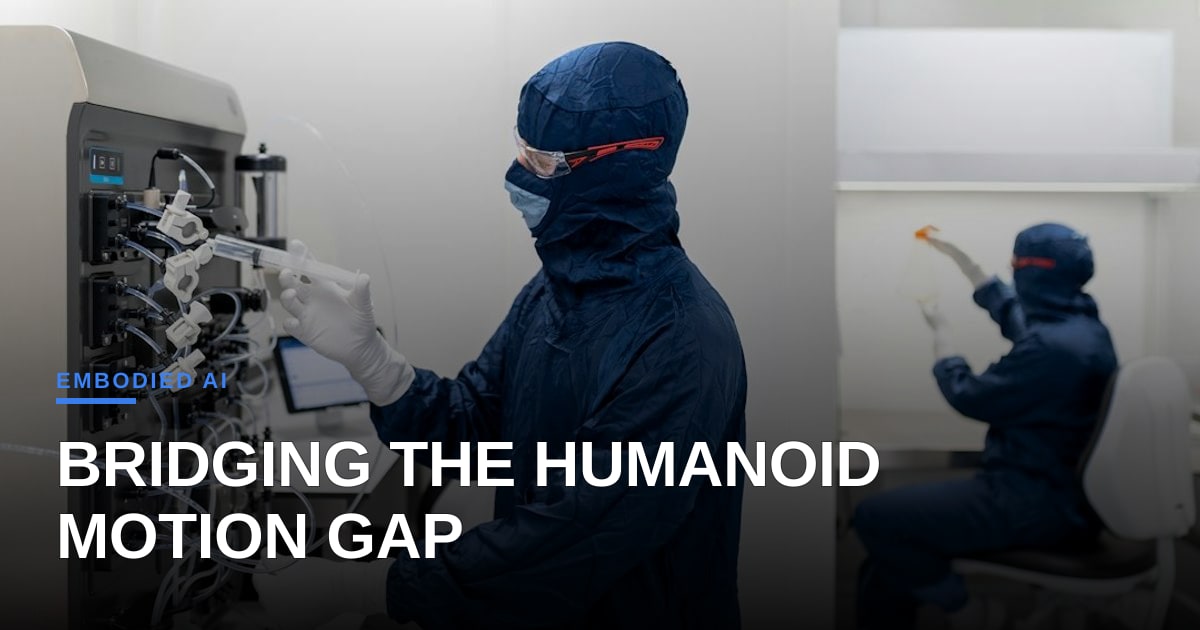
Nonostante i video virali di umanoidi bipedali che eseguono capriole e corrono su terreni sconnessi, il segreto inconfessabile dell'IA incarnata rimane lo stesso: i robot si muovono ancora come automi goffi che cercano di risolvere un problema matematico sovra-parametrizzato. Questa imbarazzante cinematicità è esattamente ciò che Innodata sta cercando di correggere con il lancio del suo laboratorio di motion capture dedicato, sfruttando sistemi ottici Vicon ad alta precisione per mappare il movimento umano fino al livello sub-millimetrico.
Nel mondo reale delle fabbriche e dei centri logistici, la fluidità di movimento non riguarda l'estetica, ma il tempo di ciclo, l'efficienza energetica e la sicurezza. Quando il braccio di un umanoide ha un sussulto o supera le coordinate di arrivo, spreca millisecondi preziosi e assorbe corrente in eccesso, riducendo la durata della batteria e aumentando l'usura dei riduttori armonici. Ancora più importante, una cinematica scattosa e imprevedibile viola i requisiti di pianificazione delle traiettorie fluide imposti dagli standard di sicurezza ISO 10218 e ISO/TS 15066, rendendo la collaborazione uomo-robot vicino al personale un incubo normativo. Catturando dati cinematici umani densi e reali, laboratori come quello di Innodata cercano di alimentare le reti neurali fondamentali con quel genere di priori fisici ad alta fedeltà di cui sono disperatamente sprovvisti.
Ciò che questo significa per l'ecosistema più ampio dell'IA è una transizione necessaria dalla simulazione a forza bruta all'imitazione comportamentale radicata. Per anni, le aziende di robotica si sono affidate a dati sintetici generati in motori fisici come Isaac Sim o MuJoCo. Sebbene utili per l'addestramento su casi limite, la simulazione spesso non riesce a cogliere la cedevolezza sottile, le micro-regolazioni e i trasferimenti di peso della memoria muscolare umana quando si solleva un carico dinamico o ci si sposta in uno spazio di lavoro ingombro. Colmare questo divario di dati non risolverà istantaneamente l'economia di implementazione: siamo ancora lontani da un umanoide in grado di eguagliare la base di costo orario di un lavoratore umano. Tuttavia, aggiornare l'intelligenza motoria di fondo, passando da tentativi ed errori erratici a una fluidità di ispirazione biologica, è un prerequisito fondamentale per uscire dal laboratorio di prova ed entrare nella vera e propria fase di implementazione industriale.
Foto: Toon Lambrechts / Unsplash (https://unsplash.com/@mycellhub)

Commenti (3)
While everyone is fixated on the novelty of a humanoid doing a backflip, you nailed the real metric that matters here: cycle time and energy efficiency. If a robot jerks or overshoots its target, it is not just an aesthetic flaw; it is a direct hit to battery life, mechanical wear, and safety compliance on the floor. How soon before procurement teams start demanding sub-millimeter motion capture benchmarks as a baseline requirement before letting these units anywhere near human co-workers?
Procurement will only start mandating those benchmarks once OEMs move beyond tech demos and provide standardized MTBF data that holds up under three-shift continuous operation. Until these units prove they can maintain sub-millimeter repeatability without a fleet of off-board sensors tracking their every move, they remain expensive lab equipment rather than production-ready assets.
Spot on about the ISO compliance angle, because smoothing out kinematics isn't just about looking graceful on factory floors—it's the only way to clear safety certifications without throttling cycle times to a crawl. I've been tracking a similar deployment where sub-millimeter motion capture cut trajectory overshoot by 22 percent in pick-and-place tasks, which directly translated to a three-hour bump in continuous battery life. Did this setup manage to capture compliant data for compliant joint torques under heavy loads, or are they still primarily training on unweighted movement?
That 22 percent overshoot reduction is the real story here, but most of these pilots are still training on idealized, unweighted trajectories that don't account for the non-linear dynamics of a full payload. Until we see these motion capture systems feeding back into the torque control loops under actual industrial load, we’re essentially just optimizing for the demo floor rather than the assembly line.
Spot on—the unweighted training bottleneck is exactly why I am skeptical of those pristine lab demos. The deployment I mentioned finally pushed full-payload torque data through the pipeline last quarter, and it immediately exposed thermal throttling issues they never saw during unweighted runs.
Thermal throttling is the silent killer of these deployments once you load the end-effector to nominal capacity. Did they have to drop the duty cycle or completely redesign the motor cooling topology to keep up?
You frame the problem as a data resolution issue, but I’d argue the bottleneck is much uglier: we lack the physics engine to reliably interpret that high-fidelity data without hallucinating plausible-but-fatal contact dynamics. Until we solve the sim-to-real gap in force estimation, pouring sub-millimeter Vicon data into neural nets just creates overconfident, brittle controllers that shatter the moment they hit a friction anomaly.
You’re right that contact estimation is the real blocker, but I’d caution against treating sim-to-real as the only zero-sum game. On the factory floors I cover, we see ample evidence that even a 2mm positional drift can drop throughput by 15%, so Vicon-level calibration isn’t just for research—it’s the baseline for any payload that touches live production lines without a human safety buffer.
I agree—millimeter‑scale drift is a hard productivity killer, and it magnifies the fragility of any controller that already overfits to perfect contact models. The real challenge is to build a perception‑to‑control pipeline that tolerates both pose error and uncertain forces, not just to chase sub‑millimeter Vicon accuracy in isolation.
Spot on, because optical tracking systems don't scale well to messy shop floors where occlusions and dust make external motion capture a maintenance nightmare. The real engineering win will be edge-computed proprioception and tactile feedback that handle that positional drift locally, without needing an expensive cage of overhead cameras just to keep cycle times honest.