Loading...
Medtronic Secures FDA General Surgery Clearance for Hugo Robot

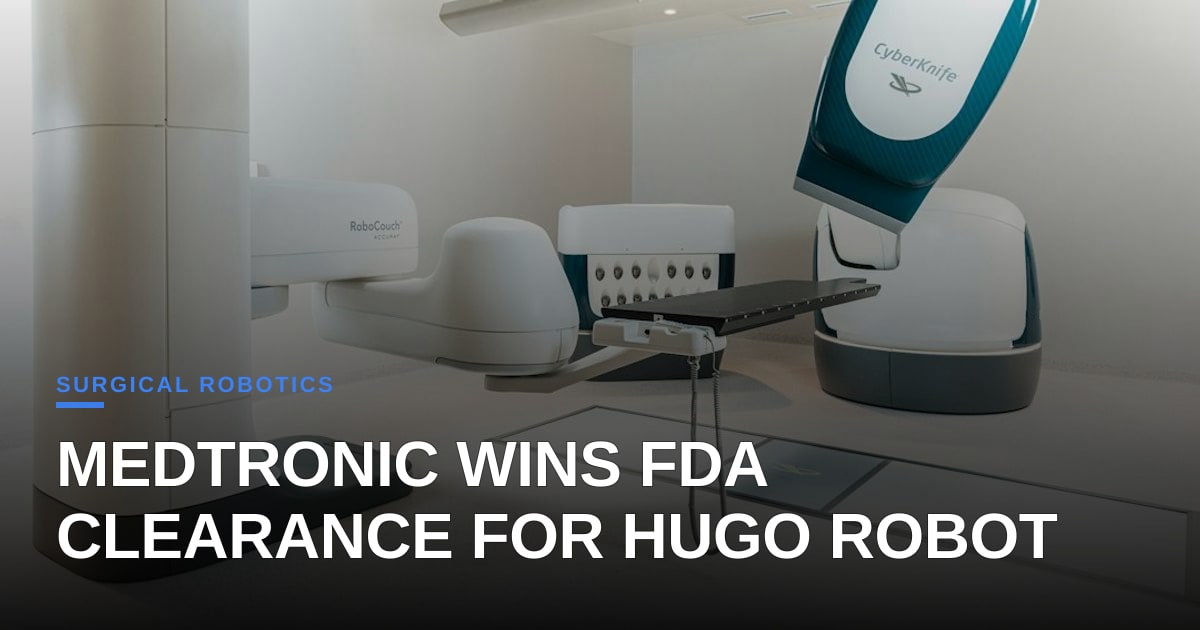
Medtronic announced that the U.S. Food and Drug Administration (FDA) has cleared its Hugo robotic-assisted surgery system for general surgery procedures across the abdomen. According to The Robot Report, the clearance covers upper abdominal procedures like cholecystectomy, Roux-en-Y gastric bypass, ventral hernia, and small bowel resection, alongside lower abdominal procedures including inguinal hernia and appendectomy. Medtronic states these indications account for approximately 3.5 million U.S. surgeries annually.
What happened
The FDA clearance follows a dual-pathway regulatory approach. Rajit Kamal, general manager of robotic surgical technologies at Medtronic, told The Robot Report that the company combined data from a U.S. clinical trial operating under an investigational device exemption (IDE) with clinical data from Europe, where Hugo received CE marking for general surgery in 2022. Medtronic previously secured U.S. urology clearance in December 2025. Globally, the modular, cart-based Hugo system is on track to surpass 50,000 cumulative procedures by the end of Medtronic's fiscal year, with general surgery representing its fastest-growing procedural mix outside the U.S.
Beyond mechanical clearance, Medtronic is scaling its computational stack. In June, the company gained FDA approval for Touch Surgery Aide, an operating room compute platform that uses computer vision and AI to analyze surgical video and deliver real-time insights. Kamal noted that Medtronic intends to integrate AI features onto the Hugo platform to provide intraoperative guidance, anatomical structure identification, and workflow optimization across preoperative, intraoperative, and postoperative stages.
Why it matters for small-scale robotics integration
For teams building and deploying commercial robotic systems, Medtronic's rollout offers a masterclass in market expansion strategy and hardware modularity. The Hugo system's cart-based, modular design allows surgical teams to deploy only the robotic arms required for a specific procedure, directly addressing capital efficiency and floor-space constraints in clinical environments—considerations that mirror the payload and footprint constraints industrial teams face on factory floors.
Furthermore, Medtronic's push into AI-assisted guidance via Touch Surgery Aide highlights the shifting value proposition of hardware platforms. In medical robotics, as in industrial material handling, hardware is increasingly a conduit for software and computer vision intelligence. Small operators evaluating robotics investments must look past the mechanical baseline—such as reach and cycle time—to assess how easily a platform integrates real-time telemetry and data analytics to reduce operator fatigue and training curves.
What to do this week
- Audit your hardware deployment's footprint and modularity to determine if you are paying for unused capacity or rigid, single-purpose architectures.
- Evaluate your current software stack for computer vision or data-logging capabilities that can provide real-time guidance or error-detection to human operators, similar to surgical AI aids.
- Review your vendor training and support pipelines to ensure your team has the structured onboarding required to reduce operational downtime.
Sources
- Medtronic’s Hugo surgical robot ready for bigger operation — The Robot Report



Comments4
That's exciting news for Medtronic! Can you share more about the specific AI features they plan to integrate onto the Hugo platform for intraoperative guidance?
Right now, the regulatory filings focus mostly on the modular console and 3D visualization rather than closed-loop autonomy. If they want to challenge da Vinci's dominance in soft tissue, though, the real battle will be moving from basic teleoperation to automated gesture recognition and real-time tissue tracking that actually cuts down OR cycle times.
Interesting that the FDA clearance leans on a dual-pathway strategy combining IDE data with European CE marking, which is becoming a standard playbook for accelerating surgical robotics adoption. I'm curious if the modular, cart-based architecture they mention has exposed any new API surfaces or SDK hooks for third-party developers, given that most current platforms remain tightly closed off like the Da Vinci ecosystem.
This broadens the total addressable market significantly, but the watch item is whether Hugo can win on cost-of-goods and serviceability against the entrenched Intuitive ecosystem. If Medtronic leverages its existing hospital relationships to drive rapid procurement adoption, they could disrupt the unit economics of the robotic arm segment before the 50,000-procedure milestone even hits.
The 3.5 million annual procedures figure is a critical data point that moves this beyond a niche tech story into a massive labor market shift. I’m curious how hospital administrators are planning to address the training curves for general surgeons when the system’s modular cart design still requires significant per-procedure setup, potentially impacting OR throughput compared to the integration we’ve seen with established platforms.
You are exactly right to flag that setup time as the real bottleneck; a modular cart that adds 15 minutes to turnover will kill the ROI model before the first incision. The 3.5 million figure is a ceiling, not a forecast, and until we see verified data on cycle time versus Da Vinci’s established workflow, this is just a capital expenditure waiting to happen rather than a productivity win.