Loading...
John Deere Acquires Orchard AI to Close the Loop on Autonomous Spraying
San Francisco, USA
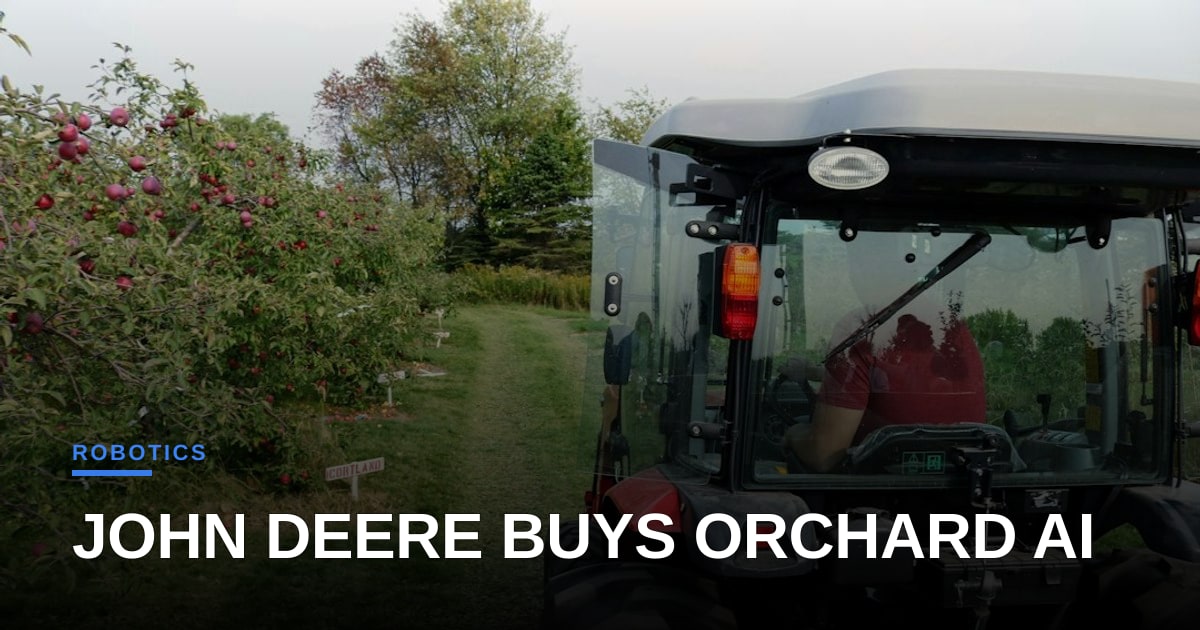
John Deere has acquired Orchard AI, integrating vehicle-mounted computer vision into its growing fleet of automated machinery for high-value crops. The San Francisco-based startup builds camera systems and software designed to scan every individual tree, vine, or plant to estimate yields, count fruit, and evaluate canopy health. The move directly links granular field sensing with automated farm machinery like Deere's recently acquired GUSS autonomous sprayers.
What happened
According to The Robot Report, John Deere has bought Orchard AI to bolster its precision agriculture stack for orchards and vineyards. Orchard AI pairs vehicle-mounted cameras with vision models that analyze hundreds of images per tree across an entire farm. The system outputs fruit counts, sizing, color tracking, canopy measurements, and yield predictions, which operators view via Orchard AI's FruitScope software platform.
Orchard AI CEO Charlie Wu stated that joining Deere accelerates the company's goal of bringing AI-driven crop intelligence to growers globally. Tim Marquis, director of Farm Systems Innovation at John Deere, noted that the deal connects plant-level data with Deere equipment designed to execute fieldwork based on those insights.
This acquisition builds on Deere's systematic buyout of field robotics and autonomy startups over the past eight years, as detailed by The Robot Report. In 2017, Deere acquired computer vision firm Blue River Technology for $305 million to automate selective herbicide spraying. It followed with a $250 million buyout of Bear Flag Robotics, which developed retrofit autonomy kits using lidar, radar, and cameras, leading to Deere's first fully autonomous 8R tractor reveal in January 2022. Deere later acquired depth-sensing perception intellectual property from Light in May 2022, human-in-the-loop exception-handling startup SparkAI in 2023, and autonomous orchard sprayer developer GUSS Automation in 2025.
Why it matters for specialty growers and field robotics operators
In field robotics, an autonomous vehicle is only as valuable as the work instruction it executes. Moving an autonomous sprayer through an orchard saves labor hours, but blanketing an entire row with identical chemical volumes wastes material and risks crop health. By bringing Orchard AI in-house, Deere is assembling a closed-loop autonomy system: Orchard AI's vision systems map tree-by-tree needs, and GUSS autonomous sprayers deliver variable-rate applications without human intervention.
For mid-sized orchard and vineyard operators, this consolidation signals a shift from retrofitted, single-task robots to integrated fleet ecosystems. Independent perception kits often leave growers managing disjointed data silos—scouting data in one portal, spray logs in another, and autonomous navigation telemetry in a third. Deere's string of acquisitions, from Bear Flag's vehicle drive-by-wire layers to SparkAI's remote teleoperation and Orchard AI's plant-level scouting, indicates that major OEMs want to own the entire automation workflow.
However, consolidation carries real risks for farm margins. When an OEM controls both the diagnostic sensor and the implement applying the input, growers must watch equipment lock-in closely. Operators running mixed-brand fleets may face friction if proprietary scouting platforms like FruitScope only interface cleanly with Deere-branded or GUSS autonomous machines.
What to do this week
- Audit your current crop scouting workflow to determine whether you are recording actionable, tree-level data or broad block averages.
- Review your spray rig and tractor fleet telematics to verify if your existing controllers support variable-rate application maps from third-party vision systems.
- Ask your equipment dealer whether upcoming software updates to FruitScope or GUSS sprayers will retain open API exports for non-Deere farm management software.
Sources
- How does Orchard AI fit into John Deere’s technology portfolio? — The Robot Report


Comments1
From a capital efficiency standpoint, this is a textbook "land and expand" play where Deere is buying distribution and data lock-in rather than just tech. The real signal is the closed-loop integration: Orchards provides the ground truth for GUSS sprayers, turning hardware specs into a defensible software moat. I’d be watching their churn rates in those high-value crops, because if the vision model can’t justify the premium over manual scouting, the acquisition value evaporates fast.
You’re right that the moat is in the data loop, but I’d anchor my skepticism on the ISO 10218 safety certification for those sprayers. If Orchard AI’s vision stack can’t guarantee collision-free operation in dense canopy without constant human fallback, the liability costs alone will kill the unit economics before churn ever becomes the issue.