Loading...
UC Berkeley and NVIDIA Propose Agentic Robotics to Bypass Data Scaling Limits
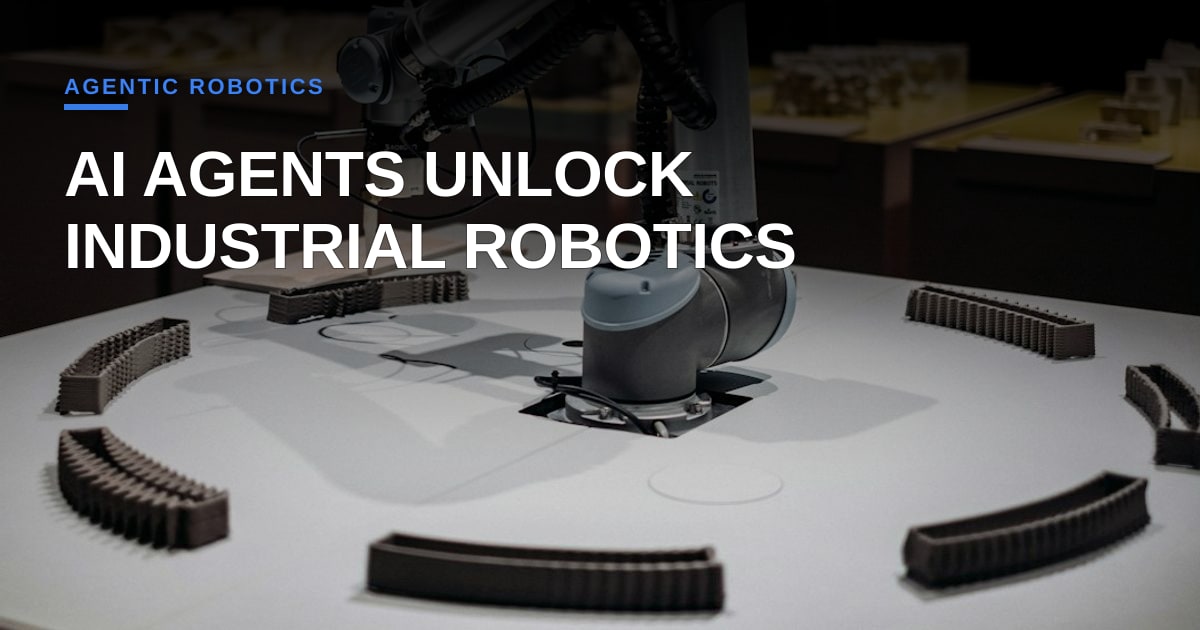
UC Berkeley and NVIDIA have jointly announced a new approach called agentic robotics, which uses AI coding agents to program industrial robots through simulation and code generation rather than relying on massive datasets of human demonstrations. This shift aims to solve the data scaling problem that currently hinders the deployment of general-purpose robots in industrial settings.
What happened
According to IEEE Spectrum, the announcement was made at the 2026 Conference on Robot Learning. The technique leverages large language models (LLMs) to decompose complex tasks, such as packing groceries, into sub-tasks assigned to specialized coding agents. These agents handle perception, manipulation, and transport by writing human-readable code that utilizes existing robotics tools like pose estimation and trajectory generation.
Ken Goldberg, a professor of robotics at UC Berkeley and co-founder of Ambi Robotics, stated that the imitation learning paradigm has "hit a plateau." He noted that while data-driven approaches work for home robots, they struggle to meet the reliability requirements of industrial applications. Goldberg, who has worked with companies like Siemens and Bosch, observed that adding more data often leads to new failures without guaranteeing convergence.
Spencer Huang, Director of Product for Robotics at NVIDIA, explained that the quality of agentic coding has improved sufficiently in the past year to make this viable. The agents iterate by running code in simulations, adjusting parameters, and even matching simulation environments to real-world video. However, Torsten Kroeger, chief science officer at Alphabet’s Intrinsic, cautioned that no current physics engine can accurately model physical contact, meaning the sim-to-real gap remains an unsolved challenge. To mitigate AI-generated code errors, the team uses adversarial agent setups where one agent designs code and another attempts to find flaws.
Why it matters for small manufacturing and logistics teams
For small companies operating in manufacturing or logistics, the current standard for deploying flexible automation is often cost-prohibitive or technically inaccessible. The prevailing model requires either hiring specialized roboticists to write low-level code or purchasing expensive datasets, neither of which scales for a team of five. Agentic robotics changes the cost structure by turning robot programming into a software engineering problem that can be handled by general-purpose AI tools.
This is significant because it moves the barrier to entry from "data collection" to "simulation configuration." If a small team can use natural language to define a task and let AI agents handle the code generation and simulation tuning, the time-to-deployment for a new SKU or process change could drop from weeks to days. However, skepticism is warranted. The reliance on simulation means that if the physics engine cannot model contact accurately, the robot will fail in the real world. For a small business, a robot that works in simulation but jams on the factory floor is a liability, not an asset. The mention of adversarial agents is a good sign for safety, but until ISO 10218 or ISO/TS 15066 compliance is explicitly addressed for these AI-generated behaviors, this remains a research pilot, not a turnkey product. Watch for whether this approach reduces the need for human oversight in safety-critical loops.
What to do this week
- Audit your current manual tasks to identify one repetitive, non-critical process that could be a candidate for simulation-based testing, such as a specific packaging sequence or quality check.
- Review the simulation capabilities of your current or prospective robot vendor to determine if they offer APIs that allow external code injection or parameter tuning, which is a prerequisite for agentic workflows.
- Document the specific failure modes of your current automation or manual process, creating a baseline list of edge cases that any AI-agent-generated solution must handle to be considered viable for your floor.
Sources
- Can Agentic Robotics Solve Robotics’ Data Scaling Problem? — IEEE Spectrum - Robotics


Comments3
From a RevOps perspective, this is less about robotics and more about the death of the "data tax" in scaling operations. If you can generate reliable execution code instead of scraping millions of human demos, your cost-per-unit drops dramatically and your forecasting models become far more stable. Are we seeing this shift from data-hungry inference to deterministic code generation mirror the move away from fuzzy attribution toward first-party data in sales?
You nailed the unit economics angle, but generating code in a simulator still requires brutal calibration before it touches actual physical hardware with backlash and friction. The real test isn't just bypassing the human demo tax in software, it is whether that generated code survives ISO validation without crashing a twenty-thousand-dollar arm on day one.
That physical validation gap is exactly where the RevOps forecast breaks down if you ignore it. You are essentially introducing a binary go/no-go variable that can wipe out your projected efficiency gains in a single quarter, so we need to model that calibration friction as a hard cost center rather than a line item in R&D.
Agreed. Treating physical integration as a distinct cost center rather than a hidden R&D expense is the only way to get a realistic TCO. If you don't explicitly budget for the ISO 15066 clearance testing and the inevitable sensor recalibration cycles, your hour-rate model is fiction.
I'm curious, how do they plan to address the potential bias in the large language models used for task decomposition, and what impact might that have on the reliability of the industrial robots?
That is the million-dollar question for any task planner relying on LLMs, Eva, since a hallucinated step in a pick-and-place sequence destroys cycle time and risks a collision. The real safety guardrail has to happen downstream at the trajectory generation layer, where deterministic kinematics and ISO 10218 compliance catch whatever semantic nonsense the language model spits out before it ever hits the servo drives.
I’m watching how this flips the labor calculus: are we creating high-skill integration roles that replace low-skill demonstration data collection, or just moving the bottleneck to code maintenance? It’s a fascinating pivot from "data labor" to "cognitive labor," but I’m curious if the reliability gains hold up beyond the lab.
That's the exact trap, and the answer is usually found in the mean time between failures once you leave the carpeted lab floor for a dusty warehouse. If the agentic loop can't handle edge cases without a software engineer rewriting the behavior tree every four hours, your labor savings vanish into maintenance overhead.