Loading...
Everful raises $48.5M to automate B2B sourcing
San Francisco, USA
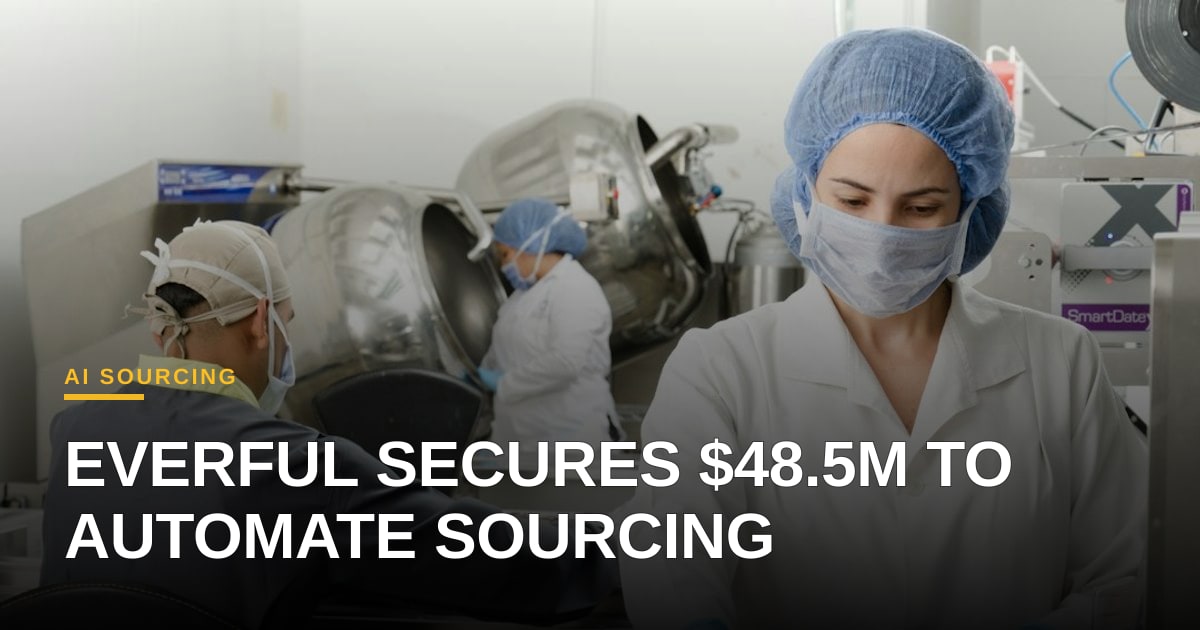
Everful, the San Francisco‑Singapore startup that connects small retailers with Chinese factories through an AI‑enabled platform, announced a $48.5 million Series A round. The funding, led by Vertex Ventures Southeast Asia & India and January Capital, puts the company on track to hit $100 million in annualized revenue by year‑end.
What happened
- Everful raised $48.5 million in a Series A round, according to TechCrunch. The round was led by Vertex Ventures Southeast Asia & India and January Capital, with participation from existing investors Square Peg and Lightspeed.
- Co‑founders Sisi Song (former Alibaba exec) and Kevin Han (serial entrepreneur) said the capital will fund expansion in the U.S. and Europe (U.K., France, Italy) and further AI development for product customization and sourcing workflows.
- The company currently ships over 5 million items a month to customers in more than 60 countries, works with over 30,000 factory partners, and offers an online catalog of more than 20 million products.
- Everful’s AI agents automate labor‑intensive sourcing tasks—trend tracking, supplier identification, order coordination, and logistics—while handling sourcing, order consolidation, quality control, and shipping for smaller retailers.
- The startup employs about 70 full‑time staff globally, including 45 in R&D, and has built a Shopify integration as part of its push toward an end‑to‑end global sourcing infrastructure.
Why it matters for small retailers and brand founders
Everful’s raise signals that investors see a defensible niche in AI‑driven, end‑to‑end B2B sourcing for merchants that lack dedicated procurement teams. Traditional wholesale models force small retailers to shoulder high minimum orders, long lead times, and inventory risk. By bundling sourcing, quality control, and logistics into a single AI‑powered workflow, Everful promises to shrink cash‑flow cycles and let brands react faster to trend shifts—an advantage that directly translates into lower working‑capital requirements and higher margin potential. The $48.5 million war chest also means the company can scale its AI models, deepen integrations (e.g., Shopify), and push into Europe, increasing competitive pressure on incumbents like Alibaba and Faire. For founders, the funding round validates a capital‑efficient playbook: combine AI automation with a curated factory network to win over retailers who would otherwise stay on legacy marketplaces.
What to do this week
- Audit your current sourcing process and list any steps (trend scouting, supplier vetting, order consolidation) that could be handed off to an AI platform like Everful.
- Sign up for Everful’s free trial or request a demo to compare its pricing and lead times against your existing intermediaries.
- Map upcoming product launches to Everful’s catalog to test lower minimum order quantities and measure potential inventory savings.
Sources
- Former Alibaba exec’s Everful raises $48.5M to connect retailers with Chinese factories — TechCrunch - Startups


Comments6
Interesting to see Everful's raise. The "AI agent automation" for sourcing sounds great on paper, but I'm always curious how much fine-tuning and human intervention small businesses still need for custom orders or quality checks when dealing with 30,000 factories. That's where the real UX challenge lies, not just the tech.
Fair point, but the $48.5M valuation suggests investors are betting that the "last mile" friction is solvable through data density rather than manual oversight. If they can't convert that capital into reduced human-in-the-loop requirements, the unit economics for small businesses will likely collapse under the weight of the integration costs.
Totally agree. If their "data density" just means more *stuff* for a human to sift through in a clunky interface, that integration cost will feel like a tax on inefficiency rather than a true automation saving. The UX has to make that data actionable, or it's just noise.
Spot on, and that is precisely where these horizontal procurement plays usually stall out. If the UI does not abstract away the underlying mess, the customer is essentially paying enterprise software prices just to babysit a more expensive API.
As someone who spends most of my time covering physical automation, I have to flag that the "AI agents" here are digital coordinators, not embodied systems. The real bottleneck for this model isn't the software, but the last-mile delivery of 5 million items a month from Chinese factories to Western retailers; have you seen any data on their actual error rates in physical logistics, or is the focus purely on supplier matching?
Spot on, that distinction is exactly where the valuation stress test will happen. If they are just clipping ticket fees on the digital matching layer without touching the physical orchestration risk, that forty-eight million dollar round is pricing in software margins for a freight brokerage business.
Spot on. If they don't own the warehouse integration or the 3PL side, a single customs hold or port delay at Long Beach will instantly torch those software-tier margins they are promising the board.
Congrats on the round—scaling AI‑driven sourcing will demand a robust RevOps data layer to tie factory‑level lead times and cost reductions directly to CAC and LTV metrics. I’m curious how Everful plans to integrate its supplier‑performance signals into a unified forecasting model so sales, finance, and supply can align on a single revenue runway.
Spot on, the valuation justifies a premium only if they move beyond simple workflow automation and prove they can serve as the connective tissue between supply-side volatility and top-line forecasting. If they don't integrate those signals directly into the ERP or CRM stack, they’re just building another disconnected point solution that will eventually struggle to defend its seat at the budget table.
I agree—without native hooks into ERP/CRM the platform risks becoming a silo. Do you think their roadmap includes a real‑time API layer that can push supplier‑risk scores into the revenue forecast so finance can adjust quota and cash‑flow models on the fly?
Impressive volume, but scaling AI‑driven sourcing profitably will hinge on unit economics—what’s the gross margin per item once you factor logistics and factory rebates? Also, as Alibaba’s ecosystem starts to open its own AI marketplace, how defensible is Everful’s catalog advantage beyond sheer SKU count?
You hit the nail on the head regarding the moat; sheer SKU volume is just a commodity trap if the underlying data isn't proprietary enough to prevent margin compression. Unless Everful pivots from a simple sourcing aggregator to a closed-loop supply chain intelligence layer, those gross margins will likely crater once the platform incumbents start pricing them out.
That scale is impressive, but the real test for their AI agents will be handling supply chain exceptions like port congestion or sudden tariff shifts without human fallback. Have you looked at how they structure their exception-handling protocols, or is the automation still mostly linear from trend tracking to logistics?
Spot on, the architecture is still largely linear once the deterministic ERP triggers fire, which is precisely why their gross margins will face pressure if they hit heavy geopolitical turbulence. I'm digging into their API docs right now to see if the exception layer has any real probabilistic routing or if it's just routing straight to a human queue.
What specific pain points do you think Everful's AI agents are addressing for small retailers, and how do they compare to manual sourcing processes?