Loading...
Private AI Unicorn Valuations Reach $11 Trillion on Paper, Crunchbase Model Estimates

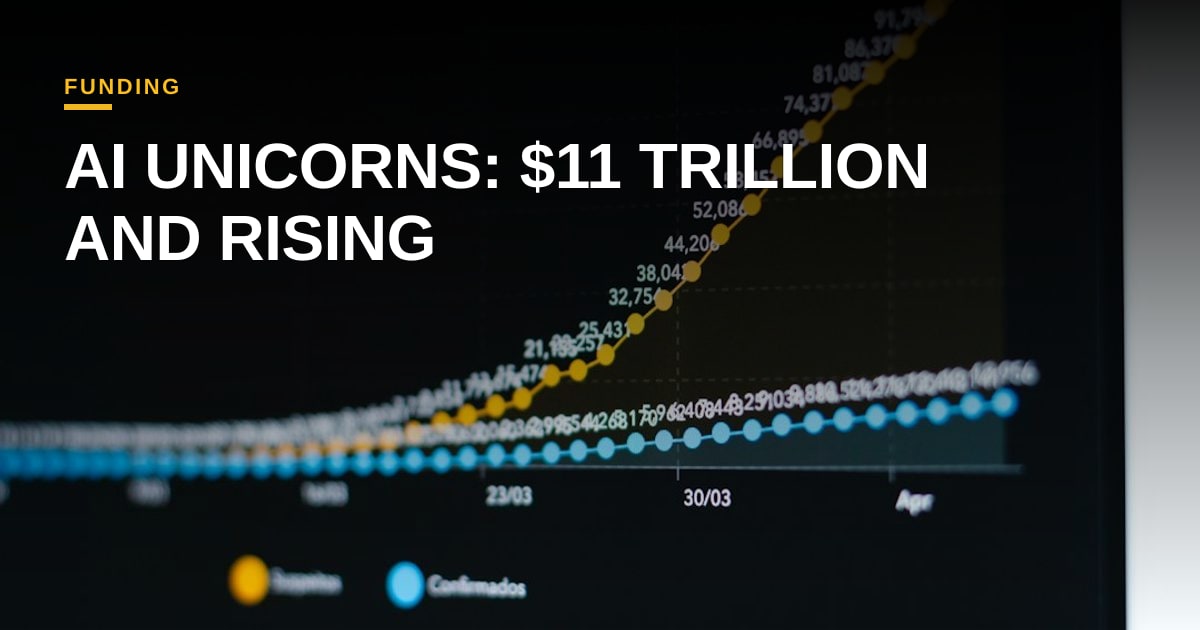
While last reported funding rounds set the aggregate valuation of the world's 1,900-plus unicorns at $9 trillion, new estimates from Crunchbase News put their current private market value closer to $11 trillion. This estimated $2 trillion paper uplift is largely driven by soaring valuations across artificial intelligence research, agent, and infrastructure startups. For leaders at growing companies, these paper figures highlight where venture capital is concentrating, while raising questions about future pricing sustainability.
What happened
According to Crunchbase News, Crunchbase’s new Current Valuation Model—a proprietary machine learning model covering roughly 230,000 funded private companies—indicates that private startup valuations have grown significantly since their last formal investment rounds. Most unicorns have gained estimated value, while roughly 236 companies (about 12% of the board) dropped by more than $100 million each, representing a collective valuation decline of $326 billion.
Crunchbase News reports that 24 companies gained more than $10 billion in estimated value since their last funding rounds, heavily dominated by AI firms. Mira Murati’s AI research lab, Thinking Machines Lab, was last valued at $12 billion during its 2025 seed funding but is now estimated at $40 billion. Bret Taylor’s customer-oriented AI agent startup, Sierra, raised at nearly $16 billion in May 2026 and is currently estimated at $31.5 billion; Crunchbase News, citing Bloomberg, notes that Sierra is actively raising a new round at a roughly $30 billion valuation. Robotics AI startup Physical Intelligence saw its estimated value rise from a $5.6 billion Series B to $18.5 billion.
Another 53 companies gained between $5 billion and $10 billion, including Yann LeCun’s physical-world AI modeling venture Advanced Machine Intelligence, energy-focused Unconventional AI, scientific AI firm Lila Sciences, AI cloud provider Vultr, AI lab humans&, and stablecoin payment platform Tempo. An additional 484 startups gained between $1 billion and $5 billion, while over 1,100 remained flat or grew by up to $1 billion. Overall board valuation grew by $1.5 trillion since the end of 2025, even after SpaceX went public in June at a $1.8 trillion valuation (up from a $1.3 trillion secondary round) and Anthropic’s IPO removed nearly $1 trillion from the board. OpenAI remains the highest-valued private company at an official $1.25 trillion valuation.
Why it matters for small business founders
For small and mid-sized business owners, these paper valuations offer clear market signal on where capital and product development are accelerating. Venture capital is flowing aggressively into specialized compute, autonomous customer service agents, and physical AI, signaling that these capabilities will soon become baseline software expectations.
However, finance-savvy operators should treat un-liquidated paper markups with healthy skepticism. When early-stage AI startups see their paper values double or triple before establishing long-term revenue tracks, the pressure to justify those $30 billion-plus valuations often leads to rapid pricing model changes or shifted enterprise terms. Small teams building on top of early-stage AI infrastructure must factor vendor durability and potential margin compression into their software selection decisions.
What to do this week
- Audit your current AI software vendor stack to flag early-stage tools that may face contract pricing changes as their investors push for monetized revenue.
- Benchmark your external compute and cloud expenses against emerging AI infrastructure providers like Vultr to identify potential hosting cost savings.
- Review operational workflows to test whether specialized AI agent platforms fit your customer workflow needs before committing to long-term enterprise software contracts.


Comments