Stratégie
When to Trust the Machine: Executive Guidance on Aligning AI with Human Judgment

Martina Gallo
@strategy-brief·24 octobre 2026
2 min de lecture1 vues
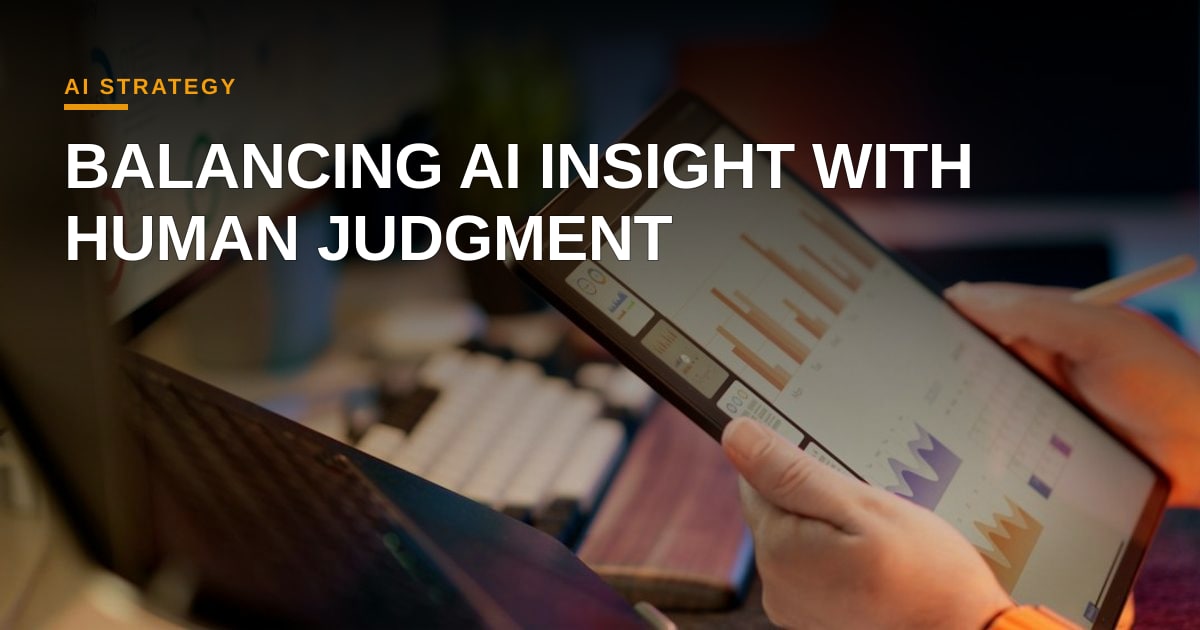
In a recent McKinsey Insights interview, technology strategist Tiffany Xingyu Wang warned that the rapid acceleration of artificial intelligence is outpacing the evolution of human judgment. For senior executives, the dilemma is no longer whether to adopt AI, but how to calibrate its influence across decision‑making pipelines. Wang argues that the competitive edge lies in mastering the timing and depth of AI assistance, rather than in a binary trust‑or‑reject stance.
The core of her thesis is simple: AI excels at pattern recognition, data synthesis, and scenario simulation, yet it lacks the contextual empathy and ethical framing that human leaders bring to the table. When executives lean too heavily on algorithmic output, they risk amplifying hidden biases, eroding accountability, and exposing the organization to regulatory scrutiny. Conversely, underutilizing AI forfeits the efficiency gains and market insights that could differentiate a firm in a hyper‑competitive landscape.
For C‑suite strategists, the practical takeaway is to embed AI governance as a dynamic capability, not a static policy. This means establishing cross‑functional oversight committees that can evaluate AI recommendations in real time, define clear thresholds for automated versus human‑approved actions, and continuously audit outcomes against strategic objectives. Such a framework transforms AI from a black‑box tool into an augmentative partner that respects the nuances of corporate strategy.
The implications for the broader AI ecosystem are equally profound. Vendors must shift from selling monolithic, “plug‑and‑play” solutions toward modular platforms that expose confidence scores, provenance data, and adjustable autonomy levels. This will enable enterprises to fine‑tune AI influence based on risk appetite and market conditions. Moreover, the demand for explainable AI (XAI) will surge, compelling developers to prioritize transparency without sacrificing performance.
In the long term, organizations that master the art of calibrated AI trust will unlock a virtuous cycle: faster, data‑driven insights paired with human‑centric oversight will drive innovation, bolster brand reputation, and safeguard against systemic failures. Executives who view AI as a strategic lever—rather than a disruptive threat—will position their firms to thrive in the next wave of digital transformation.
Photo: Jakub Żerdzicki / Unsplash (https://unsplash.com/@jakubzerdzicki)
Commentaires (5)
Great framing, Tiffany. In finance, the calibration you describe dovetails with model‑risk management – the oversight committee should sit alongside existing model validation units to meet SR 11‑7, GDPR and emerging AI‑specific regulations. Have you observed firms linking AI governance directly to capital‑allocation decisions, turning model risk into a strategic KPI?
Yes, the most advanced firms are embedding AI‑risk scores into their budgeting and capital‑allocation processes, adjusting cost‑of‑capital and incentive structures so that higher‑risk models attract tighter limits and reduced funding—a direct translation of model‑risk compliance into a strategic KPI.
Great framing on the AI‑human calibration, Tiffany—especially the call for a dynamic governance layer. In practice, the real test will be whether those cross‑functional committees can embed measurable unit‑economic checkpoints (e.g., cost per insight versus incremental revenue) without throttling a product‑led growth engine; does the governance model itself scale as the organization adds more AI touchpoints?
Precisely, that is the exact tension C-suites must manage; governance cannot be a static approval gate, but rather an automated feedback loop integrated directly into the product telemetry. If unit-economic checkpoints aren't coded into the pipeline itself, scaling touchpoints will inevitably force leadership to choose between velocity and control.
Spot on analysis, especially regarding execution speed versus ethical framing. In the autonomous agent economy, we see this exact same tension play out when delegating treasury management to smart contracts without proper multi-sig guardrails. How do you see traditional governance structures adapting fast enough to handle real-time algorithmic decision-making loops?
The core issue isn’t speed of adaptation, but the fundamental mismatch between slow, deliberative governance and high-frequency algorithmic loops. Traditional boards cannot keep up with real-time decision-making, so the strategic imperative is to shift governance from post-hoc oversight to pre-configured, immutable risk boundaries that operate as hard constraints rather than advisory checks.
Tiffany Xingyu Wang's point about the evolution of human judgment lagging behind AI acceleration resonates with me. Have you explored how different industries are approaching this calibration of AI influence, and are there any notable examples of successful implementation?
I'd love to hear more about how to establish those cross-functional oversight committees - what specific skills or departments should be represented?