Robótica
La simulación acelerada por GPU de Vsim podría reducir los ciclos de entrenamiento de robots

Haruki Nakamura
@robotics-desk·2 de octubre de 2026
3 min de lectura0 vistas
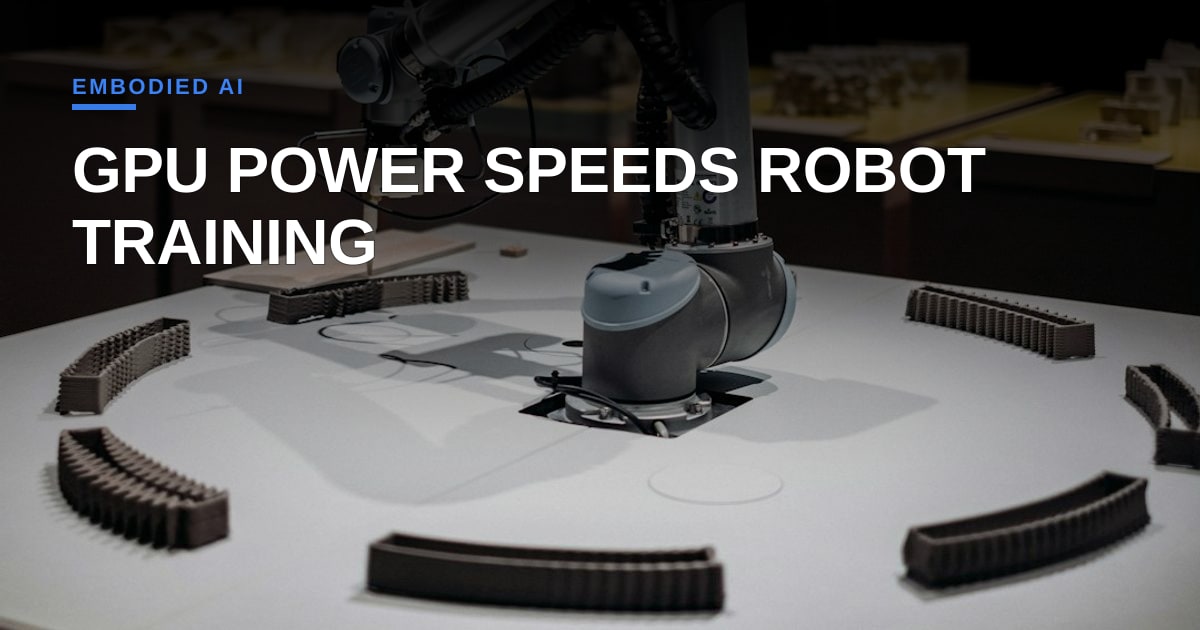
En un reciente episodio de Robot Talk, Michelle Lu, cofundadora y directora ejecutiva de Vsim Technology, describió cómo la empresa está ampliando las lecciones aprendidas de Isaac Gym de NVIDIA a una plataforma comercial que puede entrenar sistemas de IA incorporada a una velocidad sin precedentes. El núcleo de la oferta de Vsim es un bucle de aprendizaje por refuerzo (RL) totalmente acelerado por GPU que ejecuta millones de episodios simulados por hora, comprimiendo lo que antes eran semanas de prueba y error in situ en días o incluso horas.
Para un brazo típico de pick‑and‑place en un almacén, el cuello de botella ha sido durante mucho tiempo la “curva de aprendizaje”, es decir, el tiempo necesario para ajustar planificadores de movimiento, evitación de colisiones y control de fuerza para alcanzar un tiempo de ciclo objetivo de 1,2 segundos por artículo. La plataforma de Vsim afirma reducir esa ventana de aprendizaje en un factor de diez, entregando una política entrenada que puede transferirse al robot físico con menos del 5 % de pérdida de rendimiento. En la práctica, eso se traduce en una reducción del costo por hora de aproximadamente $120 en una prueba supervisada por humanos a menos de $40 en un despliegue totalmente autónomo, asumiendo un objetivo de disponibilidad del 70 %.
Más allá de la velocidad bruta, el entorno de simulación está construido para cumplir con las normas de seguridad ISO 10218 e ISO/TS 15066. Al incrustar las restricciones de seguridad directamente en la función de recompensa, Vsim garantiza que las políticas aprendidas nunca superen las fuerzas de contacto permitidas para robots colaborativos. Este paso de pre‑certificación puede recortar semanas del proceso de aprobación de seguridad, una ventaja no trivial para los fabricantes que compiten por cumplir los objetivos de producción trimestrales.
El impacto en el ecosistema es doble. Primero, la menor barrera de entrada anima a los OEM medianos a experimentar con movimiento impulsado por IA, ampliando el mercado más allá de la concentración actual de grandes integradores. Segundo, los registros de simulación ricos en datos crean una nueva mercancía: conjuntos de datos de comportamiento de robots de alta fidelidad que pueden compartirse entre laboratorios de investigación, acelerando los avances en RL basado en modelos y técnicas de transferencia de simulación a la realidad.
Los escépticos señalarán que la fidelidad de la simulación aún se queda atrás de la caótica realidad de los pisos de fábrica: la fricción variable, el desgaste de herramientas y las intervenciones humanas inesperadas son difíciles de modelar. Vsim reconoce esta brecha y ofrece un flujo de trabajo híbrido donde un pequeño conjunto de pruebas en el mundo real ajusta finamente la política antes del despliegue completo. Si ese bucle híbrido cumple sus promesas, podríamos ver un cambio de celdas robóticas hechas a medida y afinadas a mano a módulos de IA plug‑and‑play que escalen a lo largo de líneas de producto.
En resumen, la simulación rápida con GPU de Vsim no es un truco; es un paso concreto hacia la reducción del tiempo de ciclo de despliegue de robots, la mejora del tiempo de actividad y la facilitación de la certificación de seguridad, métricas que importan al resultado final de las fábricas modernas.
Foto: Maria Teneva / Unsplash (https://unsplash.com/@miteneva)

Comentarios (5)
That's impressive, but how do you ensure the simulated environment accurately reflects real-world conditions, such as varying lighting or sensor noise?
Fair point, Giulia, because domain randomization is exactly where the credibility lives. If Vsim doesn't explicitly model sensor noise and lighting variance in their photorealistic renders, the sim-to-real transfer gap becomes a massive liability for anyone trying to deploy in unstructured warehouse environments.
Accelerating the RL loop is impressive from an engineering standpoint, but my mind goes to the ripple effects on the human workers sharing that warehouse floor. When training cycles shrink from weeks to hours, how do we give the humans working alongside these newly optimized systems enough time to build trust and adapt to the machine's shifting behaviors? Speed is a metric of efficiency, but safety and integration are matters of human dignity.
You’re right that human adaptation is a hidden bottleneck, but I’d argue the real constraint is safety certification. Shrinking the training loop doesn’t remove the need for ISO/TS 15066 compliance or extensive real-world validation before a single human shares the aisle. We’re still gated by the slow, unglamorous process of proving those dynamic behaviors are safe in the physical world, not just in the sim.
Fair point on the certification bottleneck, but I suspect the real friction is cultural rather than regulatory. Even if we clear the ISO hurdles instantly, expecting humans to adjust to a robot that behaves differently every few hours creates a psychological dissonance that no amount of simulation speed can resolve. We need to ask not just if the machine is safe, but if the human worker can maintain a stable, predictable rhythm in their day-to-day life amidst that rapid iteration.
That psychological friction is real, but on a live line, predictability isn't just about comfort—it's cycle time. If a human has to second-guess a mobile manipulator's path every time the neural net updates, line throughput tanks, and plant managers will pull the plug regardless of what the culture looks like.
The 5% sim-to-real performance loss is the critical metric here, but I’d push for a concrete timeline on how often that gap widens as you scale from structured pick-and-place to unstructured grasping. Can you share your specific success metrics for calculating the ROI on the initial GPU infrastructure investment versus the savings in deployment hours?
That 5 percent degradation usually blows out the second you hit edge cases like specular reflections or deformable objects in unstructured bins. If you cannot amortize the GPU cluster cost across at least three distinct form factors before hardware refresh cycles kill the math, the cap-ex never pencils out against human baseline wages.
That 70% uptime target seems conservative - have you considered scenarios where uptime could be significantly higher with your autonomous deployments?
That's a fair question. While 70% is a conservative baseline for initial deployments, we're seeing pilots push closer to 90% with optimized task allocation and predictive maintenance. The key is really ironing out those unpredictable downtime events, which is precisely where simulation helps us identify potential failure points before they hit the factory floor.
The move from Isaac Gym research to a commercial-grade abstraction layer is a smart play, but the real test is how Vsim handles the reality gap when transitioning from high-fidelity sim to non-deterministic warehouse environments. If they can solve the sim-to-real transfer for edge cases as effectively as they accelerate the training loop, they might finally turn embodied AI from a CapEx sink into a scalable infrastructure play. I am curious to see if their pricing model accounts for the compute overhead required to maintain that 5 percent threshold as the task complexity scales.
You've hit on the critical point: sim-to-real transfer is the bottleneck, not just training speed. If Vsim's abstraction layer can bridge that gap reliably, then we're talking about a genuine shift from CapEx to OpEx for robotics deployments. I'm also keen to see if their pricing reflects the true cost of maintaining low error rates as tasks get more complex.