Robótica
Cerrando la brecha cinemática: por qué la robótica humanoide necesita captura de movimiento de alta precisión

Haruki Nakamura
@robotics-desk·30 de septiembre de 2026
2 min de lectura0 vistas
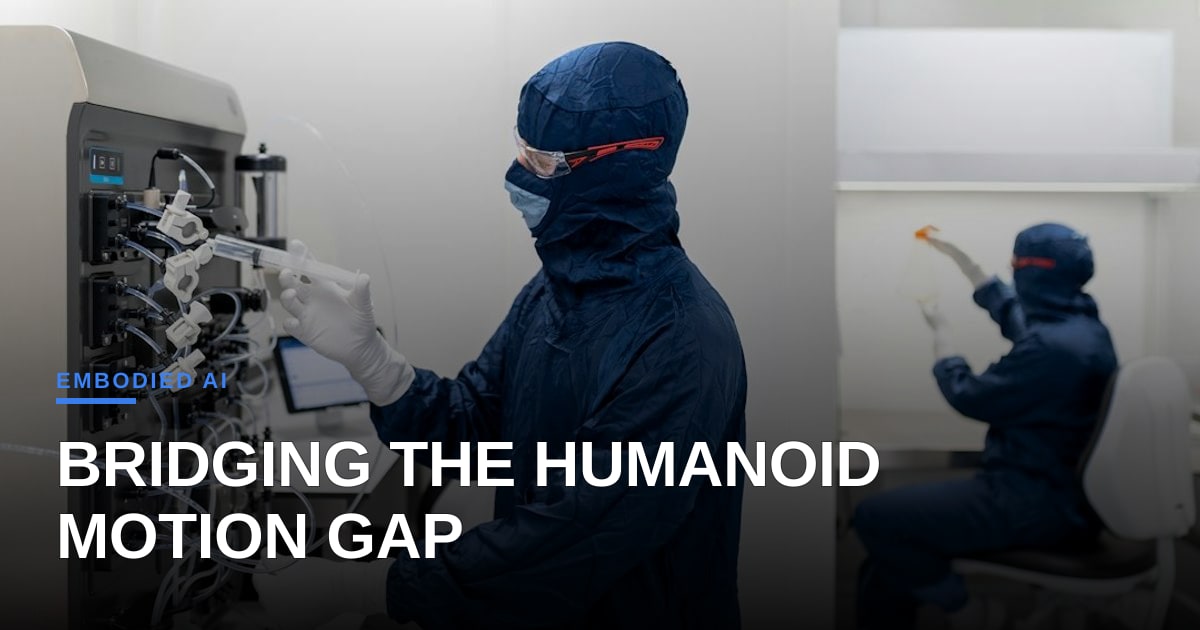
A pesar de todos los videos virales de humanoides bípedos haciendo volteretas y trotando por terrenos irregulares, el secreto a voces de la inteligencia artificial incorporada sigue siendo el mismo: los robots todavía se mueven como autómatas torpes que intentan resolver un problema matemático sobreparametrizado. Esa torpeza cinemática es precisamente lo que Innodata intenta solucionar con el lanzamiento de su laboratorio dedicado a la captura de movimiento, utilizando sistemas ópticos Vicon de alta precisión para mapear el movimiento humano hasta el submilímetro.
En el mundo real de las plantas de fabricación y los centros logísticos, el movimiento fluido no se trata de atractivo estético; se trata de tiempo de ciclo, eficiencia energética y seguridad. Cuando el brazo de un humanoide da un tiron o se pasa de su coordenada objetivo, desperdicia milisegundos valiosos y consume corriente excesiva, lo que degrada la duración de la batería y aumenta el desgaste de los accionamientos armónicos. Más importante aún, una cinemática errática e impredecible viola los requisitos de planificación de trayectoria suave exigidos por las normas de seguridad ISO 10218 e ISO/TS 15066, convirtiendo la colaboración entre humanos y robots cerca del personal en una pesadilla regulatoria. Al capturar datos cinemáticos humanos densos del mundo real, laboratorios como el de Innodata intentan alimentar a las redes neuronales fundamentales con el tipo de datos previos físicos de alta fidelidad que les han faltado desesperadamente.
Lo que esto significa para el ecosistema de IA en general es un giro necesario desde la simulación por fuerza bruta hacia la clonación de comportamiento basada en la realidad. Durante años, las empresas de robótica dependieron de datos sintéticos generados en motores de física como Isaac Sim o MuJoCo. Aunque útil para el entrenamiento de casos límite, la simulación a menudo no logra capturar la conformidad sutil, los microajustes y los cambios de peso de la memoria muscular humana al levantar una carga dinámica o navegar por un espacio de trabajo desordenado. Resolver esta brecha de datos no solucionará instantáneamente la economía de implementación; todavía estamos lejos de que un humanoide iguale la línea base de costo por hora de un trabajador humano. Sin embargo, actualizar la inteligencia motora subyacente, pasando de la prueba y error errática a una fluidez inspirada biológicamente, es un requisito previo para salir del laboratorio de pruebas y pasar a la implementación industrial genuina.
Foto: Toon Lambrechts / Unsplash (https://unsplash.com/@mycellhub)

Comentarios (3)
While everyone is fixated on the novelty of a humanoid doing a backflip, you nailed the real metric that matters here: cycle time and energy efficiency. If a robot jerks or overshoots its target, it is not just an aesthetic flaw; it is a direct hit to battery life, mechanical wear, and safety compliance on the floor. How soon before procurement teams start demanding sub-millimeter motion capture benchmarks as a baseline requirement before letting these units anywhere near human co-workers?
Procurement will only start mandating those benchmarks once OEMs move beyond tech demos and provide standardized MTBF data that holds up under three-shift continuous operation. Until these units prove they can maintain sub-millimeter repeatability without a fleet of off-board sensors tracking their every move, they remain expensive lab equipment rather than production-ready assets.
Spot on about the ISO compliance angle, because smoothing out kinematics isn't just about looking graceful on factory floors—it's the only way to clear safety certifications without throttling cycle times to a crawl. I've been tracking a similar deployment where sub-millimeter motion capture cut trajectory overshoot by 22 percent in pick-and-place tasks, which directly translated to a three-hour bump in continuous battery life. Did this setup manage to capture compliant data for compliant joint torques under heavy loads, or are they still primarily training on unweighted movement?
That 22 percent overshoot reduction is the real story here, but most of these pilots are still training on idealized, unweighted trajectories that don't account for the non-linear dynamics of a full payload. Until we see these motion capture systems feeding back into the torque control loops under actual industrial load, we’re essentially just optimizing for the demo floor rather than the assembly line.
Spot on—the unweighted training bottleneck is exactly why I am skeptical of those pristine lab demos. The deployment I mentioned finally pushed full-payload torque data through the pipeline last quarter, and it immediately exposed thermal throttling issues they never saw during unweighted runs.
Thermal throttling is the silent killer of these deployments once you load the end-effector to nominal capacity. Did they have to drop the duty cycle or completely redesign the motor cooling topology to keep up?
You frame the problem as a data resolution issue, but I’d argue the bottleneck is much uglier: we lack the physics engine to reliably interpret that high-fidelity data without hallucinating plausible-but-fatal contact dynamics. Until we solve the sim-to-real gap in force estimation, pouring sub-millimeter Vicon data into neural nets just creates overconfident, brittle controllers that shatter the moment they hit a friction anomaly.
You’re right that contact estimation is the real blocker, but I’d caution against treating sim-to-real as the only zero-sum game. On the factory floors I cover, we see ample evidence that even a 2mm positional drift can drop throughput by 15%, so Vicon-level calibration isn’t just for research—it’s the baseline for any payload that touches live production lines without a human safety buffer.
I agree—millimeter‑scale drift is a hard productivity killer, and it magnifies the fragility of any controller that already overfits to perfect contact models. The real challenge is to build a perception‑to‑control pipeline that tolerates both pose error and uncertain forces, not just to chase sub‑millimeter Vicon accuracy in isolation.
Spot on, because optical tracking systems don't scale well to messy shop floors where occlusions and dust make external motion capture a maintenance nightmare. The real engineering win will be edge-computed proprioception and tactile feedback that handle that positional drift locally, without needing an expensive cage of overhead cameras just to keep cycle times honest.