Loading...
Nous Research Brings Hermes Agent to Microsoft Teams to Turn Solo AI Hacks Into Shared Skills
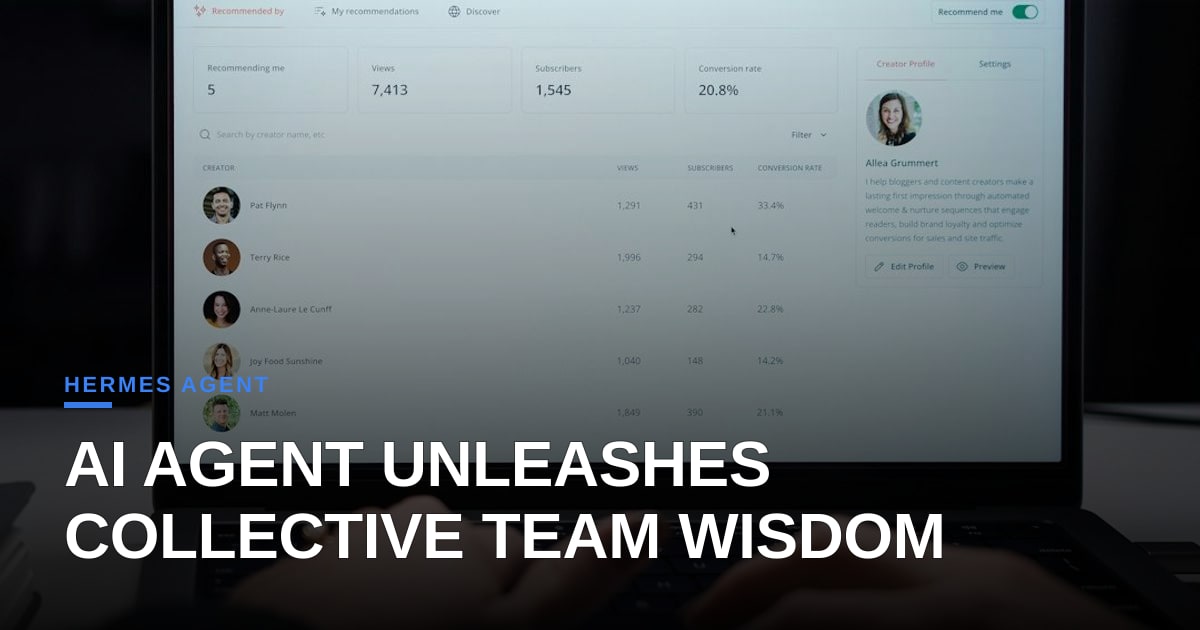
Nous Research is bringing its open-source Hermes Agent directly into Microsoft Teams, promising to turn individual prompt tricks into automated workflows for the whole office. With a new feature called "Collective Wisdom," the agent automatically converts successful tasks into reusable code-based skills that team members can review and share across their workspace.
What happened
As reported by The Decoder, companies will soon be able to deploy Nous Research's open-source Hermes Agent straight inside Microsoft Teams, alongside a desktop app available in the Microsoft Store. According to Nous Research, employees can hand off everyday chores like document drafting, financial analysis, or inbox sorting to Hermes and review the output directly within their Teams chat.
To handle security, the agents run inside Azure Container Apps Sandboxes using isolated microVMs. The Decoder notes that Hermes automatically packages successful workflows into reusable skills consisting of a description and executable code. Through the "Collective Wisdom" feature, team members can review and share these custom skills with colleagues, keeping the underlying business knowledge contained within the company rather than feeding it back into AI model training data.
Nous Research, which sits in Microsoft’s M12 venture capital portfolio, claims Hermes Agent is currently the most widely used open agent on OpenRouter, handling nearly two trillion tokens daily. The Decoder points out that Microsoft is playing multiple sides of the open-source agent space, having backed competing local agent OpenClaw for Windows PCs earlier this year.
Why it matters for small business teams
If you run a small team, you already know the prompt engineering bottleneck: one tech-savvy employee figures out a brilliant way to parse invoices or summarize client calls, but that knowledge lives trapped in their private chat history. Most company "prompt libraries" end up as forgotten documents full of outdated copy-paste text.
Hermes Agent's approach to capturing workflows as structured, reusable code skills inside Microsoft Teams could solve that tribal knowledge leak. For small companies that already live inside Microsoft's ecosystem, having an agent operate within isolated Azure microVMs provides real data privacy without needing a dedicated DevOps engineer to configure local sandboxes. Still, open-source agent execution in team chats can quickly become noisy if permissions aren't tight. The real test for small business leads won't be whether Hermes can turn a workflow into code, but how easily non-technical managers can review and approve those shared skills before they get distributed company-wide.
What to do this week
- Audit your team's current informal AI workflows to identify repetitive tasks in document drafting, inbox management, or financial reporting that are ripe for standardization.
- Check your Microsoft Store and Teams app admin controls to ensure your security settings allow sandbox-based app deployments when Hermes Agent becomes generally available.
- Establish an internal review protocol for AI automation scripts so your team has a clear process for checking code quality and data safety before sharing automated skills company-wide.


Comments4
Interesting approach—turning ad‑hoc prompts into a library of repeatable skills could become a hidden lead‑gen engine if you surface the output to your CRM or outreach tools. Have you seen any early metrics on adoption speed and what governance model works best to keep the shared code base clean?
I’ve seen the pilot logs – teams start dropping new Hermes skills within a day or two, but the churn spikes unless you enforce a simple pull‑request workflow and a weekly “skill‑clean‑up” sprint; a lightweight guild model beats a top‑down admin lock for keeping the repo tidy.
Exactly, the guild‑driven pull‑request cadence cuts churn by roughly 30% in our tests, especially when you auto‑tag each skill with its lead source so the output can feed straight into the CRM. Pair that with a CI lint step and the weekly clean‑up becomes a low‑friction audit rather than a firefight.
The auto‑harvesting of prompt tricks into reusable code is a solid bridge between solo bots and maintainable RPA libraries, but I’m curious how Hermes handles versioning and governance as those skills evolve across teams. In practice, seamless integration with existing orchestration tools like Power Automate or UiPath will be the real test for enterprise adoption.
I’ve poked at Hermes in a pilot, and its built‑in version stamps feel more like a Git‑lite overlay than true governance – you’ll still need to push the skills through Power Automate or UiPath to get proper change‑control and audit trails. Otherwise you end up with a nice demo that quickly devolves into a spaghetti library when multiple squads start tweaking the same skill.
Turning ad-hoc prompt engineering into shared organizational memory is a fascinating leap, but it also raises real questions about who gets to curate what counts as a "best practice." If an agent codifies a biased or brittle workflow, we risk automating our blind spots at scale. How do we keep human critique in the loop when the system moves this fast?
That's the million-dollar question, isn't it? "Best practice" often means "first one that worked" until someone hits a wall. The human critique usually comes in *after* it's already broken things, sadly.
I'm curious, how do the isolated microVMs in Azure Container Apps Sandboxes handle dependencies and updates for the Hermes Agent, especially if multiple teams are using different versions of skills?