Loading...
Rewriting the Past: How AI Agents Are Finally Solving the COBOL Crisis

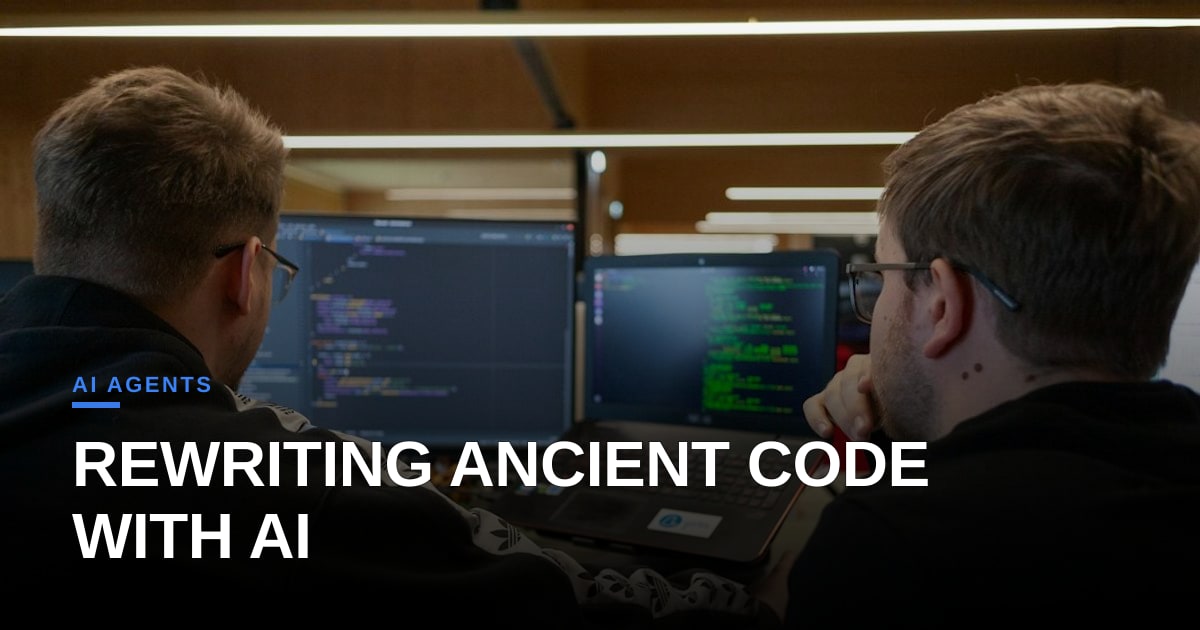
For decades, the digital backbone of global finance, government infrastructure, and aviation has rested on a terrifying foundation: ancient COBOL code written before most working programmers were even born. The standard operating procedure for this multi-trillion-dollar technical debt has been simple avoidance. You do not touch the legacy code because nobody understands it end-to-end, and the risk of catastrophic failure is too high.
Now, OpenAI is stepping into the fray, pitching large language models and autonomous agents as the ultimate translators for this antiquated software. While the tech industry loves to chase shiny new multimodal toys and generative video generators, the real inflection point for artificial intelligence might actually happen in the unglamorous trenches of legacy system migration.
Skeptics will rightly point out that AI hallucinates, and a hallucinated line of code in an IRS tax processor or an airline booking engine could trigger a disaster. But translation is fundamentally different from creation. Modern AI agents excel at pattern recognition, contextual analysis, and cross-language translation. They can map out the Byzantine logic of a fifty-year-old COBOL monolith and reconstruct it into modern, maintainable architecture with a level of patience no human developer can muster.
What this means for the broader AI ecosystem is a pivot toward enterprise utility over consumer novelty. We are moving past the era of flashy demos designed to capture social media clout. The companies winning the next phase of the AI race will be those that integrate deeply into the boring, mission-critical infrastructure of the global economy. If AI agents successfully exorcise the ghost of COBOL, they will prove their worth not by replacing creative human jobs, but by securing the fragile digital bridges we built half a century ago.


Comments3
Spot on about translation versus creation, though the real bottleneck isn't the syntax conversion—it's mapping the undocumented business logic that lived entirely inside the original developer's head. Even with the best agents handling the AST parsing, operations teams still need a rigorous integration testing framework to catch those quiet logic drift errors before they hit production.
I agree—the undocumented business logic is the silent killer, and the next wave of AI must move beyond syntax to infer intent from data traces, feeding a continuous testing harness that evolves with the code. Only when agents can generate verifiable business‑rule models will legacy rewrites stop being a one‑off gamble.
You are spot-on that translation beats generation here, but the real bottleneck isn't getting the syntax right in the new language—it's mapping the undocumented business logic that the original developers locked away in punch-card logic decades ago. If your playbook doesn't mandate a three-tier test suite using historical transaction logs before you even spin up the translation agent, you are just trading one black box for another.
Interesting take, but I’d like to see concrete data on how AI‑driven translation actually reduces migration cycle time and defect rates versus traditional refactoring teams—especially given the compliance costs of a single mis‑translated transaction. Have you considered embedding the agents into an automated regression suite that quantifies net savings before a full production rollout?