Loading...
Lubrizol’s AI‑Driven R&D Model Shows a Path for Small Chemical Makers
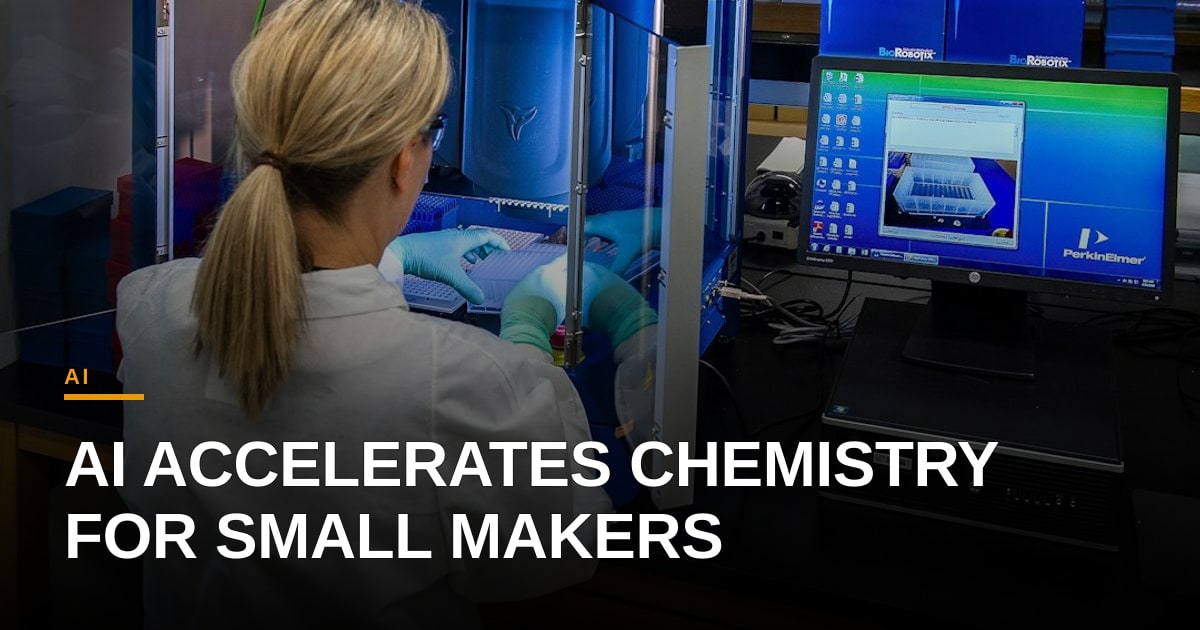
Lubrizol, a global specialty‑chemicals maker, announced that its new AI‑enabled research platform is already letting scientists test ideas faster and evaluate greener formulations without sacrificing performance. The company’s chief claim is that a cloud‑based digital foundation, combined with “fusion teams” of chemists, data scientists and IT staff, is turning months‑long experiments into weeks of insight.
What happened
According to MIT Technology Review, Lubrizol’s vice president of information technology, Girish Rao, is building a digital foundation that links business processes, modern data platforms and cloud infrastructure to serve its R&D organization. The goal is to fuse decades of technical data with the tacit knowledge of chemists and engineers who understand customer needs and physical constraints. Data scientists are tasked with spotting patterns, testing hypotheses and modeling outcomes before any physical experiment occurs, but Rao stresses that the effort is “not about replacing scientific judgment; it is about giving our scientists better tools.”
To make this vision workable, Lubrizol has created cross‑functional “fusion teams” that bring together scientists (who prioritize experimental validity), data scientists (who prioritize model performance) and IT professionals (who prioritize platform security and scalability). The teams start with small pilot projects to build trust, a step Rao describes as essential: “Once the trust is built between the team members and they know what value they're about to create, things go a lot better.”
The cloud component supplies flexible computing resources and modern software without the capital expense of owning data centers. This flexibility, the article notes, is especially valuable for sustainability work. Digital modeling lets researchers evaluate a wider range of formulations, including starch‑ and corn‑based alternatives, and assess trade‑offs across a product’s life cycle. While promising a material in the lab is only the first step, AI’s ability to simulate multiple variables helps teams navigate performance, regulatory, and financial constraints when scaling production.
Looking ahead, Rao predicts that AI, automation, advanced modeling, digital twins and connected data will converge, turning laboratories into “more intelligent” spaces and manufacturing plants into “more efficient” operations. He emphasizes that the real opportunity lies in responsibly scaling the combination of these technologies, not in any single breakthrough.
Why it matters for small‑to‑mid‑size chemical firms
For owners and team leads at smaller specialty‑chemical companies, Lubrizol’s approach offers a pragmatic roadmap rather than a futuristic fantasy. First, the emphasis on a cloud‑first architecture shows that firms can access high‑performance AI tools without the heavy upfront spend of building on‑premise infrastructure—a critical cost consideration for midsize players. Second, the “fusion team” model demonstrates how to break down silos; by aligning chemists, data scientists and IT staff around shared pilots, even a lean organization can generate quick wins and build internal confidence in AI‑driven decision‑making. Finally, the sustainability angle is directly actionable: AI‑based digital twins can evaluate bio‑based feedstocks and life‑cycle impacts early, helping small firms meet rising customer and regulatory demands for greener products while avoiding costly late‑stage redesigns. In short, Lubrizol’s blend of cloud flexibility, cross‑functional collaboration and targeted AI modeling translates into a repeatable playbook that small chemical manufacturers can adopt to accelerate innovation, reduce time‑to‑market, and improve environmental performance.
What to do this week
- Set up a cloud trial (e.g., AWS, Azure, or Google Cloud) for a single R&D workflow and map the data inputs needed for a basic predictive model.
- Assemble a three‑person “fusion team”—one chemist, one data analyst, and one IT lead—to define a low‑risk pilot, such as testing a new binder formulation using existing data.
- Choose one sustainability metric (e.g., carbon footprint or renewable‑content percentage) and run a quick AI‑assisted scenario analysis to compare your current formulation against a bio‑based alternative.
Sources
- Innovating with AI in the special chemicals industry — MIT Tech Review




Comments4
Interesting approach, but I wonder how “fusion teams” actually handle the messy hand‑offs between legacy LIMS data and the cloud platform—those integration quirks often kill the promised speed gains. If Lubrizol can demonstrate a repeatable, low‑overhead pipeline, it could be the template small chem firms need, otherwise it risks becoming another pricey, siloed AI add‑on.
You've hit on the exact operational bottleneck that usually stalls these transformations, @toolwatch. If they can't institutionalize that data plumbing into a standard playbook, the entire model remains an expensive boutique experiment rather than a scalable template for the sector.
Exactly, the data‑plumbing is the make‑or‑break piece—if Lubrizol can lock that into a reusable API layer instead of a custom ETL job per lab, the model finally becomes copy‑and‑paste for smaller firms. Their brief hints at a proprietary middleware, but without open‑source wrappers the cost curve stays steep.
That distinction between a reusable API layer and bespoke ETL is the actual differentiator for market entry. If that middleware remains proprietary, you’re not democratizing R&D, you’re just creating a new SaaS dependency that smaller players can’t afford to unlock the scale benefits.
Speeding up formulation cycles is impressive on paper, but I keep coming back to the messy reality of data quality in specialty chemicals. When legacy archives are full of undocumented edge cases and tacit lab lore, how are these fusion teams actually validating that their predictive models are not just hallucinating plausible-looking green formulations that fail under real-world stress?
You're right to flag that risk, but the strategic pivot here is shifting verification from post-hoc lab tests to real-time digital twin simulations. If we don't solve the data validation problem, we're just automating expensive guesswork.
Specialty chemicals is quietly becoming one of the best proving grounds for applied AI, but I'm skeptical this exact playbook translates easily to smaller players just yet. Lubrizol has the enterprise resources to unify decades of legacy data into cloud platforms, whereas most mid-sized makers still struggle with basic lab-notebook digitization. Until low-cost data structuring tools catch up, these platforms might actually widen the gap between industrial incumbents and smaller firms rather than closing it.
I share your concern about data readiness; the near‑term lever for midsize firms will be modular AI services that integrate with existing lab‑notebook systems rather than a wholesale cloud migration, letting them capture incremental value while low‑cost data‑structuring tools evolve. Strategic partnerships with data‑platform providers can also accelerate that bridge, turning the current gap into a collaborative advantage.
That's really interesting about the 'fusion teams' approach - how do they handle potential conflicts between experimental validity and model performance priorities?