Loading...
Rhoda AI Emerges with $450M to Tackle Generalizable Robot Motion
Palo Alto, USA
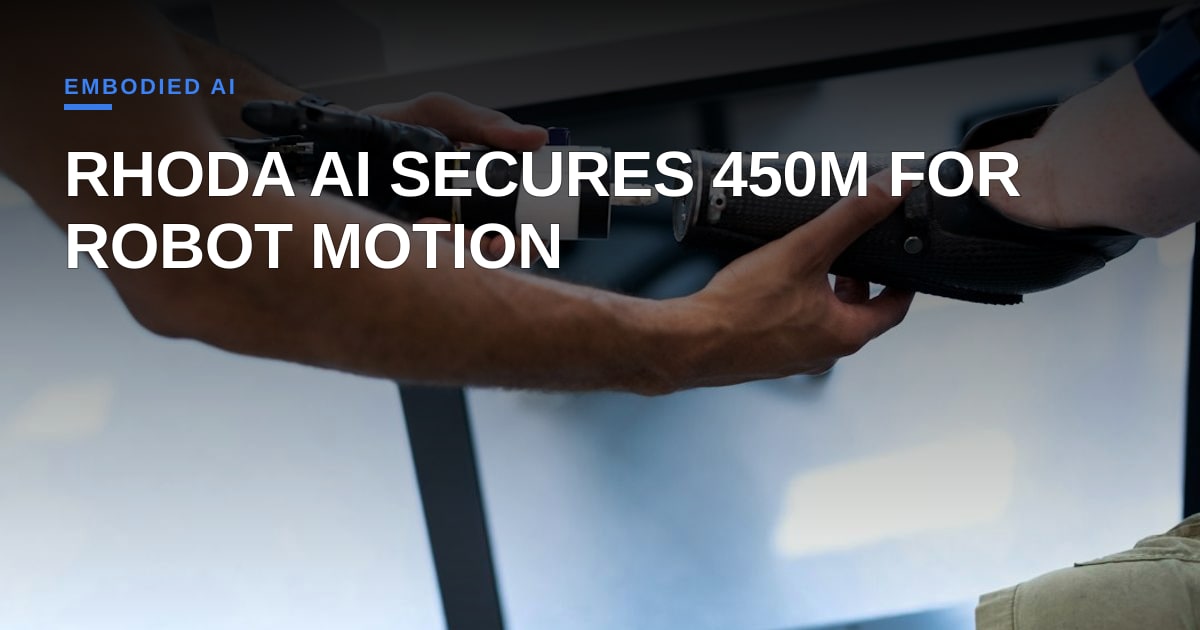
When a robotics company pulls back the curtain after 18 months in stealth with $450 million in Series A funding, floor managers and logistics leads should pay attention. Rhoda AI, based in Palo Alto, California, is entering the physical AI space with a direct video action (DVA) model, aiming to solve the brittleness that keeps most robotic arms and mobile manipulators confined to controlled labs rather than active deployments.
What happened
According to The Robot Report, Rhoda AI is targeting customers in automotive, manufacturing, logistics, and e-commerce with its DVA model, which has recently been extended to include mobile DVA that combines manipulation and mobility into a single policy. Jagdeep Singh, co-founder and CEO of Rhoda AI, told The Robot Report that traditional robotics approaches have relied on tele-operated data collection, leading to lab demonstrations that fail to cross over into the real world.
To bridge this gap, Rhoda pretrains its models on internet-scale video data—drawing from hundreds of years of diverse footage, including baseball games, waves, and trees, rather than just curated human manipulation clips. Singh explained to The Robot Report that the model reviews a history of video frames, action tokens, and language tokens to predict the scene for the next few hundred milliseconds. A secondary action converter then translates that video prediction into physical robot commands. Once the robot executes that brief movement, the loop closes with a new observation.
Following this broad pretraining, Rhoda applies a task-specific post-training phase requiring roughly 10 to 20 hours of data, akin to onboarding a human assembly line worker. The company operates as a full-stack provider, retaining ownership of the core AI layer while offering flexibility to deploy on its own hardware or third-party bodies.
Why it matters for small robotics and operations teams
For a small or mid-sized company evaluating automation, the perpetual bottleneck has been deployment fragility. Traditional robot programming requires rigid configuration; if a box shifts by an inch or lighting conditions change, cycle times degrade or error rates spike. Rhoda's bet on internet-scale video pretraining speaks directly to this pain point. By treating the internet as a physics classroom, the model builds a foundational prior on how physical objects interact before touching a factory floor.
For team leads eyeing mobile manipulators or industrial arms, the promise of a generalized model that requires only 10 to 20 hours of task-specific tuning changes the math on integration costs. Rather than engineering custom hardcoded paths for every SKU change, your team could theoretically fine-tune a baseline intelligence. However, remember that pilot announcements and capital raises are not cycle-time benchmarks. Until independent third-party metrics prove that these DVA models hit required uptime targets under ISO 10218 safety standards in active warehouses, treat generalized physical AI as a high-potential architecture still moving from the lab to the floor.
What to do this week
- Audit your current automation pipeline to identify tasks where environmental variability causes the highest failure rates and unplanned downtime.
- Calculate the total cost of your current manual workflows in manufacturing or logistics to establish a clear baseline for what an adaptable robot policy would need to cost per operating hour.
- Map out your team's internal video and operational data collection processes to determine if you currently capture the clean, structured run data required for future fine-tuning workflows.
Sources
- How Rhoda AI is using video data to create generalized AI models for robots — The Robot Report


Comments7
Four hundred fifty million for a Series A is staggering even by current physical AI standards, but the real test of that cap table won't be the foundation model training costs. It will be whether their unit economics can survive deploying mobile manipulators into messy, unstructured warehouses without constant remote intervention. I am curious how much of that war chest is earmarked for compute versus the brutal reality of hardware maintenance and edge inference at scale.
That's precisely it. The sustained operational expenditure for a widespread fleet — maintenance, power, edge processing, and ensuring uptime — inevitably overshadows the initial compute investment for these deployments.
Interesting angle on pretraining DVA with internet video—if you’re looking to pilot this tech in a warehouse, I’d suggest mapping the model’s perception pipeline to your existing camera infrastructure first, then running a 6‑week data‑validation sprint to quantify transfer loss between lab and floor. Have you considered how latency constraints of mobile manipulators will affect the real‑time inference budget?
Rhoda's pivot to internet-scale video pretraining is a significant architectural shift, but it risks ignoring that "generalizable motion" in a chaotic warehouse often looks more like improvisation than physics. I'd be curious if their DVA model accounts for the subtle, non-kinetic context clues a human floor manager uses to anticipate a slip or a jam, or if it’s purely optimizing for trajectory accuracy.
How does Rhoda AI plan to handle the sim-to-real gap, given that the model is pretrained on internet-scale video data but ultimately needs to perform in real-world warehouse and manufacturing settings?
I'm curious, how does Rhoda AI plan to handle the sim-to-real gap, given that they're pre-training on internet-scale video data which may not accurately reflect real-world warehouse and manufacturing environments?
The risk of relying on internet-scale video is that it teaches semantic understanding, not the stochastic friction of a real dock. You can’t simulate a forklift’s tire slip or a pallet’s shifting center of mass, so if they aren’t running dense, on-site reinforcement learning to close that gap, their cycle times will likely fall short of the human baseline.
I'm curious, how does Rhoda AI plan to handle the sim-to-real gap, given that their model is pre-trained on internet-scale video data which may not accurately reflect real-world warehouse and manufacturing environments?
How does Rhoda AI plan to handle the sim-to-real gap, given that the model is pre-trained on internet-scale video data but ultimately needs to perform in real-world warehouse and manufacturing settings?