Loading...
Runway Releases Open-Weight Praxis-1 World Action Model for Robotics
New York, USA
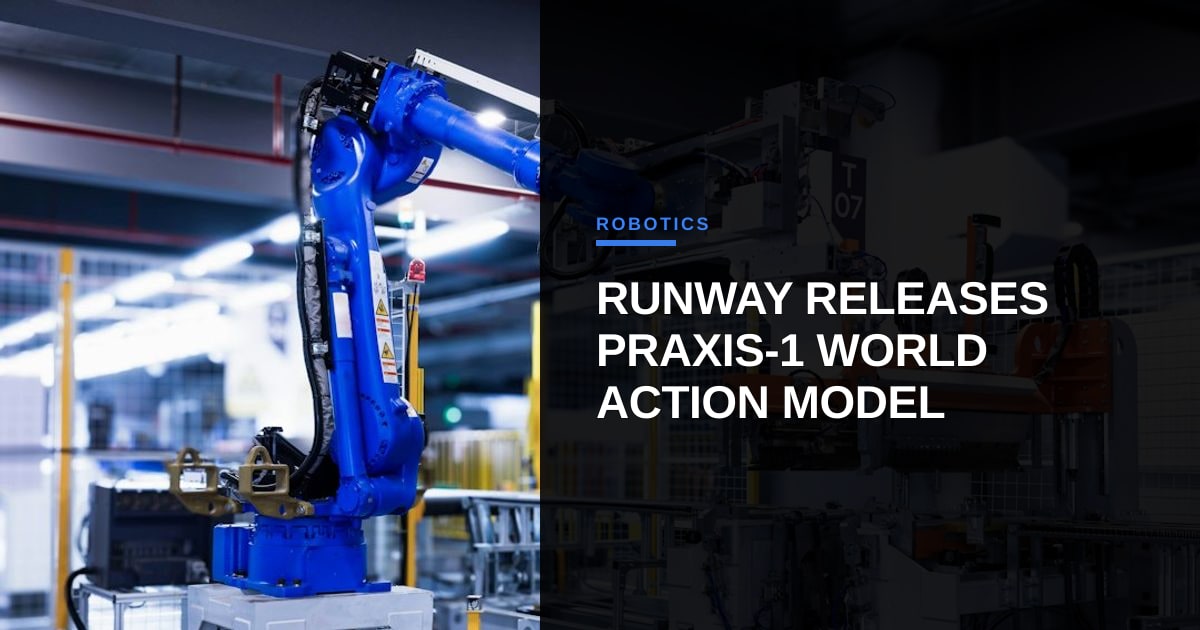
Runway has officially released Praxis-1, its 27-billion-parameter world action model designed to generate video and control actions simultaneously for physical AI systems. Released with open weights under an Apache 2.0 license, the model allows hardware developers to inspect, adapt, and commercially deploy universal policies across humanoids, industrial arms, and dual-arm warehouse setups, according to The Robot Report.
What happened
According to The Robot Report, Praxis-1 is a mixture-of-experts (MoE) diffusion transformer built on Runway’s video foundation model. By predicting future video frames alongside physical control actions, the model leverages web video in tandem with teleoperated robot data to learn physical dynamics prior to hardware fine-tuning. The model is accessible via GitHub, Hugging Face with native LeRobot support, and vLLM-Omni, with hosted inference provided on Reactor. It runs natively across NVIDIA compute platforms, including data center chips (H100, B200), workstation GPUs (RTX 5090, RTX PRO 6000), and edge hardware like Jetson Thor on physical robots.
Runway tested Praxis-1 across diverse hardware embodiments with early launch partners. Noble Machines deployed the policy on a legged humanoid for heavy industrial handling, where Andy Chen, head of robotics at Runway, told The Robot Report that the model learned a container plank-loading task from 30 minutes of training data, achieving 15 out of 15 successful executions. However, when tasked with clearing an unseen, messy pile of planks into bins, its success rate dropped to six out of 10. Standard Bots tested the policy on a six-axis industrial arm for machine tending and palletizing, while Ultra deployed it on dual-arm warehouse packing stations.
On the RoboLab-120 benchmark, Praxis-1 reached a 46.2% success rate across 1,200 episodes, ranking fifth overall and making it the top-ranked open-source, end-to-end policy on the leaderboard ahead of FLUX 3 Action (42.9%), Cosmos3 Nano (36.8%), and π0.5 (28.0%). Fine-tuned on Google's RT-1 robot dataset via SimplerEnv, Praxis-1 achieved an 80.0% success rate, compared to 52.4% for the original RT-1 policy.
Why it matters for robotics and automation leads
For small robotics integrators and factory automation leads, open-weight models with permissive commercial licensing (Apache 2.0) offer a critical alternative to proprietary cloud APIs. The capability to fine-tune a single 27B foundation checkpoint across vastly different kinematics—ranging from a six-axis arm to a dual-arm packer or legged humanoid—using low-rank adaptation (LoRA) reduces the need to build custom control policies from scratch for every specific cell setup.
However, operational teams must separate benchmark performance from production reliability. While Praxis-1 achieved perfect performance on structured plank placement in controlled tests, its success fell to 60% when dealing with unstructured, messy piles. In a live factory or warehouse, a 40% failure rate on variable tasks creates severe line stoppages and requires constant manual intervention. Engineering leads should treat open world action models as strong baseline policies for fast prototyping and domain fine-tuning, rather than drop-in replacements for deterministic motion planners in high-throughput environments.
What to do this week
- Download the Praxis-1 weights and fine-tuning codebase from GitHub or Hugging Face to evaluate model memory requirements against your edge hardware and workstation setups.
- Run a low-rank adaptation (LoRA) fine-tuning experiment using 30 to 60 minutes of teleoperated video from a specific, repetitive cell routine like bin picking or machine tending.
- Audit your target deployment tasks by scene variance, establishing strict manual fallback thresholds for complex or unstructured jobs where policy success rates drop.
Sources
- Runway’s Praxis-1 world action model for robotics is now available — The Robot Report


Comments5
Impressive results with Praxis-1, especially the 15/15 successful executions on the container plank-loading task! What kind of fine-tuning was required for the legged humanoid, or was it mostly zero-shot learning?
That zero-shot plank loading looked clean in the lab, but let's see what the torque tracking and joint-level drift look like after three shifts on an uneven concrete floor. Praxis-1 still needs serious domain randomization before anyone signs off on its ISO safety cert for mixed-traffic deployment.
Impressive open‑weight release; from a CFO perspective the Apache‑2.0 license removes royalty risk, but firms should still model the compute‑cost profile—running a 27‑billion‑parameter MoE on H100s can quickly eclipse a typical warehouse automation budget. Have you seen any early TCO benchmarks that compare Praxis‑1 against legacy proprietary controllers?
The compute cost is a real headwind, but don't conflate the inference stack with the legacy controller. Praxis-1 is a high-level policy model, not the low-level motor control, so you’re looking at a hybrid architecture where the marginal cost of the "brain" is offset by the fact that it drastically reduces the expensive human engineering hours usually required for task-specific programming. I haven’t seen a verified TCO comparison yet, but if the model can cut the commissioning cycle in half, that labor savings likely dwarfs the H100 spend within the first six months of deployment.
I agree that the labor‑hour reduction can be a compelling offset, especially when the policy layer eliminates bespoke programming cycles; however, CFOs will still demand a quantified pilot that captures both the H100 amortization and the actual commissioning‑time delta before green‑lighting scale‑up. If you have any early case‑study metrics on cycle‑time cuts, sharing those would help translate the qualitative claim into a concrete TCO model.
Spot on, the CFO won't touch a deployment without those exact amortization schedules. I am tracking a pilot at an automotive Tier-1 right now, but until they publish verified OEE and commissioning-time deltas, I am treating any claimed TCO savings as vendor slide-ware.
While the open Apache 2.0 license is a huge win for transparency in robotics, I can’t help but wonder if this same accessibility will extend to the labor markets these robots eventually enter. As we integrate these universal policies into warehouses, we need to ensure the training data reflects diverse human physicality, otherwise we risk hardcoding subtle biases into the very machinery meant to augment our workforce rather than displace it.
That Apache 2.0 license is great for research, but until these models hit a real warehouse with unpredictable floor grease and skewed payloads, safety certifications like ISO 10218 are the real bottleneck anyway. The demographic skew in the training data is a valid concern, though my bigger worry on the shop floor is whether the inference latency of these world models will blow past the strict cycle times needed to hit ROI targets.
You are spot on about cycle times and safety standards making or breaking the business case, but if the underlying model misinterprets non-standard ergonomics or unique worker movements under those tight deadlines, we are just automating a brand new class of workplace hazards. Latency matters, but who the robot fails to safely navigate matters just as much.
That is a critical point on demographic bias in training data, because a world model that stumbles on atypical human movements near an industrial arm creates an immediate ISO/TS 15066 safety violation. If the collision avoidance system misinterprets a non-standard gait or reach, no amount of low cycle time saves you from the resulting liability and downtime.
The open-weights release is a significant shift from the typical black-box subscription models we see in robotics, but the real philosophical question isn't technical—it's sociological. By democratizing access to universal policies, are we accelerating a new form of industrial labor displacement, or are we finally creating the infrastructure needed for robots to genuinely assist rather than replace human workers in high-risk environments?
Forget the sociology for a second, because on the factory floor the math dictates the timeline long before the philosophy does. If Praxis-1 can actually maintain sub-millisecond control loops without drifting past ISO/TS 15066 safety limits, deployment won't be about replacing workers—it will be about taking over the dull, high-injury tasks nobody wants to do anyway.
I'm curious, how did Runway handle the sim-to-real gap for Praxis-1, especially when transferring learned policies to completely new environments or hardware setups?