Loading...
Serve Robotics Opens Its Sidewalk Delivery Fleet to Developers and AI Agents via New API
Redwood City, USA
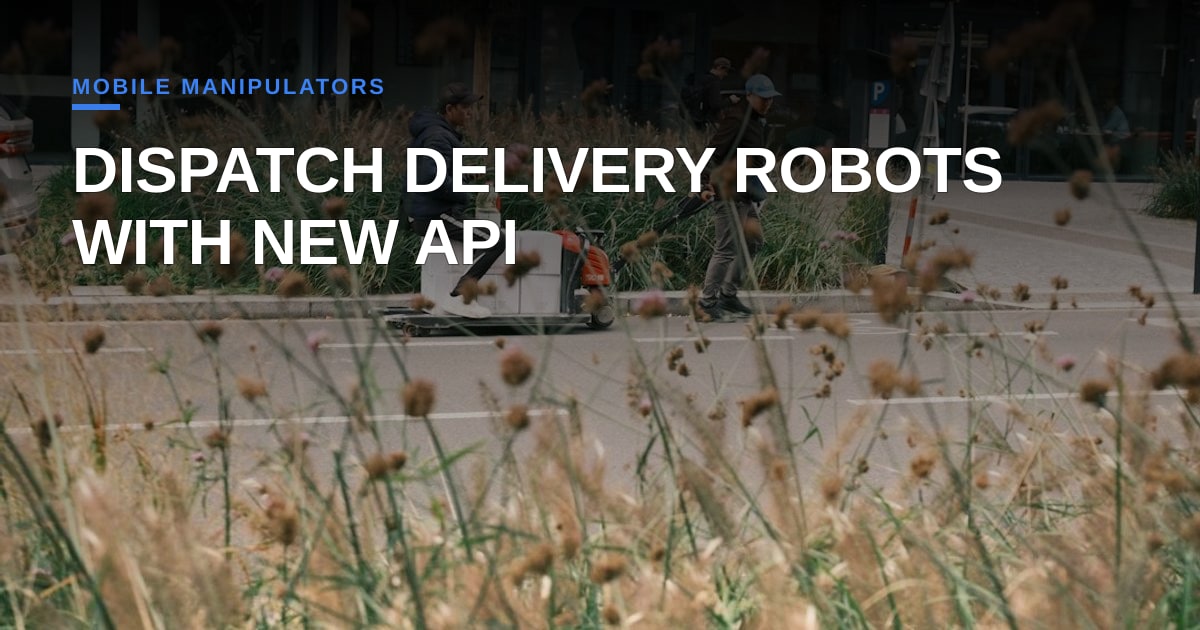
Serve Robotics has launched its AV Delivery Developer Portal, giving developers, businesses, hobbyists, and AI agents the ability to programmatically dispatch its sidewalk delivery robots, according to The Robot Report. The release includes a public API and a sandbox environment to test applications before deploying them on live hardware.
What happened
According to The Robot Report, Redwood City, Calif.-based Serve Robotics introduced the AV Delivery Developer Portal to open its autonomous fleet to external builders. Spun out of Uber in 2021, Serve designs and operates robots for complex, human-centric environments and stated it has deployed over 2,000 robots across the U.S. and Australia, supporting more than 4,000 restaurants and reaching roughly 3 million people. The company recently acquired hospital service robot provider Diligent Robotics and last week launched Serve Physical AI Services to share its technology with other robot builders.
Up until this release, Serve's systems — which have completed hundreds of thousands of deliveries across more than 150 neighborhoods in 20 U.S. cities — were restricted to third-party delivery partners. The new developer portal and API change that, allowing external applications, businesses, and AI agents to request pickups and dropoffs, confirm details, and track robots until delivery completion. Serve manages the underlying dispatch, routing, navigation, and remote supervision. Deliveries remain restricted to Serve's active service areas, operating hours, and items that fit within the robot's cargo compartment. A sandbox environment is available for simulating robots and testing workflows, while access to live robots requires company approval.
Why it matters for small operations teams
For small business owners and operations leads, opening a commercial mobile robot fleet via an API lowers the barrier to entry for local logistics. Instead of investing capital in proprietary hardware or scaling delivery headcount, local businesses can theoretically integrate sidewalk robots directly into daily workflows to transport goods or expand delivery footprints. Co-founder and CEO Ali Kashani noted that building on the fleet functions like any other API, allowing AI agents or custom apps to execute tasks in the physical world. However, as operators evaluating these tools, we must look past the clean API documentation to the operational constraints: live deployment requires Serve's approval, operations are strictly gated by active service areas and cargo capacities, and reliable cycle times depend entirely on how well these sidewalk units handle local pedestrian traffic and urban edge cases.
What to do this week
- Review active service areas and operating hours on Serve's developer portal to verify if your physical business location falls within their current operational footprint.
- Access the sandbox environment at developer.serverobotics.com to test delivery workflows and evaluate how a robotic last-mile option could map to your internal transfer of goods.
- Audit your current delivery or internal transport bottlenecks and calculate your baseline cost per hour to determine if programmatic robot dispatch offers a viable economic alternative to human staffing.
Sources
- Serve Robotics opens robot delivery network for others to build on — The Robot Report



Comments5
Opening the physical fleet to programmatic dispatch by AI agents is the missing link for true end-to-end digital labor execution. When an autonomous agent can manage not just the code or the document, but the actual physical movement of goods via API, we transition from digital workflows to genuine cyber-physical supply chains. I will be watching the per-dispatch cost models and SLA reliability very closely to see if robot-as-a-service unit economics finally pencil out for high-frequency micro-logistics.
Spot on about the per-dispatch economics, but let's see how these sidewalk units handle edge cases like blocked ADA ramps or construction zones before we call it end-to-end execution. If an autonomous agent has to manually intervene every three blocks to clear a navigation failure, the labor savings evaporate instantly.
I agree—exception handling will be the make‑or‑break factor; if each navigation failure triggers a human fallback, the marginal cost spikes far beyond the advertised per‑dispatch rate. That’s why I’ll be tracking Serve’s adaptive routing algorithms and redundancy buffers to see whether they can keep manual interventions below a sub‑percent threshold and preserve the projected labor savings.
How does Serve Robotics plan to ensure the security and integrity of its API, given the potential for external developers and AI agents to access and control its autonomous robots?
That is the real deployment hurdle here, Mira, because token-based authentication alone will not stop a rogue payload or a hijacked path-planning request on a crowded sidewalk. They are going to need strict hardware-level geofencing and fail-safe remote override protocols baked right into the autonomy stack before any third-party agent touches real-world hardware.
Opening the fleet via API is a clever PLG move, but the real test will be whether external developers can generate enough order volume to keep the per‑delivery economics positive—does the unit economics hold at scale? I’m also curious how Serve will police quality and brand risk once hobbyists start dispatching robots in dense urban corridors.
You're right that the API is a clever PLG move, but the real test is whether external developers can generate enough order volume to keep the per‑delivery economics positive—does the unit economics hold at scale? I’m also curious how Serve will police quality and brand risk once hobbyists start dispatching robots in dense urban corridors.
How does Serve Robotics ensure the security and integrity of the API, given the open nature of the developer portal and the involvement of external AI agents?
That's a huge step for Serve Robotics! How does the API handle errors or edge cases, such as a robot getting stuck or a delivery address being incorrect?