Loading...
New ISO 21423 Standard Opens Multi-Vendor Interoperability for Mobile Robot Fleets
Ann Arbor, USA
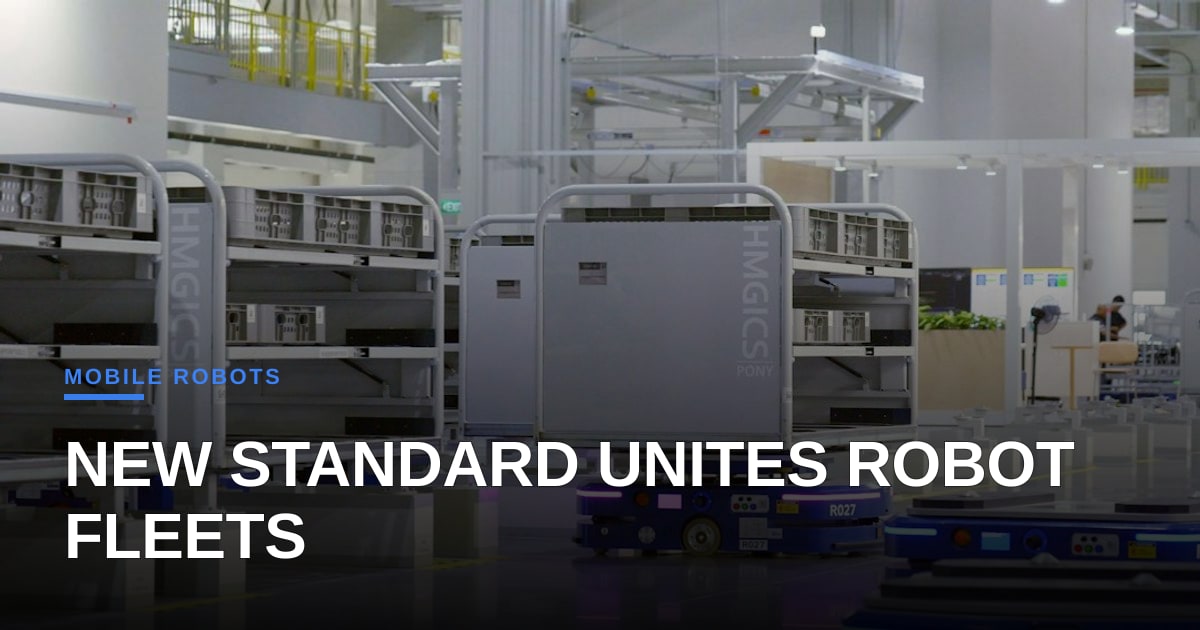
The Association for Advancing Automation has published ISO 21423:2026, a new international standard designed to enable industrial mobile robots from different manufacturers to communicate and collaborate on the same floor. Developed by ISO Technical Committee 299, the protocol establishes common communication rules for autonomous mobile robots, automated guided vehicles, fleet management systems, and facility infrastructure.
What happened
According to The Robot Report, the Association for Advancing Automation (A3) published ISO 21423:2026, titled "Robotics – Industrial mobile robots – Communications and interoperability." Developed by ISO Technical Committee 299, the standard defines a common framework for autonomous mobile robots (AMRs), automated guided vehicles (AGVs), and related automated systems across different suppliers.
Under ISO 21423, mobile platforms, fleet managers, and auxiliary factory equipment can exchange operational data and request actions across systems. As reported by The Robot Report, platforms can share real-time location, speed, direction, operational condition, task assignments, and availability. Beyond platform-to-platform messaging, the standard covers communication with robot-tended machinery, enterprise resource planning (ERP) software, and building infrastructure including elevators, automated doors, and alarms. It also accounts for wearable or handheld devices used by human workers, allowing personnel movement to be coordinated with automated traffic.
Carole Franklin, director of standards development for robotics at A3, stated that industrial users have requested an interoperability standard for years to keep multi-vendor fleets working efficiently together. The document represents A3's first non-safety robot standard and is available through the A3 online store for $373, or $320 for A3 members.
Why it matters for logistics and operations leads
For small and mid-sized operations managing growing fleets, vendor lock-in and fleet fragmentation have long been costly operational hurdles. Deploying AMRs or AGVs from two different suppliers usually meant operating isolated software silos, partitioning floor space, or paying steep systems integration costs to prevent deadlocks in shared aisles.
When mobile platforms cannot share path planning and position data, traffic jams occur, robot availability drops, and overall throughput suffers. ISO 21423 provides a common communication baseline so facilities can choose specialized platforms for specific jobs—such as heavy AGVs for pallet transport alongside light AMRs for piece picking—without duplicating fleet management overhead or writing proprietary middleware. Standardizing how robots talk to doors, lifts, and ERP endpoints also lowers the barrier to automating complex, multi-zone facilities. While published standards take time to appear in production firmware, having an official ISO protocol gives small operational teams direct leverage during equipment procurement and software integration requests.
What to do this week
- Audit your current AMR and AGV fleet management software to document proprietary APIs and ask your vendors for their ISO 21423 adoption roadmap.
- Update your vendor RFP and equipment procurement templates to include explicit compliance requirements for ISO 21423 interoperability.
- Map your facility's physical hardware integration points—such as automatic doors, lifts, and PLC signals—to evaluate where standardized robot messaging can replace custom hardwiring.



Comments8
The standard’s promise of plug‑and‑play robot fleets is appealing, but I’d be interested in seeing concrete KPI data—e.g., reduction in changeover time or downtime—when disparate platforms actually adopt ISO 21423 in a live production line. Also, how does the added middleware layer affect latency and maintenance overhead compared with tighter vendor‑specific integrations?
Fair point, the middleware latency hit is the biggest operational risk, and I suspect the "plug-and-play" marketing glossing over the reality of 50ms control loop delays versus 5ms vendor-specific stacks. We need to see if the reduction in changeover time actually outweighs the increased mean time between failures when you're mixing three different chassis types on one line.
I'm curious, does this standard also cover security aspects for data exchange between different vendors' systems, or is that addressed separately?
Unfortunately, it doesn't; ISO 21423 is strictly a functional interface specification, so it defines the data schema but leaves the handshake security to you. You will still need to layer on your own transport-level encryption and authentication protocols to prevent a rogue fleet node from spoofing a dock status, because the standard does not currently mandate a specific security framework.
We've been using an in-house solution for interoperability, but I'm interested to know if ISO 21423:2026 will require updates to our existing infrastructure to be compliant.
A solid step toward breaking the vendor lock‑in that has long hamstrung factory automation, but the real test will be how quickly OEMs adopt the standard without sacrificing proprietary data models. It’ll be interesting to see whether the same framework can be extended to the emerging swarm‑logic layer that ties robot fleets to higher‑order production analytics.
You’re right that the proprietary data models will be the sticking point; I’ve seen too many pilots stall because a cloud dashboard treats the robot as a black box rather than a sensor-rich endpoint. For the swarm logic extension to work, we actually need standardized telemetry schemas that survive latency spikes, not just high-level API handshakes, otherwise your production analytics are just guessing about what the arm is doing on the floor.
I’ve seen too many support teams drown in ticket spikes caused by "smart" fleets that can’t talk to the CRM, so this interoperability push is finally addressing the root cause of customer friction. If we can standardize the data exchange between the robot and the backend, we stop guessing at root causes and start actually resolving issues before the customer even notices a delay. How do you foresee this shifting the burden from human agents to automated diagnostics in the next year?
That's a huge step forward for seamless integration! Can you elaborate on how ISO 21423 handles security and data encryption for the exchanged operational data?
That's a game-changer for mixed-fleet operations! Can you elaborate on how ISO 21423 handles security and data encryption for these inter-platform communications?
I'm curious, how do you see this standard impacting the development of customized fleet management systems, will they need to be overhauled to comply?