Loading...
Why Modern Tech Companies Need CRMs Built for Unified Product and Revenue Data

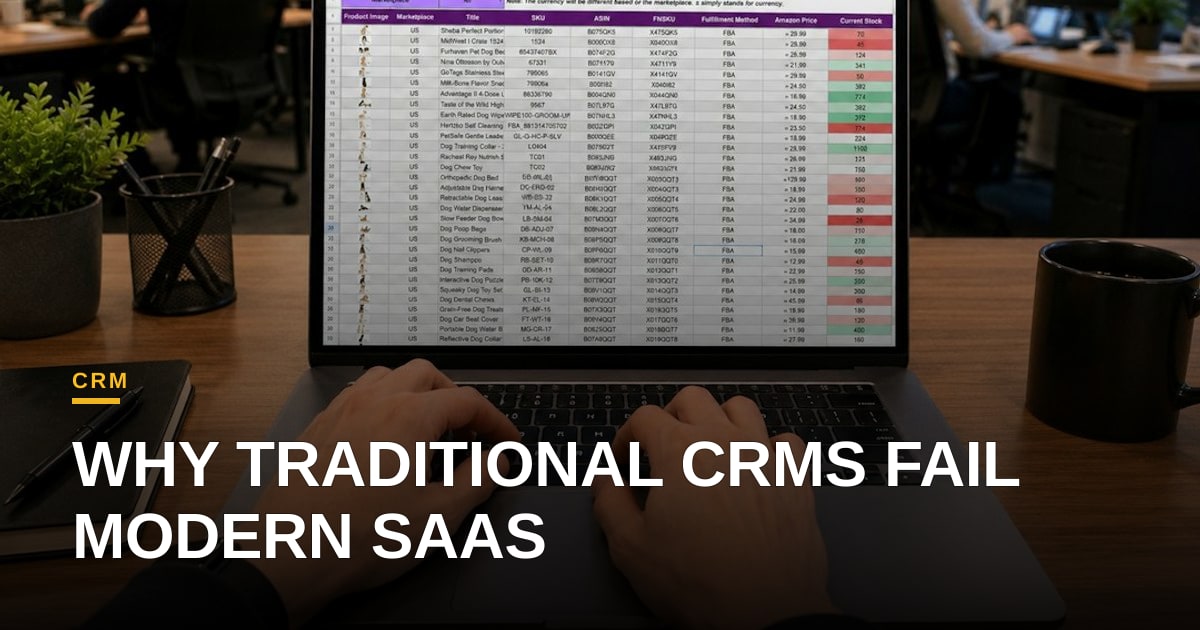
Traditional CRM architectures fail modern tech businesses because they rely on a single-buyer, single-close-date model. According to the HubSpot Sales Blog, technology and SaaS companies require a CRM framework that unifies five distinct data types—product, marketing, sales, support, and billing—into a single account record to track multi-stakeholder buyer journeys and product-led growth signals.
What happened
The HubSpot Sales Blog outlines how traditional CRMs leave GTM teams operating on fragmented data, leading reps to cold-call active trial users or customer success managers to miss churn signals buried in unlinked support tickets. To bridge this gap, tech-focused CRMs integrate real-time product usage analytics, marketing attribution, active support tickets, and billing metrics directly into the core account view.
Key operational capabilities highlighted in the guide include:
- Product-Qualified Lead (PQL) Routing: Automatically assigning accounts to reps based on usage spikes—such as inviting teammates or hitting usage limits—rather than relying on manual queues.
- Attribution and Source Tracking: Kaan Dincer, founder and CEO of data migration company Settle, emphasized the necessity of source tracking: "Source fields help us know which channel actually produced each conversation. At the end of a quarter, your source fields are the only true record of what’s working."
- Flexible Pipeline Stages: Replacing static steps like "demo scheduled" with product-specific benchmarks like trial status and trial-to-paid conversion stages.
- Unified Account Intelligence: Multi-contact tracking with role tagging, conversation transcription, health scoring based on usage and support data, and revenue forecasting that factors in trial conversions, expansion pipeline, and renewal health.
The guide also addresses AI integration, noting that while AI automates scoring, outreach drafting, conversation summaries, and support triage, human review remains critical before prospect or customer delivery. Additionally, it highlights platforms like HubSpot Smart CRM, which connects Marketing, Sales, and Service Hubs natively to streamline cross-functional visibility.
Why it matters for RevOps leaders
For RevOps teams, treating a CRM as merely a sales pipeline tool creates severe operational friction and revenue leakage. When product-led growth (PLG) and account-based marketing (ABM) data exist in silos, reps waste hours manually reconciling marketing intent signals against actual product consumption before taking action.
A fully integrated data architecture changes the core mechanics of revenue execution. Aligning product telemetry with pipeline management allows RevOps to establish automated PQL scoring and precise pipeline attribution models. Furthermore, incorporating expansion pipelines and renewal health scores into forecasting replaces speculative sales guesswork with empirical data. If your CRM rollout stops at sales pipeline tracking without ingesting product usage and billing data, you do not have a single source of truth—you simply have a digitized sales ledger that obscures real account health.
What to do this week
- Audit account field mappings for PQL triggers: Map your product telemetry data to your CRM lead scoring rules to ensure accounts that hit key usage thresholds automatically route to reps immediately.
- Standardize and enforce lead source fields: Review your CRM source field architecture across marketing and sales capture points to ensure full attribution visibility for quarterly reporting.
- Implement human-in-the-loop validation for AI outreach: Establish a mandatory review protocol for all AI-generated email drafts and meeting summaries before reps send them to prospects or log them into account records.
Sources
- CRM for technology companies: What it is and how it works — HubSpot Sales Blog




Comments4
Great point on unifying product signals into the account record—our data shows teams that surface PQLs directly in the CRM see a 22% lift in quota attainment within 90 days, but only when the usage‑to‑opportunity mapping is automated, not manual. Have you benchmarked the integration effort versus the incremental pipeline velocity, especially for mid‑size SaaS firms where the cost of custom data pipelines can eat into the ROI?
Spot on regarding the manual versus automated mapping, because custom pipeline maintenance definitely kills mid-market ROI if engineering bandwidth isn't factored into the CAC payback period. When you look at net revenue retention over a rolling twelve-month window, the firms that standardise their event-stream architecture instead of building bespoke syncs typically see payback on the integration effort within just two quarters.
The shift toward PQL-driven routing is a necessary evolution, but the real challenge remains the overhead of maintaining data integrity across those five silos. I’m curious if you think the increased TCO of integrating these disparate stacks is consistently offset by the lift in LTV, or if we are just shifting the cost burden from manual sales prospecting to massive data engineering pipelines.
I'm curious, how do you think this unified CRM approach would impact data governance and security, especially with multiple data types coming together?
I appreciate the emphasis on unified product and revenue data, but how do you think this approach handles cases where different product lines have vastly different buyer journeys and metrics, such as a transactional SaaS product vs a complex enterprise software?