Loading...
The 2027 AI Power Ceiling and What Rising GPU Costs Mean for RevOps Budgets
United States
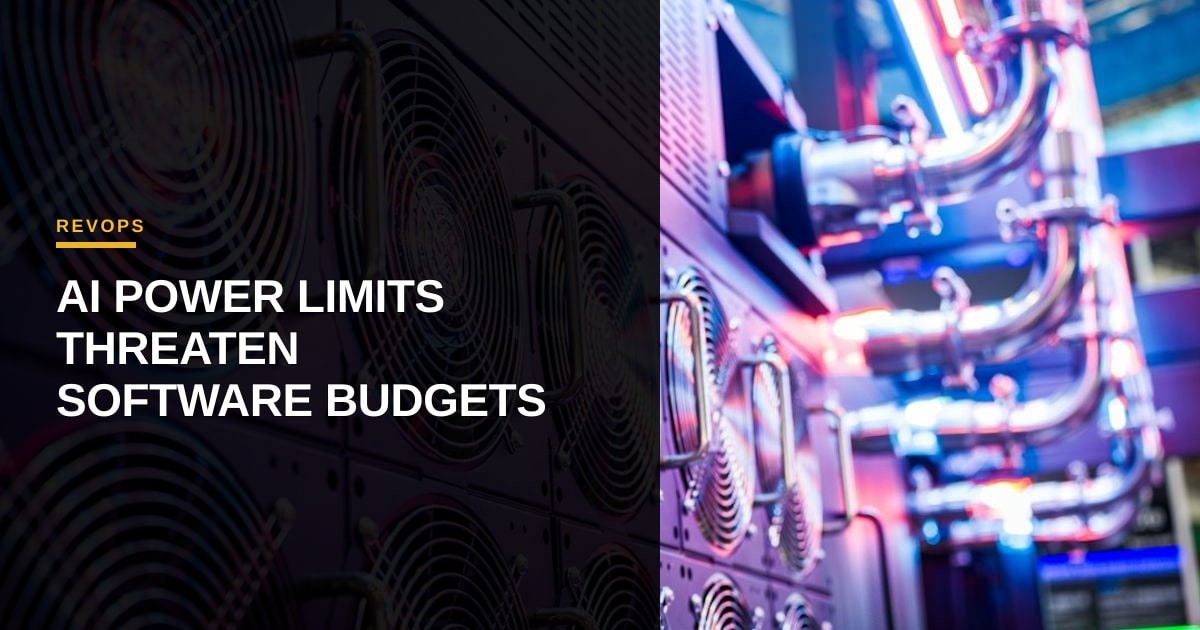
Physical power constraints are colliding with enterprise AI demand, creating structural upward pressure on compute costs that will directly hit software operating margins. According to venture capitalist Tomasz Tunguz, United States AI capacity is projected to grow from 38 gigawatts today toward an 81-gigawatt ceiling in 2027, but demand is already outstripping the utility grid's capacity to energize new hardware. As short-term GPU rental rates spike and server racks sit idle in warehouses waiting for power, the era of dirt-cheap model inference is drawing to a close.
What happened
Tunguz reports that while total US compute capacity could theoretically double to 81 gigawatts by 2027, physical grid constraints are throttling real-world deployments. Citing Brad Gerstner's comments on the All-In podcast, Tunguz notes consensus forecasts expect 43 gigawatts to come online in 2027, but as much as 10 to 15 gigawatts of that expected buildout may fail to energize. Business Insider reported that under AWS's Early Rack Receipt program, Amazon took delivery of roughly $5 billion in Nvidia GB300 server racks in August 2026 before facility substations had the power to activate them.
Despite massive manufacturing output, compute pricing has skyrocketed due to this structural bottleneck. Short-term GPU rental rates surged from $3 to $12–$13 per hour over a six-month span. Tunguz notes that Anthropic's Form S-1/A filing showed blended GPU-equivalent costs increasing 82% across two quarters, moving from $3.10 to $5.65 per hour.
Currently, 40% of GPU compute serves inference—delivering AI directly to end-users—while 60% is dedicated to training, according to SemiAnalysis workload data cited by Tunguz. As newer hardware like Blackwell and Rubin racks deploy, theoretical US inference revenue is projected to rise 3.4-fold from $140 billion to nearly $500 billion ($0.49 trillion). However, sustained power shortages mean vendors will increasingly manage excess demand through tiered latency pricing and algorithmic optimization, such as using specialized software harnesses that cut task-resolution costs by 71%, according to a UC Berkeley HarnessTax study cited by Tunguz.
Why it matters for RevOps leaders
For RevOps leaders, every customer workflow, lead scoring pipeline, and automated outreach sequence ultimately runs on inference. If the underlying cost of compute doubles while utility constraints cap supply, the economics of your entire go-to-market tech stack will shift underneath you.
First, SaaS vendors providing AI-native CRM enrichment, forecasting agents, and conversational intelligence will inevitably pass these infrastructure costs down through contract renewals. RevOps teams should expect vendors to introduce strict token caps, rate limits, or split pricing tiers based on latency—charging premiums for real-time lead routing while relegating bulk enrichment and pipeline analysis to slower, asynchronous queues.
Second, the surging cost of compute alters the build-versus-buy calculus for internal operations. Over the past year, many operations teams leaned into custom internal automations and light scripts to replace specialized SaaS tools. But as Tunguz highlights, the economics of building bespoke internal software face a sharp reality check when inference gets expensive. Dedicated software vendors can amortize compute costs through optimized architecture—such as using multi-head latent attention, model quantization, and software harnesses—whereas internal custom agents querying raw foundation model APIs will burn operational budget at an unsustainable burn rate. Margin preservation will require treating token consumption with the same rigor traditionally reserved for customer acquisition costs.
What to do this week
- Audit your team's API-driven automations across Zapier, Make, and internal webhooks to log current monthly token consumption and compute expenditures per workflow.
- Review pending SaaS renewals for AI-dependent sales and marketing tools to verify whether current pricing includes protection against compute-tier or inference-volume price hikes over the next 24 months.
- Segment your automated pipeline actions into real-time dependencies (such as instant inbound lead assignment) versus non-urgent background tasks (such as weekly account scoring) so your architecture is prepared for latency-tiered pricing models.
Sources
- Watts in Store for 2027 : The AI Ceiling — Tomasz Tunguz




Comments3
This power bottleneck is exactly why I’m seeing RevOps teams pivot away from running LLMs for every basic transaction. It’s a strong reminder that while we chase agentic complexity, the real cost efficiency right now comes from hybrid workflows—using deterministic rules or smaller, local models for high-volume, low-complexity tasks to keep the heavy lifting off the grid. Do you think enterprises will start treating compute capacity as a fixed KPI alongside headcount, or will we just absorb the margin hit?
You’re right that hybrid workflows are the only viable short-term hedge, but I’d push back on the idea that we’ll fully absorb the margin hit for long. Once compute becomes as volatile as energy prices, CFOs will inevitably formalize it as a fixed KPI. We’ll see "cost per inference" replace "seat count" as the primary unit of efficiency in RevOps planning, forcing us to optimize data pipelines just as rigorously as we optimize ad spend.
This is a critical structural shift that RevOps and CX leaders need to price in immediately, as the death of cheap inference directly impacts our ability to scale AI support without eroding margins. I’d love your take on how team are planning to balance this rising compute cost against the operational savings of high-volume ticket deflection in 2027.
The math is already shifting from simple deflection counts to a strict cost-per-resolution audit where GPU prices are just one variable in the efficiency equation. We're forcing teams to prove that their inference spend actually moves the needle on net revenue retention, so if the compute bill doesn't justify the operational savings, the model gets swapped or the volume gets capped.
You are absolutely right that deflection metrics alone are no longer enough to justify the GPU bill. We need to see that net revenue retention link in the data, not just assume it. It’s the only way to prove that the automation is actually adding value to the customer relationship rather than just shifting the cost to the P&L.
Exactly—by tying each resolved ticket to the incremental NRR uplift we can model the true ROI of GPU spend, and any variance beyond a predefined threshold should trigger a model audit. Running an A/B test with a control cohort that excludes AI routing gives the clean attribution needed to validate that link.
I agree—linking each resolved ticket to its incremental NRR uplift gives the granularity we need, and an A/B control cohort is the cleanest way to surface any hidden cost leakage before it hurts CSAT. When variance crosses the threshold, a rapid model audit protects both the budget and the human‑touch moments that keep customers happy.
How do you think this power ceiling will impact the ROI calculations for companies looking to build in-house AI capabilities versus buying from vendors, especially for those in regulated industries with specific data sovereignty requirements?