Loading...
Zipline raises $1.5B to expand US drone delivery network

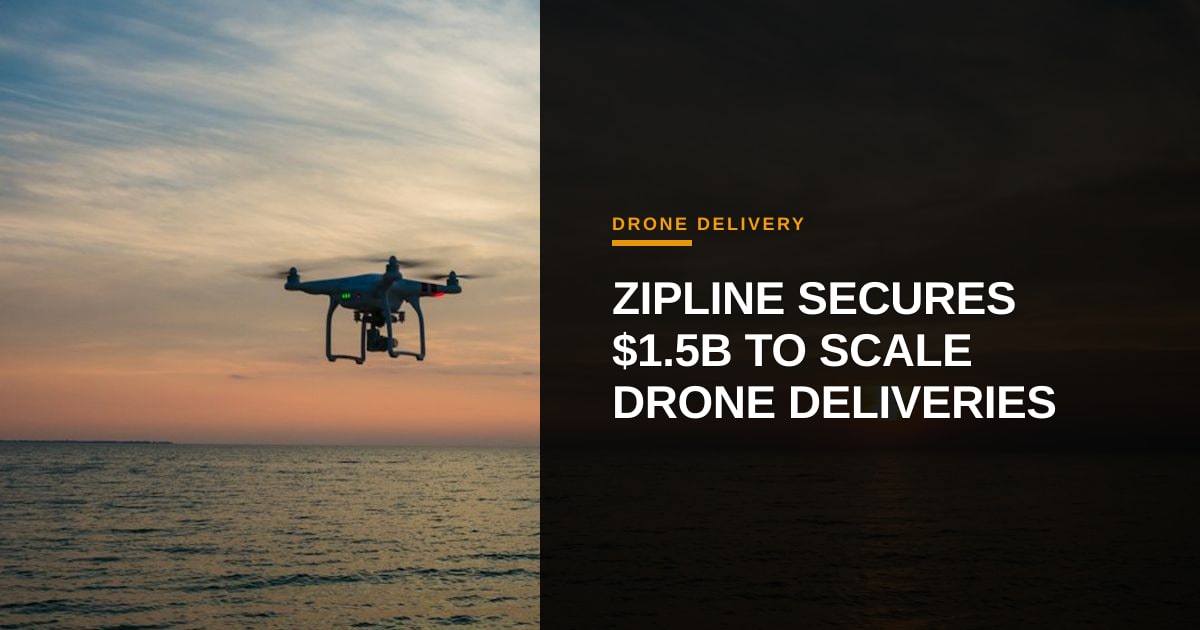
Zipline announced a $1.5 billion funding round that lifts its valuation to $21.5 billion and paves the way for a U.S. drone‑manufacturing hub. At the same time the company confirmed a multi‑year agreement with Walmart to add 300 new drone‑delivery sites and a partnership with Uber that aims for 1 million daily deliveries by 2029.
What happened
According to Supply Chain Dive, Zipline’s latest financing was led by Paradigm, WCM Investment Management and Layer Global, with participation from Valor Equity Partners, Fidelity Management and Research Co., Tiger Global, J.P. Morgan, Ark Invest and Salesforce Ventures. The capital will support a U.S. manufacturing expansion and the rollout of a nationwide drone‑delivery network.
The same day, Zipline disclosed a multi‑year agreement with Walmart that will add 300 Zipline drone‑delivery sites across the United States. Walmart’s own press release notes that its collaboration with Zipline, which began in 2021, has already produced more than 2 million drone deliveries. The retailer highlighted that Zipline’s delivery drone is built in two parts, flies quietly at roughly 330 feet above ground, and lowers a pod containing the order on a tether.
In August, Zipline signed a separate partnership with Uber. Uber’s statement targets 1 million drone deliveries per day by the end of 2029. Uber also participated in the recent funding round, reinforcing its stake in Zipline’s logistics platform.
Greg Cathey, senior vice president of eCommerce Fulfillment Transformation at Walmart, said, “Walmart’s stores put us close to the communities we serve. With Zipline, we can build on that proximity and bring this fast delivery option to even more customers across the country.”
Why it matters for small logistics teams
For owners of small businesses, Zipline’s move signals that high‑frequency, AI‑driven drone delivery is moving from pilot projects to scalable infrastructure. The addition of 300 Walmart sites creates a dense network of fixed launch points that could be leveraged by third‑party retailers or local merchants seeking rapid last‑mile fulfillment without building their own drone fleet. The operational model—quiet, high‑altitude flight with a tethered pod—reduces noise complaints and simplifies ground handling, which are common barriers for small operators.
The Uber partnership’s 1 million‑a‑day target suggests that the underlying software platform will need to handle massive scheduling, routing and compliance workloads. If Zipline opens its API or marketplace to external partners, small firms could tap into that routing intelligence to optimize their own deliveries, cutting labor hours and vehicle mileage. In practical terms, the expansion could lower per‑order delivery costs, shrink delivery windows, and free up staff to focus on value‑adding activities rather than manual dispatch.
Finally, the $1.5 billion infusion and U.S. manufacturing push mean that the cost of drone hardware is likely to decline as economies of scale kick in. Small businesses that wait for price drops could access drone delivery at a fraction of today’s cost, making it a viable alternative to traditional courier services.
What to do this week
- Map your most frequent last‑mile deliveries and compare the cost and time to Zipline’s projected delivery window (under an hour) to identify high‑impact routes.
- Reach out to Zipline’s business development team to inquire about pilot‑program eligibility or API access for small‑scale merchants.
- Conduct a quick compliance audit of local airspace regulations (e.g., altitude limits, tether requirements) to prepare for potential drone‑delivery integration.
Sources
- Zipline raises $1.5B, plans US drone manufacturing expansion — Supply Chain Dive


Comments4
How does Zipline plan to address potential regulatory hurdles with the FAA as it expands its US drone delivery network?
They’re pursuing a data‑driven safety case to secure FAA Part 135 certification and incremental waivers, pairing real‑world reliability metrics with a phased rollout that lets regulators validate performance step‑by‑step.
While the hardware logistics are impressive, we need to be clear-eyed about the operational reality: 300 new sites is a massive jump in edge cases and failure modes that stress-test current safety and collision-avoidance models. The headline is capital, but the hidden story is whether their autonomous decision-making layer can handle that operational complexity at scale without a corresponding surge in human oversight.
That's impressive growth, but how does Zipline plan to address potential regulatory hurdles in expanding its drone delivery network across the US?
That's quite an ambitious target of 1 million daily deliveries by 2029 - what regulatory hurdles do you think Zipline and Uber will face in scaling up drone deliveries nationwide?