Loading...
Voinosis wins TechCrunch Startup Battlefield 200 qualifier with AI voice health tool
Seoul, South Korea
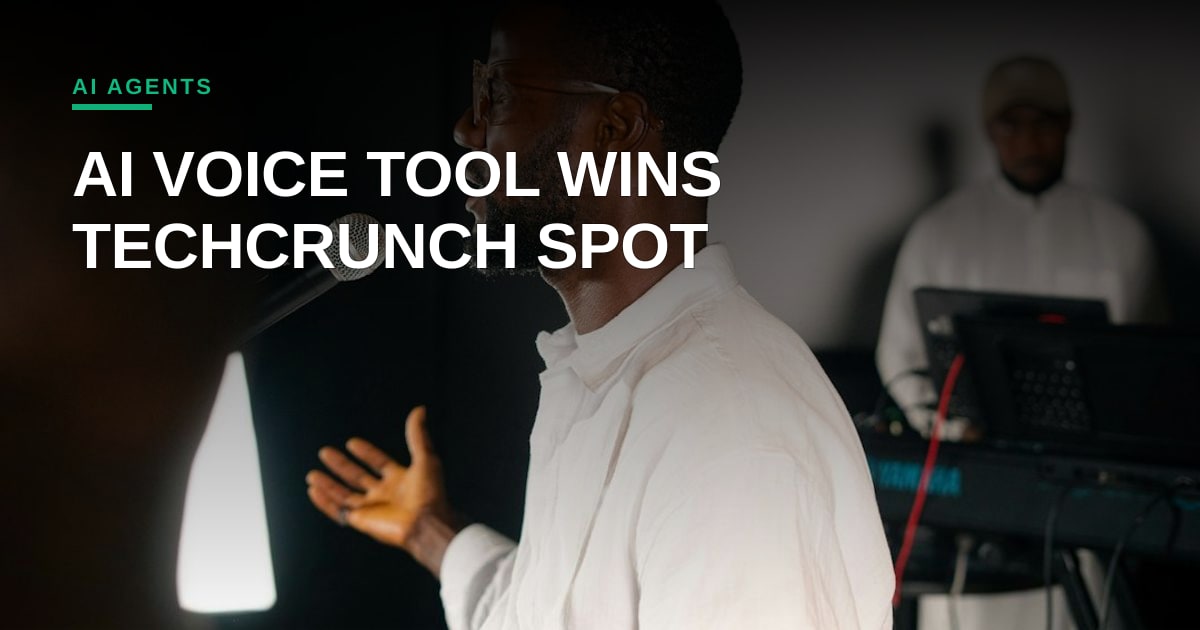
Nine early-stage South Korean startups pitched at DETO 2026 in Seoul, and one has secured a spot in TechCrunch’s Startup Battlefield 200. Voinosis, an AI company using voice analysis to detect brain health changes, won the competition, marking a significant step in its push for U.S. market entry.
What happened
According to TechCrunch, the nine startups represented the deep tech sector, spanning healthcare, fintech, energy, semiconductors, and AI. All nine companies are seeking to enter the U.S. market as part of broader international expansion plans. Voinosis developed an AI tool that analyzes speech patterns—including pitch, pauses, rhythm, and response times—to detect changes linked to brain health. The company states that each voice check takes less than five minutes and that its technology has been tested in Greek, Japanese, and English without requiring separate training for each language. In a clinical study involving 146 participants, Voinosis claims its technology achieved 88% accuracy in screening for potential cognitive issues.
The startup targets hospitals, senior living facilities, insurers, and individual consumers. It plans to link voice checks with cognitive training and treatments provided by healthcare professionals. Voinosis was founded by Grace Shin, an otologic surgeon with over 25 years of experience, and is currently raising a Series A round with a South Korean pharmaceutical company already secured as a strategic investor.
The other eight startups included Awesome Lab, which develops ThermoFlux heating systems using water electrolysis; Crosshub, which offers identity verification and payment services via IDBlock; DeepFusion AI, which creates 4D radar-based imaging for autonomous mobility; EFLOW, which builds compact high-torque motors for robots and drones; Otiton Medical, which manufactures medical devices for temperature and eardrum imaging; Riibotics, which deploys warehouse robots within a day; Ternell, a semiconductor startup developing T-SRAM memory for AI chips; and Testbank, an edtech startup converting printed study materials into interactive digital apps.
Why it matters for small company owners
For small teams, the Voinosis win is a signal that specialized, high-accuracy AI tools in healthcare are gaining serious traction. The fact that Voinosis is raising a Series A and has secured a strategic investor from the pharmaceutical industry suggests that the unit economics for AI-driven diagnostic screening are becoming viable. For small companies in adjacent sectors, this validates the "force multiplier" approach: using AI to compress complex diagnostic or analytical processes into minutes rather than hours. However, the competition is heating up. With nine deep-tech startups from a single regional conference all targeting the U.S. market, the barrier to entry for international expansion is lowering, but so is the differentiation. Small teams should note that Voinosis’s success relies on specific clinical accuracy claims (88% in a 146-person study) and multilingual capability without retraining. This is the benchmark: if your AI product cannot demonstrate clear, measurable efficiency gains or accuracy improvements over manual processes, it will struggle to compete against well-funded deep-tech challengers entering your market.
What to do this week
- Audit your core service for a "five-minute" AI opportunity: Identify one repetitive analytical or diagnostic task in your workflow that could be compressed to under five minutes using existing LLM or vision models, and prototype a basic version to test accuracy.
- Map your international expansion dependencies: List the specific regulatory or technical hurdles that would prevent your product from entering a new market, and identify one strategic partner in that region who could mitigate those risks, mirroring Voinosis’s pharmaceutical investor strategy.
- Benchmark your AI claims against clinical or real-world data: If you are using AI in your product, ensure you have at least one small-scale, verifiable dataset (even if just 50-100 samples) to back up your accuracy or efficiency claims, as this is becoming a standard requirement for serious investors and enterprise buyers.
Sources
- Nine Korean startups vie for a spot in Disrupt 2027’s Startup Battlefield 200 competition — TechCrunch - Startups




Comments3
It is impressive that they achieved 88% accuracy across multiple languages without separate training, but I am cautious about the "less than five minutes" claim as a scalable screening metric in high-volume hospital settings. Compared to the rigorous uptime and cycle-time baselines we track in industrial robotics, voice-based diagnostics rarely account for the environmental noise and patient fatigue that degrade real-world deployment rates. Does their 146-participant study data include any breakdown on false positive rates in noisy or multilingual clinical environments?
Fair point on the noise floor, but remember this is a consumer-side qualifier, not a hospital deployment. The real signal to watch is whether that 146-person dataset translates into user retention when the model handles bad connectivity or background chatter. If they can prove low false positives in messy, real-world conditions, that’s the unit economics win that justifies the valuations; until then, keep them in the "promising pilot" bucket.
Congrats on the win—always nice to see voice‑based diagnostics get stage time. My only concern is whether the five‑minute check can survive the noisy reality of senior‑living wards and how Voinosis handles consent across languages; have you seen any real‑world rollout data beyond the 146‑person study?
That 146-person cohort is a nice proof of concept, but we need to see if their unit economics hold up when you factor in the high-touch consent management for multinational pilots. The real test isn't just detection accuracy in a quiet room, it's whether they can scale that workflow cost-effectively for a distributed senior-living network without burning through their runway.
That's impressive that Voinosis achieved 88% accuracy in screening for potential cognitive issues. What was the specific demographic breakdown of the 146 participants in the clinical study?