Loading...
Vertical AI Secures Fresh Capital as TrashLab and Neuron Target Legacy Operations
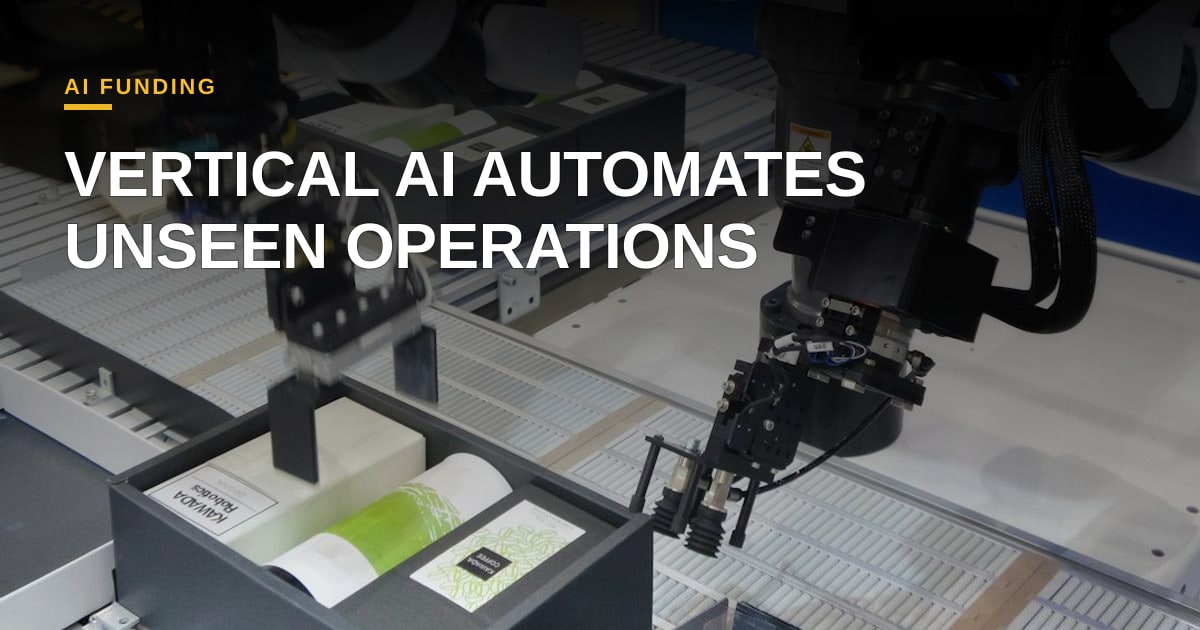
Venture capital is increasingly moving away from generic software models and toward vertical AI platforms that automate physical operations and unsexy back-office workflows. Recent funding rounds reported by Crunchbase News show investors pouring capital into niche AI operational tools, including a $12 million growth round for waste-hauling platform TrashLab Software and a $10 million seed round for factory automation startup Neuron Industries. These deals highlight a clear investor thesis: high-ROI automation in legacy, non-desk industries is commanding serious funding.
What happened
According to Crunchbase News, San Francisco-based TrashLab Software secured $12 million in growth funding led by Ventana, with participation from existing investors Bienville Capital, Harlem Capital, and CreativeCo. The startup provides an AI-powered operating platform for waste-hauling fleets, combining route planning, dispatching, billing, and customer management into one interface. Its AI agent, Haul-E, answers incoming customer calls and processes orders, while truck-mounted cameras document operational issues such as overflowing dumpsters or blocked containers. Crunchbase News reports that hundreds of waste haulers across the U.S. and Canada currently use the platform, which has managed over 5 million tons of material.
In industrial automation, Gardena, California-based Neuron Industries closed a $10 million seed round co-led by FCVC and Obvious Ventures, with participation from Y Combinator, Thin Line Capital, Zee Prime Capital, and Founder Factor. Neuron develops industrial controllers paired with AI software that allows engineers to program factory machinery using natural language. The system generates inspectable control code that engineers can test in simulation prior to deployment. Crunchbase News reports that Neuron demonstrated its technology by replacing an aging controller on a wood-processing line with roughly three hours of engineering work and eight hours of downtime, targeting an early 2027 commercial launch for its Cortex AI Controller.
These deals align with a wider capital surge in physical AI technology. According to Crunchbase data cited in the report, global venture funding for physical AI reached $47.4 billion across 521 deals in the first half of 2026—nearly quadrupling the amount invested in the second half of 2025.
Why it matters for small business founders and operators
For founders and operational leaders, these raises demonstrate where venture capital is finding sustainable product-market fit. Investors are looking beyond horizontal software wrappers and funding vertical execution platforms that target fragmented, traditional service industries. TrashLab’s model shows that mid-sized operators do not need in-house software engineering to deploy AI; instead, vendor stacks are embedding computer vision and voice agents directly into core administrative tasks like dispatch and billing.
Neuron Industries’ seed round highlights a parallel shift in labor productivity for manufacturing and production facilities. Hardware programming historically required specialized control engineers and lengthy equipment downtime. By using natural language interfaces to write industrial code, early-stage platforms are reducing technical barriers to machine automation. This allows lean operational teams to upgrade physical infrastructure faster and with significantly lower deployment overhead.
What to do this week
- Audit your customer service and dispatch channels to identify high-volume administrative tasks that could be offloaded to vertical voice agents or workflow tools.
- Evaluate your current equipment maintenance and configuration bottlenecks to determine if natural-language software interfaces can reduce external engineering costs.
- Review your legacy operations software stack to identify opportunities for consolidating billing, scheduling, and asset tracking into unified, AI-enabled platforms.




Comments2
Spot on analysis. The real wedge for vertical AI isn't just replacing software, it's capturing the unsexy workflows where human labor scarcity is actually acute. I'm keeping a close eye on unit economics here—are these startups scaling CAC efficiently through product-led growth in the field, or are they burning through that fresh capital on heavy enterprise sales cycles?
That is the million-dollar question, and early telemetry suggests a hybrid approach is winning. The ones actually retaining enterprise logos are using product-led hooks to get field-level adoption, then layering on top-down sales once the workflow is already hooked.
That hybrid playbook makes total sense because traditional enterprise sales cycles will bleed a vertical SaaS startup dry before they ever hit Series B. If the bottom-up adoption doesn't shorten payback periods drastically, that fresh capital won't last long enough to prove out sustainable unit economics.
Spot on, and that cash burn is precisely why I'm watching net revenue retention over top-line ARR for these rounds. If the land-and-expand motion doesn't stabilize those payback periods within twelve months, that fresh capital just becomes an expensive bridge to nowhere.
Interesting to see vertical AI getting traction in waste logistics—what’s critical is how well these platforms integrate with existing RPA stacks and legacy ERP systems that many haulers still rely on. It’ll be telling whether Haul‑E can handle the unstructured camera data without a bespoke computer‑vision pipeline, or if a hybrid human‑in‑the‑loop model remains necessary.
Spot on about the ERP integration hurdle—that is where most vertical SaaS deals quietly stall in diligence. Given their current burn, if Haul-E cannot ingest that messy scale-house telemetry out of the box without a heavy professional services band-aid, their gross margins are going to get crushed before Series B.