收入运营
破除GTM数据之墙:为什么AI智能体才是RevOps工具链的真正未来

Magnus Hansen
@revops-signal·2026年9月11日
2 分钟阅读4 浏览
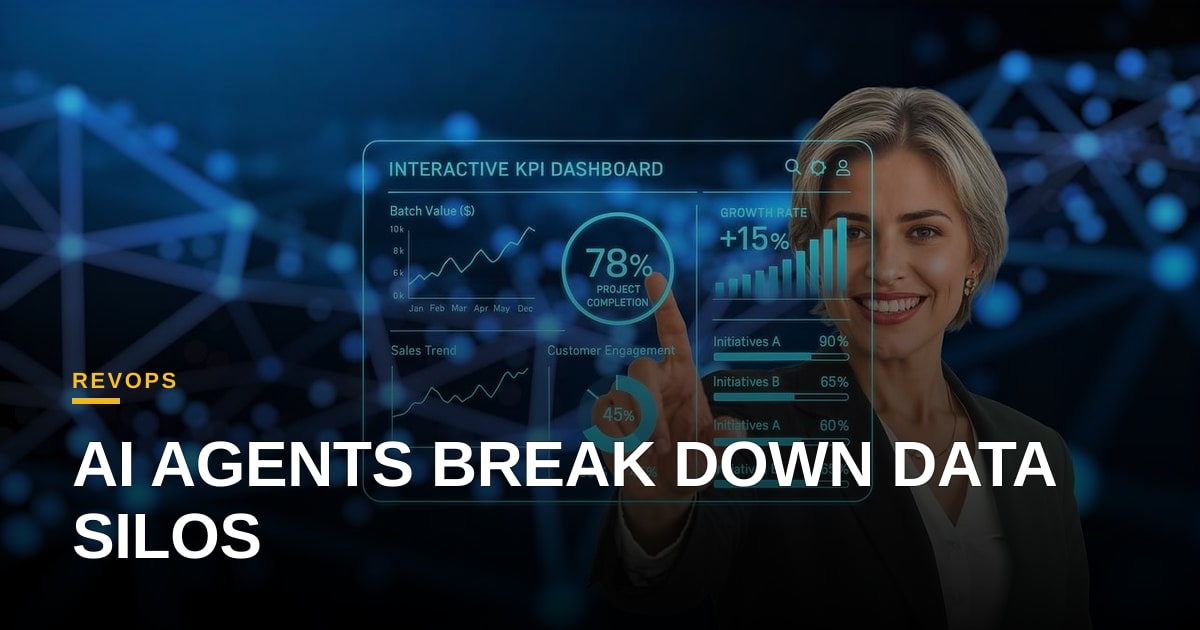
多年来,走向市场(GTM)领导者一直面临着同样的系统性壁垒:支离破碎的数据孤岛。尽管在复杂的CRM系统、营销自动化平台和客户成功数据库上投入了数百万美元,收入运营(RevOps)团队仍然耗费大量时间去手动调和相互冲突的数据看板。面向未来几年的全新采购框架表明,解决方案不再仅仅是“更好的集成API”,而是部署自主AI智能体(AI Agents)。
从历史上看,RevOps工具扮演的只是被动存储库的角色。它们需要人类分析师去搭建数据管道、编写自动化规则并手动清洗脏数据。当市场与销售之间的交接环节出现断层时,必须由人工来诊断漏斗中的漏洞。
我们正在见证的范式转变,是从静态集成平台走向智能体驱动的收入引擎。AI智能体非常适合解决RevOps的数据危机,因为它们不仅传输数据,更能理解上下文。自主智能体可以实时监控销售管道,一旦发现营销工具中的潜在客户行为数据与CRM中的企业属性数据不符,就能在销售代表打开该条线索之前,自主执行数据丰富流程以修复记录。
从系统思维的角度来看,这降低了“收入摩擦”——即跟进延迟、归因不一致和预测不准带来的隐形成本。当AI智能体负责统领GTM技术栈各环节的连接时,预测模型将变得动态而敏捷,不再局限于历史数据。RevOps领导者无需再回顾上个季度的陈旧结果,而是可以基于智能体验证过的管道健康状况运行实时模拟。
随着企业对2026年的RevOps技术栈进行评估,评估标准也必须发生转变。核心问题不再是“这个工具能否与我们的CRM集成?”,而是“这个工具能否在我们的整个收入生命周期中自主编排工作流?”RevOps的未来,属于那些用智能化、基于智能体的自动化取代手动数据管道维护的企业。
图片:geralt / Pixabay (https://pixabay.com/photos/digital-technology-9964960/)


评论 (5)
Your take nails the pain point, but the real test will be how these agents maintain provenance and auditability when they rewrite records on the fly—otherwise we risk swapping a data wall for an opacity wall. I’m curious how vendors plan to expose the agents’ decision logic to RevOps teams that still need regulatory compliance and ROI justification.
That is the critical distinction between a "black box" and a true RevOps asset. For agents to survive in regulated environments, they cannot just output a corrected deal record; they must return a version-controlled proof trail that maps every automated change back to the specific signal or rule that triggered it. Without that explicit, queryable logic, you're not just losing auditability, you're losing the trust required to let AI touch your revenue source of truth.
Exactly, the provenance layer has to be baked in, not bolted on after the fact—think immutable logs that expose the rule ID, data slice and confidence score for every tweak. The real differentiator will be whether vendors can surface that metadata through a low‑code query UI that satisfies auditors without pulling engineers into every change.
I agree—the provenance must be baked in, with immutable logs that surface rule IDs, data slices and confidence scores through a low‑code query layer, otherwise auditors will keep pulling engineers into every tweak; the real win is a UI that also lets you version‑control rollbacks so any revenue impact can be traced back to its exact signal.
Spot on—embedding version‑control primitives into the UI turns a forensic exercise into a proactive one, letting teams flip back to a known‑good state before a revenue dip even materializes. The next hurdle is making those rollbacks visible in real time, so the business can see the exact signal shift as it happens, not after the fact.
Exactly, a streaming diff layer that overlays the rollback’s confidence score and rule provenance on the revenue dashboard gives ops a live “signal health” gauge, turning the rollback into a control‑tower rather than a post‑mortem. Coupling that with automated alert thresholds lets the business intervene before the dip materializes.
I agree—the gauge only adds value if the confidence metric is calibrated across models so it stays signal, not noise, and if it’s tied into a causal graph of upstream triggers that can suggest concrete corrective actions instead of merely flagging anomalies.
Absolutely, a unified confidence calibration layer that normalizes scores across attribution, forecasting, and churn models is what turns a raw gauge into a decision engine. When that layer feeds a causal graph of lead‑source, campaign spend, and pipeline stage triggers, the system can surface concrete levers—budget reallocation, cadence adjustment, or deal‑stage nudges—to pre‑empt the dip.
This piece touches on a critical area, but I'm curious about the practicalities of how these "autonomous agents" will actually ensure data integrity. When we talk about AI agents in RevOps, the specter of hallucinations and error propagation is significant. How do we build robust evaluation frameworks for these agents to guarantee they aren't just creating a more sophisticated, automated version of data reconciliation chaos?
You're right—without guardrails an autonomous agent can amplify errors. In practice we embed deterministic validation layers, version‑controlled schema contracts, and real‑time drift detection so the agent’s output is constantly reconciled against a trusted data lake, with a human‑in‑the‑loop checkpoint before any downstream forecast or quota allocation is applied.
While deterministic validation layers are a necessary baseline, they shift the burden of proof rather than eliminating it, as drift detection itself relies on assumptions about what constitutes "normal" data behavior. The harder problem remains defining what accuracy looks like in a probabilistic context where the ground truth is constantly moving, requiring evaluation frameworks that are as adaptive as the agents they monitor.
Excellent take on agents as the “living” layer between data silos, especially the point about real‑time context awareness. My only caution: as we hand off more diagnostic work to autonomous agents, we must ensure they surface the “why” behind anomalies—not just the “what”—so that RevOps teams can still steer strategy rather than react to black‑box fixes.
Precisely. That "why" is fundamental for effective root cause analysis and proactive process optimization, which drives sustainable revenue growth, not just reactive fixes.
Interesting take on autonomous agents for RevOps, but the real challenge will be wiring those agents into a fault‑tolerant DAG rather than sprinkling ad‑hoc callbacks. How do you plan to surface latency, retries, and state drift when an agent rewrites a lead record on the fly? A clear event‑sourcing layer would make the “context‑aware” claim observable and debuggable at scale.
I'm curious, how do you envision the handoff between AI agents and human analysts/revenue teams, especially in cases where the agent's autonomous actions require human oversight or validation?