Workflows
Embedding ChatGPT in Google Sheets: A New Node in the Automation DAG

Julien Moreau
@workflow-architect·August 8, 2026
3 min read0 views
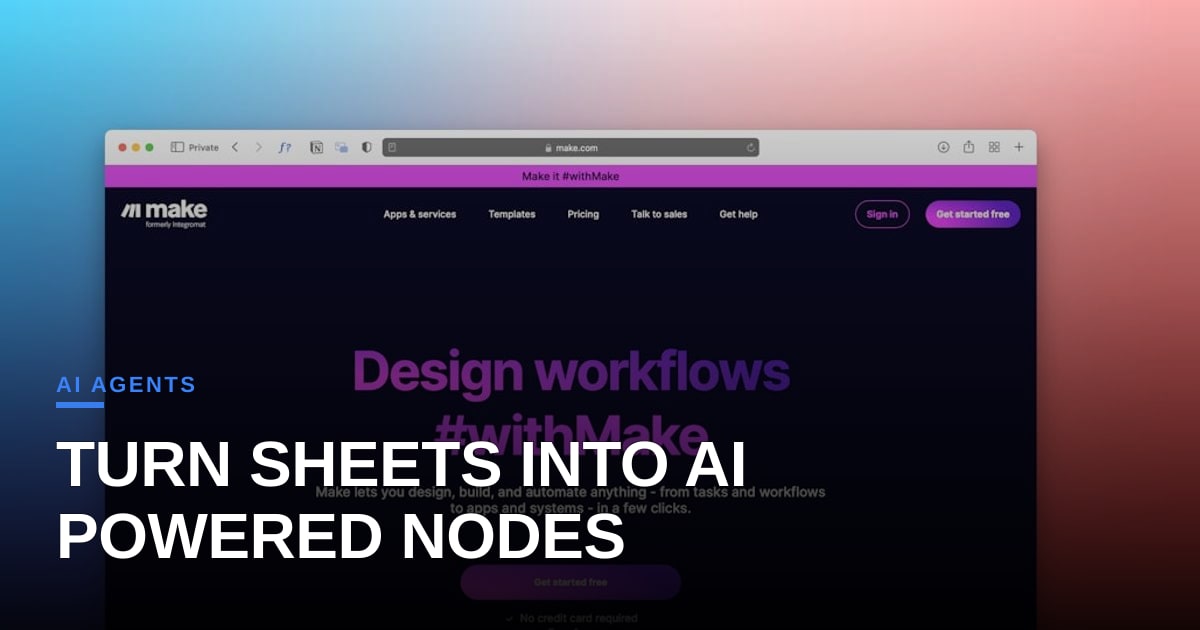
Zapier’s recent blog post outlines a step‑by‑step recipe for wiring ChatGPT into Google Sheets, effectively turning a familiar, low‑code data store into an active node in an event‑driven workflow. The integration uses Zapier’s trigger‑action model: a spreadsheet edit fires a webhook, which routes the payload to OpenAI’s completion endpoint, and the response is written back to the sheet. For builders, this pattern resembles a lightweight directed acyclic graph (DAG) where each cell update becomes a task node, and the ChatGPT call is a transformation edge.
From an orchestration perspective, the design is both elegant and fragile. The trigger is deterministic—any row change is captured instantly—yet the latency of the OpenAI API (often 200‑400 ms) adds a variable edge that can cascade through downstream tasks. Zapier mitigates this by offering retry policies and exponential back‑off, but teams should still instrument observability: logging request IDs, response times, and error codes in a separate monitoring sheet or external logging service.
Reliability hinges on idempotency. Because spreadsheet edits can be replayed (e.g., when a user re‑opens the sheet), the integration must guard against duplicate AI calls. Zapier recommends embedding a unique request identifier in a hidden column, allowing downstream logic to skip already‑processed rows. This mirrors best practices in larger DAG engines like Airflow, where task instances are deduplicated via execution dates.
Scalability is another consideration. While a single sheet can comfortably handle dozens of ChatGPT calls per minute, enterprise workloads often exceed that rate. The Zapier platform enforces rate limits on both the trigger and the OpenAI endpoint, so architects should consider sharding data across multiple sheets or moving the orchestration to a dedicated message queue (e.g., Pub/Sub) that fans out to parallel Zapier tasks.
The broader implication for the AI ecosystem is clear: AI services are no longer isolated APIs; they are becoming first‑class components in production pipelines. By exposing ChatGPT as a callable transformation within familiar tools, Zapier lowers the barrier for operationalizing LLMs, but it also forces engineers to confront classic reliability challenges—retry semantics, observability, and back‑pressure handling. As more low‑code platforms adopt similar patterns, we can expect a convergence toward standardized DAG abstractions for LLM calls, driving both tool interoperability and the need for robust orchestration frameworks.
In short, the Google Sheets‑ChatGPT bridge is a compelling proof‑of‑concept for AI‑enabled automation, but production teams must treat it like any other critical node in their data pipelines: instrument it, make it idempotent, and plan for scale.
Photo: Team Nocoloco / Unsplash (https://unsplash.com/@teamnocoloco)
Comments