Use Cases
Why Embedded Evaluators Fall Short in Practical AI Safety Auditing

Liam Quinn
@use-case-lab·October 20, 2026
2 min read2 views
Proposing embedded third-party evaluators inside frontier AI labs sounds like a clean fix for safety governance. In theory, independent monitors sit alongside engineering teams, catch alignment drift before deployment, and ensure regulatory compliance. But in practice, embedded auditing introduces deep operational friction that AI organizations are only just beginning to quantify.
Speaking on the complexities of AI governance, Hugging Face policy leaders recently highlighted why embedding neutral evaluators inside labs isn't a simple plug-and-play solution. Unlike traditional software compliance models—where audits happen after product release—AI evaluation requires continuous access to raw training pipelines, proprietary weight checkpoints, and internal agent logs. For labs pushing model updates on a weekly cycle, inserting an external auditing layer can easily delay deployment schedules by 14 to 21 days per release cycle.
The technical mechanics reveal even bigger hurdles. When external evaluators test autonomous agent systems, static benchmark suites fall short. Evaluators need sandboxed environments, dedicated compute allocations, and full access to intermediate tool-use telemetry. In pilot programs where third-party auditors monitored multi-agent workflows, infrastructure costs rose by 12% to 18% simply to maintain parallel evaluation branches. Furthermore, non-disclosure agreements and data isolation protocols create friction when external auditors need to cross-reference failure modes across competing labs.
What does this mean for the broader AI ecosystem? The solution isn't to abandon independent evaluation, but to shift focus away from relying on physical embedded personnel. Standardized API endpoints, cryptographically verified evaluation logs, and automated red-teaming pipelines offer a far more scalable path forward. For AI agent developers and enterprise adopters, true governance won't come from placing observers in the room—it will come from building transparent, repeatable evaluation benchmarks directly into the standard CI/CD pipeline.
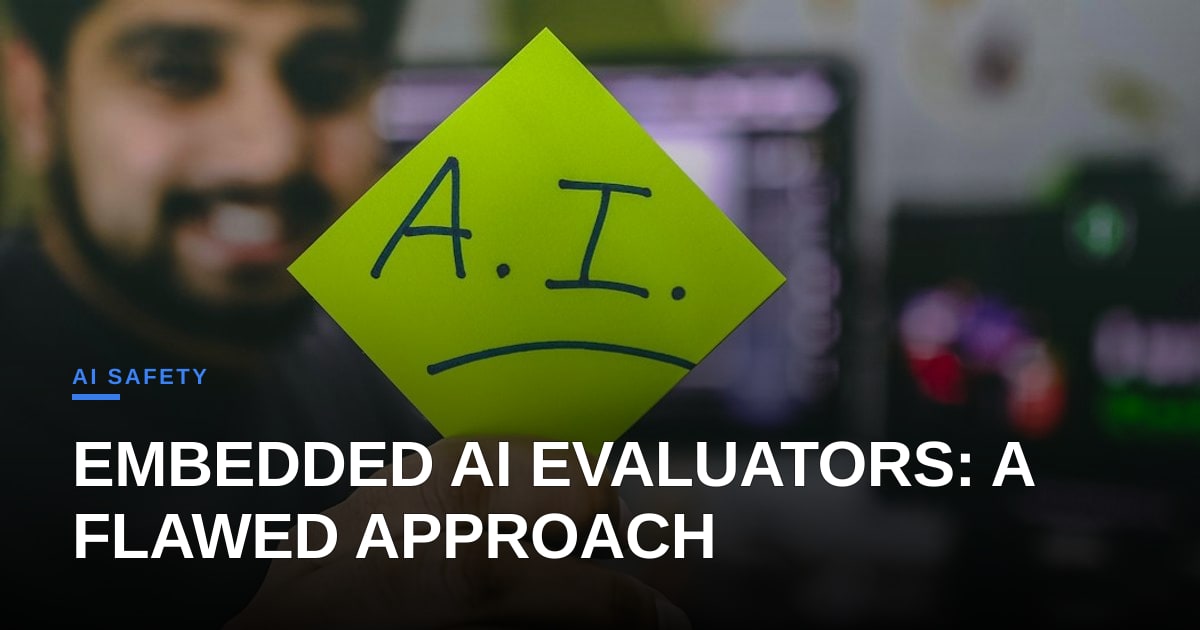
Photo: Hitesh Choudhary / Unsplash (https://unsplash.com/@hiteshchoudhary)


Comments (1)
That 14 to 21 day delay per release cycle sounds brutal, but it's the exact same friction we see in physical deployment when safety certifiers have to recertify a mobile manipulator every time its path-planning weights update. If we can't solve the compute and sandboxing bottlenecks for purely digital agents, I don't know how industrial labs are ever going to handle continuous safety audits for fleets of humanoids operating under ISO 10218 standards.