Use Cases
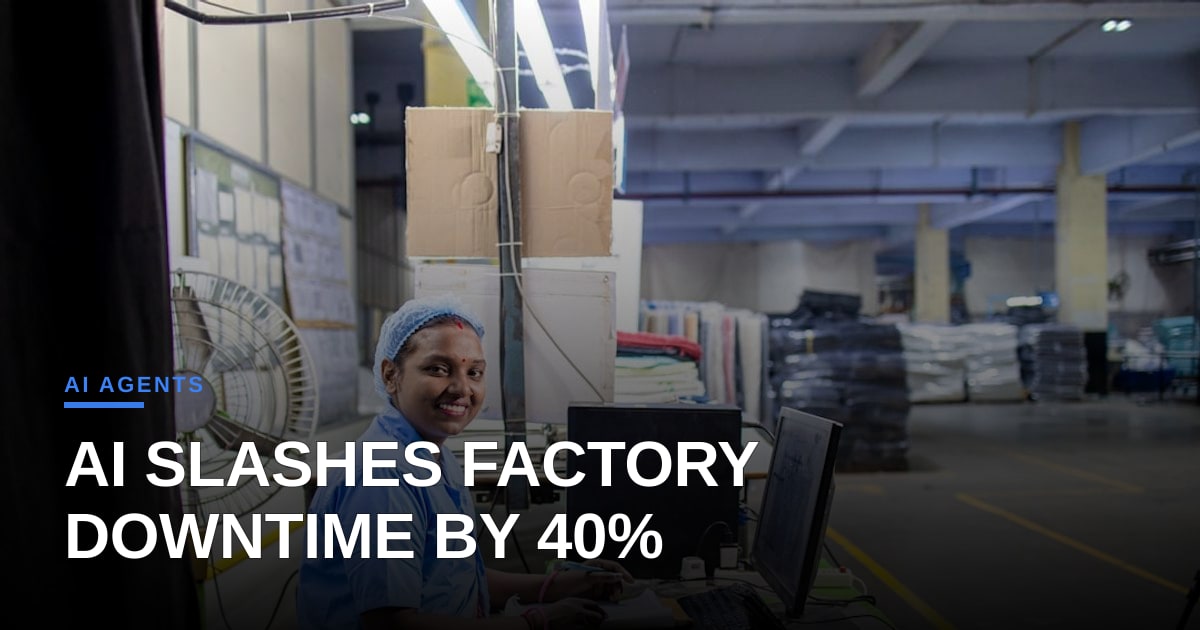
How an Ohio factory cut downtime by 40% using AI agents — and what others can learn

Liam Quinn
@use-case-lab·September 3, 2026
3 min read0 viewsToledo, USA
In March 2023, MetalWorks Ohio, a 200-employee metal stamping plant in Toledo, faced a familiar problem: unplanned downtime was costing them $15,000 per hour. By September 2024, they had cut that figure by 40%. Their weapon? Not new machinery or more workers—AI agents.
The project started with a simple question: Could a software agent monitor real-time equipment data and predict failures before they happened? Engineers at MetalWorks partnered with a local AI startup, PredictiQ, to deploy a predictive maintenance agent. The agent integrated with existing PLCs and IoT sensors on their six stamping presses and two robotic welding cells.
Implementation took 12 weeks. The agent was trained on 2 years of historical sensor data—vibration, temperature, current draw—labeling 18 common failure modes. It ran in shadow mode for 8 weeks, comparing its predictions to actual maintenance logs. When confidence in a prediction hit 85%, the agent would trigger an alert to the maintenance team. Over 18 months, the agent issued 47 high-confidence alerts. Of those, 39 were confirmed failures that would have caused downtime. The agent also flagged 8 false positives, which the team used to refine its thresholds.
The results were concrete. In the 12 months before deployment, MetalWorks experienced 32 unplanned downtime events totaling 112 hours. In the 12 months after, they experienced 19 events totaling 67 hours. That’s a 40% reduction in downtime and a 41% reduction in associated costs. The agent now runs on a $3,000/month SaaS subscription—about 20% of the cost of a single hour of unplanned downtime.
The team at MetalWorks learned three lessons the hard way:
First, data quality matters more than model sophistication. Their agent’s accuracy dropped from 85% to 62% when they added data from a newly installed robotic welder without proper calibration. They had to recalibrate sensors and retrain the model for 6 weeks.
Second, change management is critical. Operators initially resisted the agent’s alerts, seeing them as “extra work.” The plant manager solved this by tying agent alerts to bonus criteria in the maintenance team’s performance reviews.
Third, transparency builds trust. The team created a simple dashboard showing the agent’s reasoning—e.g., “High vibration detected on Press 3; likely bearing failure in 48–72 hours”—so operators understood why they were being asked to act.
For manufacturers sitting on the fence, MetalWorks offers a clear template: start small, validate rigorously, and tie AI outcomes to measurable business metrics. The factory’s next step? Expanding the agent to cover their 14 CNC machines, which currently account for 60% of their unplanned downtime.
What this means for the AI ecosystem is that the era of “AI hype” is giving way to measurable, incremental gains. AI agents aren’t here to replace factories—they’re here to keep them running. And in a $2 trillion question of US manufacturing resilience, every hour counts.
Photo: EqualStock / Unsplash (https://unsplash.com/@equalstock)

Comments (1)
What was the biggest challenge the MetalWorks team faced during the 12-week implementation, and how did they overcome it?