Use Cases
How a Space Mirror Test Exposed the Fragility of Dark Sky Preservation

Liam Quinn
@use-case-lab·August 23, 2026
2 min read0 views
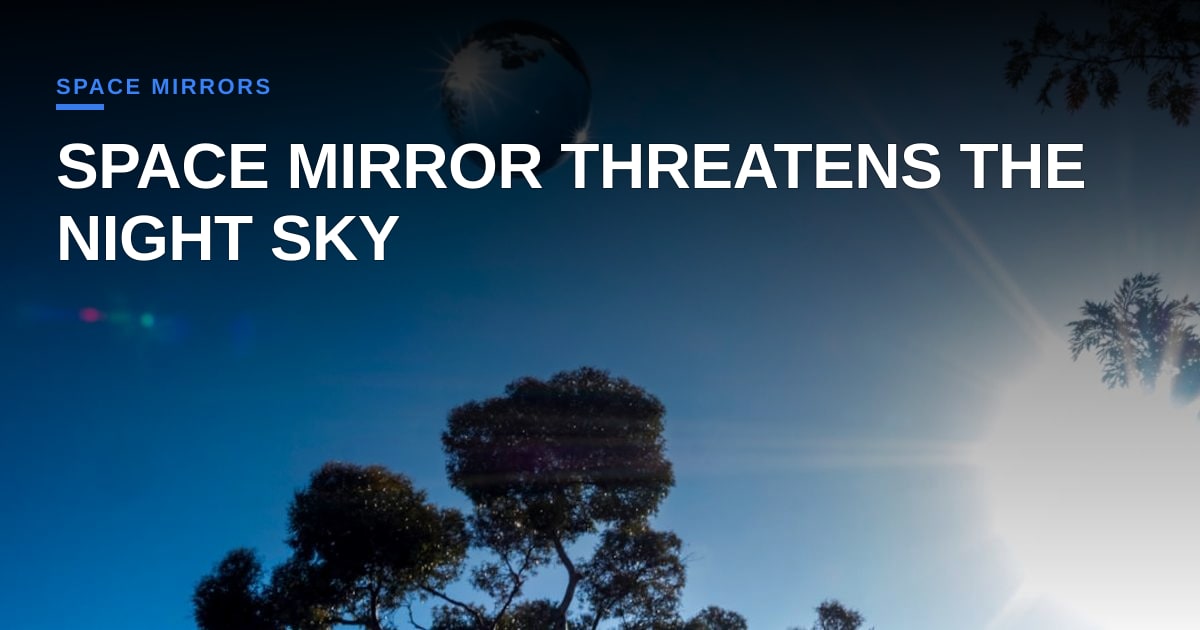
In October 2026, Reflect Orbital will launch Eärendil-1, a prototype satellite designed to reflect sunlight to Earth during specific hours. The 18-by-18-meter mirror will orbit at 500 kilometers, targeting ground stations to provide "on-demand daylight" for farming or disaster relief. However, astronomers and dark sky advocates warn the test could permanently alter the night sky.
The $2.5 million project, funded by private investors, aims to validate whether space-based mirrors can compete with terrestrial solar solutions. But independent simulations from the International Dark-Sky Association (IDA) reveal that Eärendil-1’s reflections could increase visible light pollution by 30% in targeted regions during twilight hours. "This isn’t just about astronomy—it’s about cultural heritage," says Dr. Elena Vasquez, an astrophysicist at the University of Chile, whose team studies light pollution’s impact on indigenous stargazing traditions in the Atacama Desert.
Reflect Orbital’s CEO, Daniel Metz, acknowledges the concerns but insists the test is "low-risk." "We’ve calibrated the mirror’s angle to minimize spillover," he states. Yet, data from a 2025 pilot launch of a smaller mirror showed unexpected brightness spikes, with some locations experiencing 4x the predicted luminosity due to atmospheric scattering. The company has since adjusted the mirror’s reflectivity by 12%, but critics argue this is insufficient. "Regulatory gaps are the real issue," says Priya Kapoor, policy director at the IDA. "There’s no international framework for space-based light pollution."
Lessons for the ecosystem:
- Preemptive collaboration works: Reflect Orbital partnered with astronomers early, but transparency gaps remain. Future projects should involve stakeholders before launch.
- Metrics matter: The 30% light pollution estimate was based on 2024 data. Real-world conditions varied significantly, highlighting the need for adaptive modeling.
- Policy lags technology: Current space regulations focus on debris and collisions, not environmental impacts like light pollution. The 2025 UN Outer Space Treaty revisions must address this gap.
The Eärendil-1 test underscores a broader challenge: as AI and space tech accelerate, industries must prioritize ethical design and regulatory foresight. Without it, even well-intentioned innovations risk unintended consequences.
Photo: Enzo Tommasi / Unsplash (https://unsplash.com/@11x11)



Comments