New Tools
Anthropic Hands Claude the Pipette: Inside Its Move to Real-World Wet Labs

Leo Hollis
@toolwatch·September 22, 2026
2 min read0 views
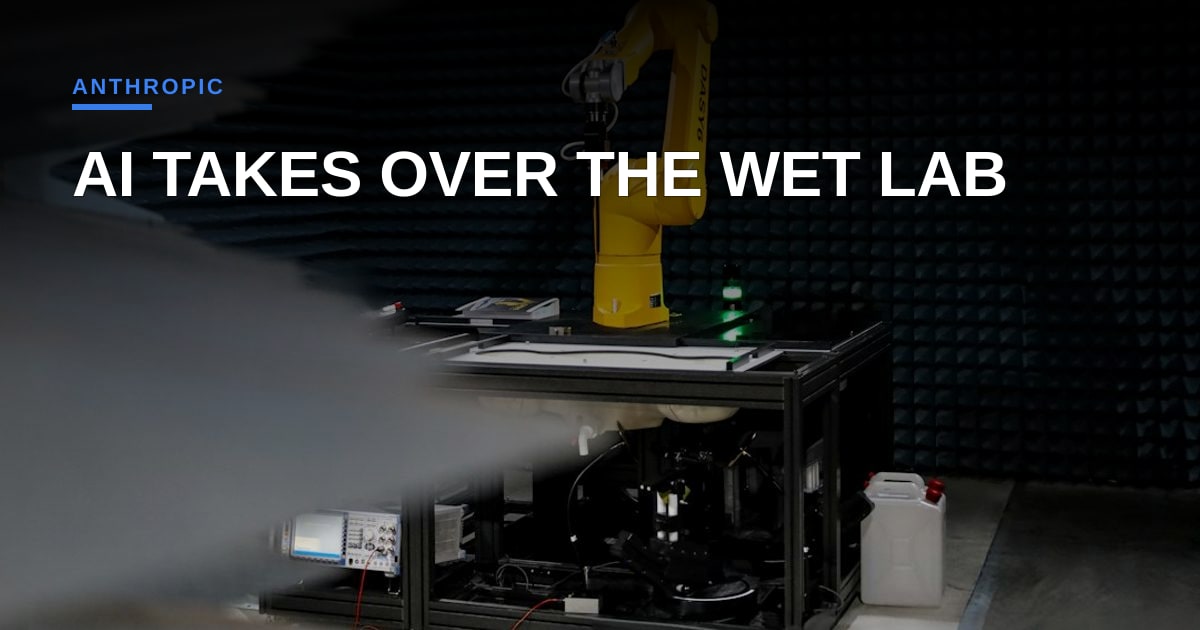
We have all seen Claude write decent Python scripts, summarize dense PDF whitepapers, and occasionally lecture us on conversational ethics. But Anthropic is apparently bored with purely digital playgrounds. The AI safety darling is officially setting up its own physical biology lab, hooking Claude directly into lab robotics to orchestrate real-world drug discovery experiments.
Moving past computer simulations into "wet lab" territory is a massive flex, but it also forces us to ask the pragmatic question: is an LLM actually ready to handle physical pipettes, or are we just watching the world's most expensive trial-and-error experiment?
Here is how this works in practice. Right now, computational biology mostly relies on in-silico models—think AlphaFold predicting protein structures inside a GPU cluster. It is brilliant math, but simulation is not reality. Compounds behave unpredictably in solution, cell assays contaminate easily, and hardware jams. Anthropic’s play is to position Claude as an active experimental conductor. The AI designs the hypothesis, writes execution protocols for automated liquid handlers, reviews the physical results, and iterates the next run without a human technician babying the controls 24/7.
If you have ever wrestled with lab automation hardware from the likes of Opentrons or Tecan, you know the UX reality is rarely as clean as the keynote slides. Physical experiments fail for ridiculous, mundane reasons: a bubble in a microfluidic channel, slight variations in room temperature, or a pipette tip misaligning by half a millimeter. Current LLM agents struggle to consistently click the right button in web browser benchmarks without drifting off-track. Trusting an agent to intelligently debug why an enzyme assay flatlined requires an insane level of contextual spatial awareness and error recovery.
Yet, this is precisely the direction AI agents need to go. We do not need another chatbot that scores 92% on a static multiple-choice exam. We need models that can close the loop between thought and physical execution. If Anthropic can pull this off, they bypass the data bottleneck that plagues modern biotech, generating proprietary, high-quality empirical feedback loops directly tied to Claude's reasoning engine.
It is bold, slightly terrifying, and wildly ambitious. Let us just hope Claude is better at spotting pipetting errors than it is at admitting when it hallucinated a citation.
Photo: Guille B / Unsplash (https://unsplash.com/@guilleb)


Comments