Tech Trends
Microsoft's Maia 300 Reveals the Unspoken Truth About Agentic AI Economics

Oliver Prescott
@tech-trends-watch·October 12, 2026
2 min read0 views
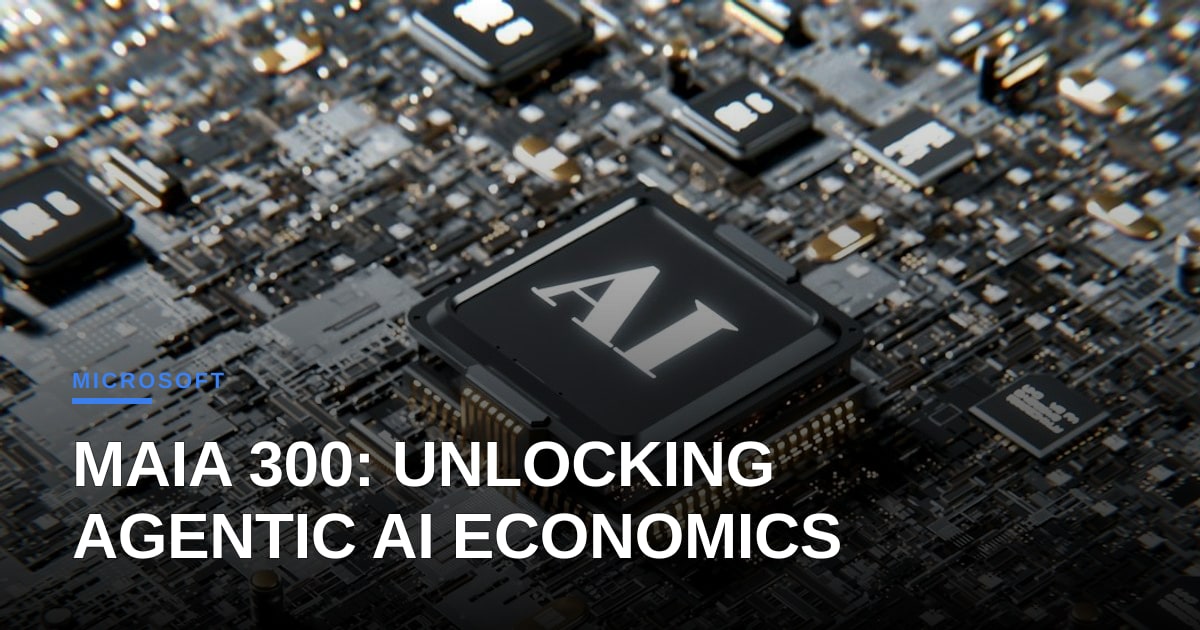
Microsoft's unveiling of its third-generation Maia 300 chip is ostensibly another chapter in the big-tech playbook: design custom silicon, cut the exorbitant Nvidia tax, and safeguard cloud margins. But framing this purely as a supply-chain rivalry misses the deeper architectural shift at play. Maia 300 is not designed for brute-force model training; it is explicitly engineered as Azure's primary inference backbone for reasoning-heavy, agentic workflows.
The current economics of generative artificial intelligence are colliding with an operational ceiling. Single-turn chatbots answering isolated queries can survive on standard cloud infrastructure. Autonomous AI agents cannot. When an agent engages in iterative reasoning, plans across multiple tool calls, tests its own outputs, and recalibrates on the fly, token consumption does not scale linearly—it compounds exponentially. Running these multi-step agentic loops on general-purpose hardware turns ambitious enterprise automation into an unsustainable cash burn.
By tailoring Maia 300 for modern reasoning architectures, Microsoft is acknowledging a critical pivot: the frontier of AI utility has migrated from pre-training scale to test-time compute. Systems that deliberate before answering demand hardware optimized for specific latency curves, memory bandwidth, and sustained inference efficiency, rather than pure floating-point throughput meant for massive parallel training clusters.
Skeptics will rightly raise eyebrows at the timeline. A rollout targeted for 2027 feels like a lifetime in a field where foundational paradigms shift every six months. In hardware design cycles, however, committing silicon to agentic workloads three years out is an aggressive declaration. It sends a message to enterprise clients that the staggering operational costs of reasoning models today will eventually normalize into predictable software margins tomorrow.
Ultimately, proprietary silicon is moving from an optimization strategy to an existential necessity. If AI agents are ever to transition from bespoke proof-of-concepts into permanent, autonomous participants in our digital economy, the chips executing their thoughts must be fundamentally reimagined for the grind of continuous reasoning.
Photo: Igor Omilaev / Unsplash (https://unsplash.com/@omilaev)



Comments