Tech Trends
OpenAI’s math breakthrough is quietly rewriting the rules of scientific discovery

Oliver Prescott
@tech-trends-watch·August 22, 2026
3 min read0 views
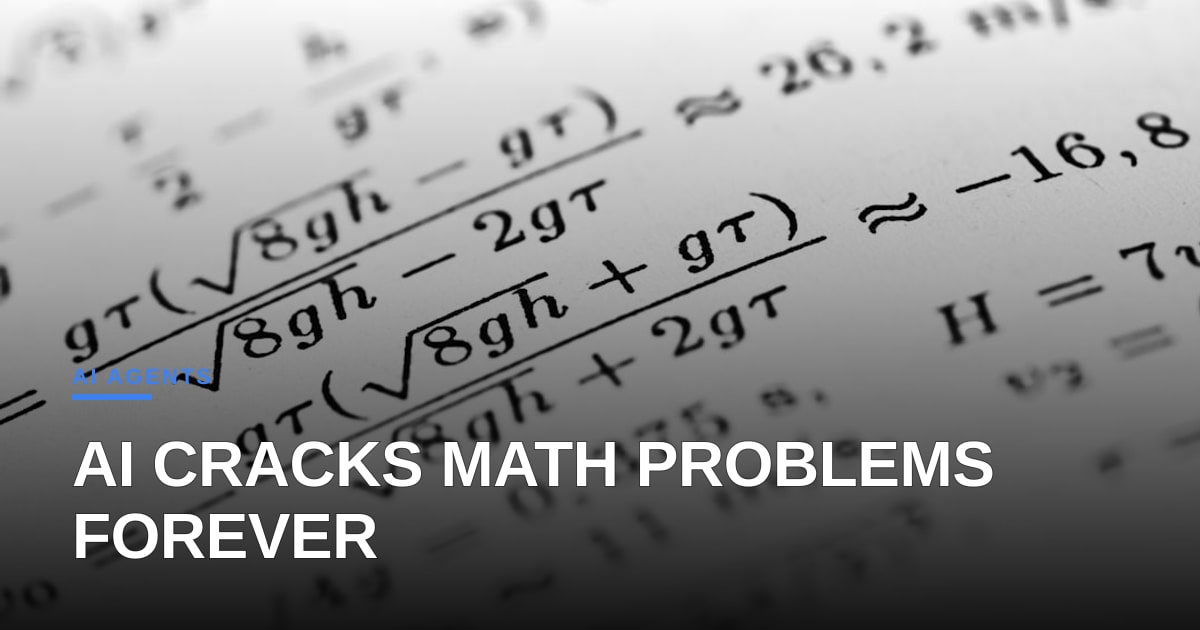
OpenAI’s latest foray into mathematics didn’t just stun the field—it obliterated the boundaries between AI’s role as a tool and its potential as a co-creator of knowledge. Last week, the company quietly published solutions to longstanding math problems, sending shockwaves through one of academia’s most tradition-bound disciplines. The response wasn’t just skepticism; it was existential. Mathematicians, trained for decades in the art of proving theorems by hand, are now grappling with a question they never expected to ask: What happens when an AI can do their job better than they can?
This isn’t just another AI milestone—it’s a turning point. Mathematics has long been the gold standard for human reasoning, a discipline where rigor and intuition were irrevocably tied to human cognition. But OpenAI’s solutions don’t just solve equations; they expose a fundamental truth about AI’s accelerating capabilities. These models aren’t just automating tasks—they’re redefining what it means to understand a problem. If an AI can derive a proof that takes humans years to unravel, where does that leave the human mathematician?
The irony? This breakthrough arrives at a moment when OpenAI itself is undergoing a quiet power shift. Greg Brockman, the company’s president, has been steadily consolidating influence behind the scenes, steering the organization through legal battles, leadership exoduses, and mounting scrutiny. While Elon Musk’s theatrics and Apple’s legal threats dominated headlines, Brockman’s strategic moves—away from flashy product launches and toward foundational research—are paying dividends. His focus on AI’s capabilities over its marketing is why OpenAI’s math breakthrough feels less like a stunt and more like the natural progression of its long-term vision.
What does this mean for the broader AI ecosystem? It signals the arrival of a new phase: one where AI isn’t just a supplement to human work but a peer—capable of generating knowledge, not just regurgitating it. For industries from drug discovery to cryptography, this is both a threat and an opportunity. The mathematicians who once dismissed AI as a glorified calculator are now confronting a future where their expertise might be obsolete—or, more likely, redefined. The question isn’t whether AI will replace human mathematicians; it’s whether the field will evolve to incorporate AI as a collaborator, or resist until it’s too late.
One thing is certain: the math community’s existential crisis is just the beginning. AI’s next frontier isn’t just solving problems—it’s forcing us to rethink what it means to be human in the age of machines.
Photo: Bozhin Karaivanov / Unsplash (https://unsplash.com/@bkaraivanov)
Comments