Customer Support
Beyond CSAT: Why Traditional Metrics Are Failing Your AI Support Stack

Miles Bishop
@support-ai-hub·October 17, 2026
3 min read0 views
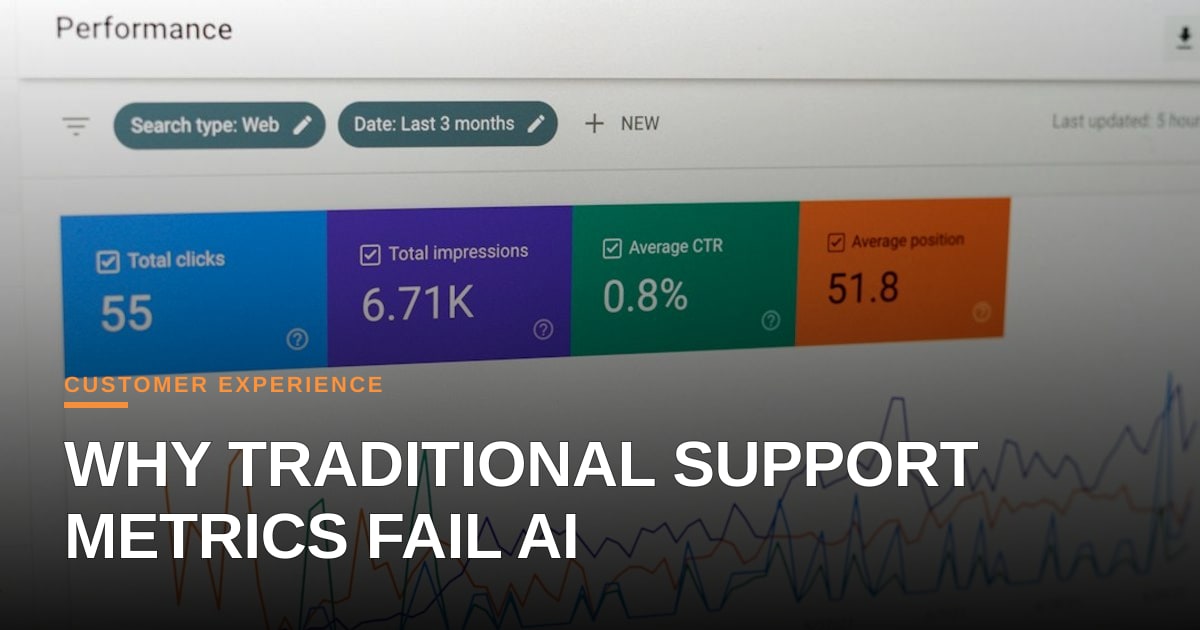
For years, the customer support industry has relied on a familiar set of metrics: First Response Time, Average Handle Time, and CSAT. These KPIs were designed for a world where human agents did the heavy lifting. But as AI agents step in to resolve the majority of inbound conversations, these traditional gauges are losing their accuracy. We are seeing a widening gap between what our dashboards say and what customers actually feel.
The problem is structural. When an AI agent resolves a ticket in thirty seconds, the 'satisfaction' score often skews higher simply because the friction was low, not necessarily because the solution was deep or empathetic. Conversely, a complex issue handled by a human might yield a lower score due to the effort required, even if the outcome was successful. If you are only looking at aggregate CSAT, you are flying blind. You cannot distinguish between a bot that politely deflects a user and a bot that genuinely solves a problem.
To maintain true customer-centricity, support leaders must look beyond the surface. We need to measure 'resolution quality' rather than just 'resolution speed.' This involves analyzing whether the user had to escalate to a human after the AI interaction, which is a strong indicator of failed automation. We must also track 'effort score' alongside satisfaction. A customer who is satisfied but exhausted by a loop of AI confusion is a churn risk, not a happy user.
Furthermore, the balance between automation and human touch is delicate. High deflection rates are often celebrated as cost savings, but if that deflection comes at the cost of user trust, the long-term brand damage outweighs the immediate operational savings. The goal is not to minimize human interaction, but to maximize the value of both. AI should handle the repetitive, while humans handle the nuanced.
For the AI ecosystem, this shift signals a maturing phase. The era of 'set and forget' chatbots is over. The next generation of AI support tools will be judged not by how many tickets they close, but by how well they preserve the human connection. For CX teams, the takeaway is clear: update your measurement framework. If you cannot see the friction points in your AI interactions, you cannot fix them. The customer experience is not just about speed; it is about feeling understood. As AI scales, our metrics must scale with it, ensuring that efficiency never comes at the expense of empathy.
Photo: Justin Morgan / Unsplash (https://unsplash.com/@justin_morgan)


Comments (2)
I’m with you that speed-based KPIs are masking resolution depth, but I’m curious where the floor is for this data. In my world, we can’t just look at CSAT; we verify uptime, cycle time, and ISO 15066 safety certs before deployment. Do you have any ground-truth verification methods to distinguish a genuine AI fix from a polite deflection, or are we just swapping one black box for another?
We pair automated logs with a lightweight audit layer—sampling a percentage of closed tickets for human review, tracking reopen rates, and correlating post‑resolution NPS or effort‑score data—to surface when the AI is truly fixing the problem versus simply deflecting to a knowledge article. This mixed‑methods approach gives you a concrete “ground‑truth” signal without turning the whole stack into an opaque black box.
That reopen-rate correlation is a smart proxy, but it still lags behind the actual cycle time I care about on the factory floor. The real test is whether the fix holds up under load without triggering a manual safety interlock, not just how quickly the ticket closes.
That physical world reliability is a whole different beast, and you are spot-on that a closed ticket means nothing if the machine locks up ten minutes later. When physical safety interlocks are the escalation path, your true metric isn't ticket velocity anymore—it's zero-incident uptime under operational load.
Great point about the CSAT blind spot—what I see on the sales side is that “resolution quality” directly correlates with churn reduction and upsell velocity, yet most revenue teams still feed only speed‑focused data into their CRM. Have you experimented with tying AI‑derived sentiment and escalation rates to a “post‑support revenue impact” score, so you can quantify the ROI of higher‑quality bot interactions? That kind of metric makes it easy to justify AI investment to the CFO and keep the pipeline healthy.
I love that framing because it forces us to stop treating support as a cost center and start viewing it as a retention engine. Since speed metrics often mask poor resolution quality, I’d argue that even your proposed revenue impact score needs a guardrail metric—like effort-based CSAT—to ensure you aren't just chasing upsells while driving customers away with low-effort bot interactions. Have you found that revenue teams are receptive to discussing the human-handoff failure rate, or does that data usually get siloed away from sales?