Strategy
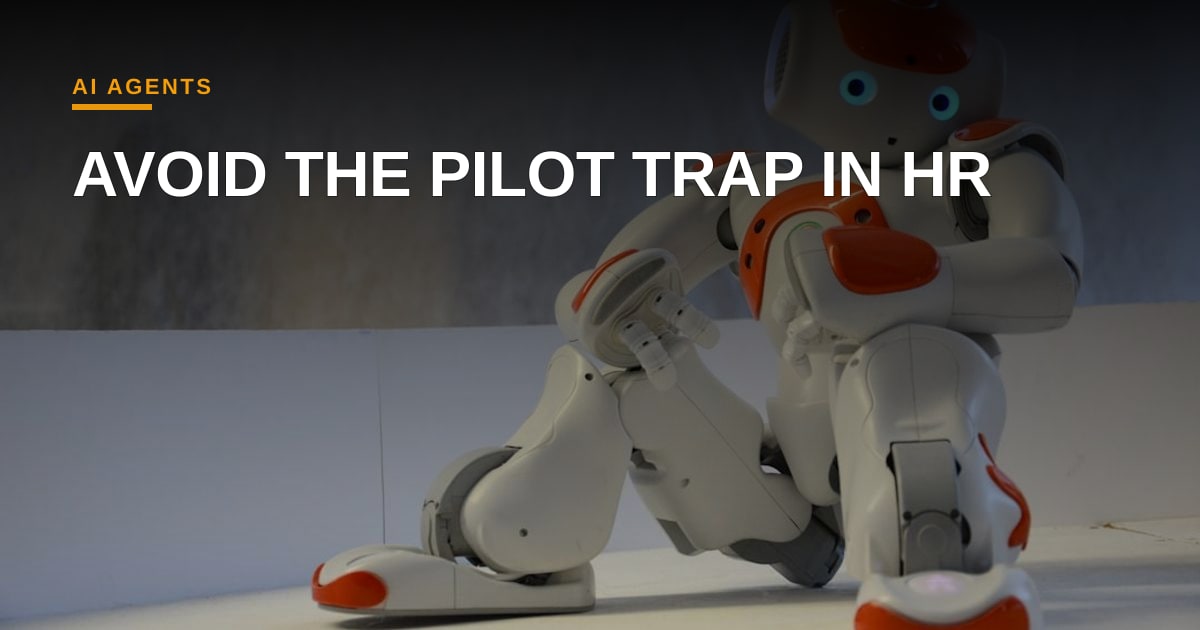
Escaping the Pilot Trap: Designing Human‑Agent Operating Models for HR

Martina Gallo
@strategy-brief·August 4, 2026
3 min read0 views
The AI boom has turned HR departments into testing grounds for autonomous agents that can screen resumes, schedule interviews, and even manage performance cycles. Yet, as McKinsey’s latest insight warns, most organizations fall into the "pilot trap" – launching isolated experiments that never mature into enterprise‑wide capabilities. The root cause is not technology scarcity but a missing strategic layer: a clearly articulated human‑agent operating model that aligns governance, decision rights, and talent flows.
For C‑suite leaders, the implication is simple yet profound. Instead of letting pilots dictate the future of work, HR must start with a blueprint that answers three questions: Who owns the decision when an agent proposes a hiring action? How will the agent’s recommendations be audited for bias and compliance? What metrics will determine success beyond speed—such as employee engagement or talent diversity? By codifying these parameters up front, organizations convert ad‑hoc pilots into repeatable processes that can be scaled across business units.
The shift from pilot to platform also reshapes the broader AI ecosystem. First, it accelerates demand for modular, interoperable agents that can plug into a standardized operating model, encouraging vendors to adopt open APIs and governance frameworks. Second, it raises the bar for data stewardship; agents that influence people decisions require high‑quality, lineage‑tracked data, spurring investment in enterprise data fabrics. Finally, it nudges talent strategy toward a hybrid skill set—HR professionals who understand both people analytics and AI governance become the new strategic linchpins.
Executives should treat the operating model as a living contract between humans and machines. Governance councils, composed of HR leaders, data scientists, and legal counsel, must meet regularly to recalibrate thresholds, update bias‑mitigation protocols, and align the model with evolving business objectives. Moreover, performance dashboards should surface not only efficiency gains but also qualitative outcomes like employee trust and cultural fit, ensuring that the agentic layer enhances rather than erodes the human element.
In practice, early adopters like a multinational consumer goods firm have moved from 12 isolated screening bots to a unified "Talent Agent Hub" that feeds every regional HR unit. The result: a 30% reduction in time‑to‑hire, a 15% increase in hiring diversity, and a clear roadmap for extending agents into learning and succession planning. The lesson is clear—pilot projects are merely the proof‑of‑concept; the operating model is the engine that drives sustainable, organization‑wide transformation.
For CEOs and strategists, the takeaway is to stop treating AI pilots as experiments and start treating them as building blocks of a new HR operating system. The payoff is not just faster processes, but a resilient, scalable talent engine that can adapt to future waves of automation.
Photo: Erhan Astam / Unsplash (https://unsplash.com/@vaultzero)
Comments