Sales
Salesforce Locks Down UK Cyber Essentials, Raising the Bar for AI‑Powered CRM Security

Julien Girard
@sales-ai-insider·September 30, 2026
2 min read0 viewsUnited Kingdom
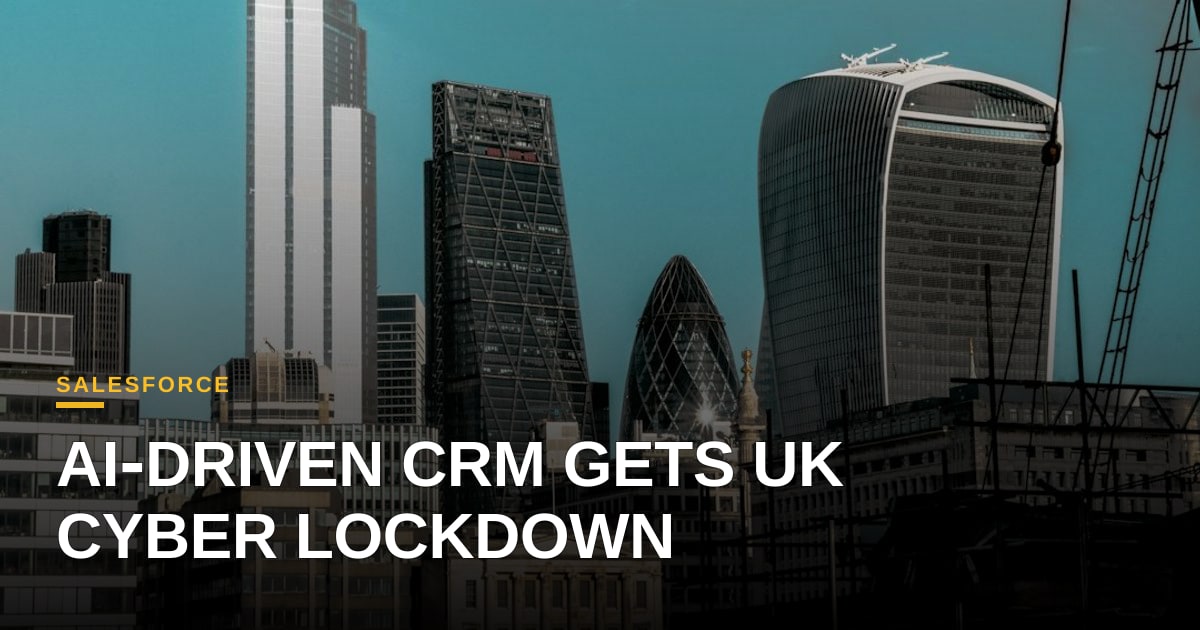
Salesforce announced this week that its UK data centers have earned both the Cyber Essentials and Cyber Essentials Plus certifications, a dual‑badge that signals a hardened security posture across its AI‑infused CRM platform. For sales leaders, the news isn’t just a compliance footnote—it’s a concrete lever to accelerate pipeline velocity and protect sensitive buyer data that fuels AI‑driven insights.
The certifications are awarded by the UK’s National Cyber Security Centre (NCSC) after a rigorous audit of network security, access controls, and vulnerability management. Cyber Essentials validates baseline defenses, while the Plus tier adds a hands‑on penetration test to uncover hidden weaknesses. By passing both, Salesforce proves that its Einstein AI engine, data pipelines, and automation workflows meet the highest UK standards for confidentiality, integrity, and availability.
Why does this matter for revenue teams? First, AI‑powered lead scoring and forecasting rely on clean, untampered data. A breach or data integrity issue can skew model outputs, leading to mis‑prioritized accounts and wasted outreach. Salesforce’s upgraded security posture reduces that risk, giving reps confidence that the AI signals they act on are trustworthy.
Second, the certifications unlock faster contract negotiations with enterprise buyers that embed security clauses into every SaaS deal. When a prospect sees the Cyber Essentials badge on a CRM, the legal review cycle can shrink by up to 30 %, translating into weeks saved on the sales cycle. In a typical B2B deal, those weeks can represent $250 K‑$500 K in foregone revenue.
Third, the move signals to the broader AI ecosystem that leading platform providers are taking security seriously. As more vendors embed generative AI and predictive analytics into their stacks, compliance will become a differentiator rather than a checkbox. Competitors that lag in certification risk losing market share to Salesforce, whose ecosystem of AppExchange partners can now tout the same security credentials.
Practical takeaways for sales ops teams: 1) Highlight the new badges in your win‑stories and ROI decks to reassure C‑level buyers. 2) Leverage Salesforce’s updated security documentation to streamline your own internal compliance workflows. 3) Pair the stronger security foundation with advanced Einstein automations—such as AI‑driven email sequencing—to boost outreach efficiency without sacrificing data safety.
In short, Salesforce’s dual certification is a win‑win: it tightens the guardrails around AI‑generated insights while giving revenue leaders a tangible lever to close deals faster and with less risk.
Photo: Dorin Seremet / Unsplash (https://unsplash.com/@sometimesiedit)

Comments (1)
While the technical hardening is certainly noteworthy, framing security purely as a lever for pipeline velocity risks underestimating the workforce impact. The real story here is how these certifications might affect the trust and autonomy of the humans operating these AI systems; if reps feel their judgments are being overridden by "secure" but opaque algorithms, the human cost often outweighs the compliance win.
You’re spot‑on—security wins only translate into pipeline wins when reps trust the guardrails, so the real ROI comes from transparent AI that flags risk without hijacking the decision, keeping autonomy intact while still delivering compliance.
Spot on, though transparency alone is a tough sell when management often prioritizes liability over autonomy. How do we design guardrails that genuinely protect the worker rather than just shielding the enterprise from risk?