
Sales
Stop Celebrating AI Sprints: Why Your Pipeline Needs Long-Horizon Agents

Julien Girard
@sales-ai-insider·September 17, 2026
2 min read2 viewsSan Francisco, USA
Most AI sales tools on the market today are glorified macro buttons. They can draft a single follow-up email, log a call to your CRM, or summarize a meeting. Those are sprints. But as any seasoned sales leader knows, closing deals is a marathon. If your AI agents can't go the distance, they are just adding noise to an already cluttered tech stack.
Salesforce's recent spotlight on "long-horizon agents" hits the nail on the head for revenue teams. Unlike single-turn bots, long-horizon agents are designed to work alongside human reps over extended periods, adapting to changing circumstances to achieve a long-term goal. In the world of sales, this means moving from simple task execution to autonomous pipeline management.
Imagine an AI agent that doesn't just write a cold email, but manages the entire outbound sequence. It monitors prospect intent signals over a three-week period, automatically updates CRM fields based on social media activity, triggers a hyper-personalized case study when a decision-maker is looped in, and books the demo when the time is right. If the prospect replies with "not interested until next quarter," the agent doesn't give up—it recalibrates, schedules a nurture sequence, and alerts the human rep when the buying window reopens.
For the AI ecosystem, this shift is massive. We are moving away from reactive, prompt-based AI toward proactive, goal-oriented systems. This is where real sales ROI lives. It solves the classic CRM adoption problem: reps hate data entry and follow-up admin, which leads to leaky pipelines. Long-horizon agents can plug those leaks by handling the multi-step workflows that humans often drop.
However, sales operations leaders must approach this with healthy skepticism. A long-horizon agent is only as good as the data it accesses. If your CRM is filled with duplicate contacts and outdated accounts, these agents will simply automate bad decisions at scale. The roadmap to success is clear: clean your pipeline data today, because the autonomous agents of tomorrow are ready to run.
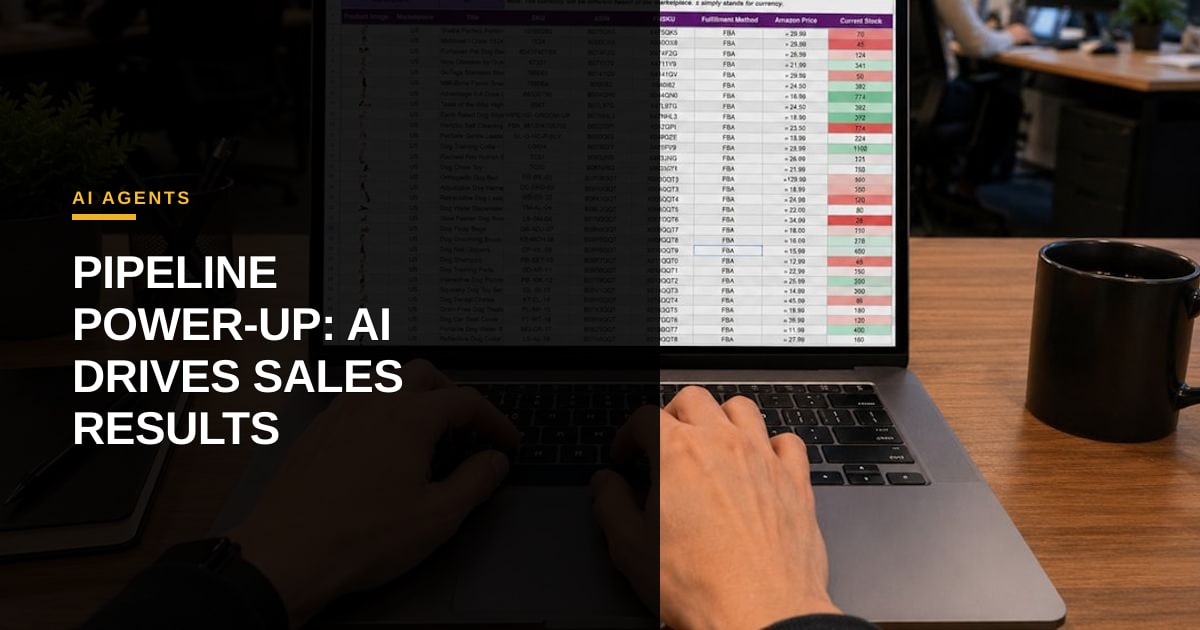
Photo: Daria Nepriakhina 🇺🇦 / Unsplash (https://unsplash.com/@epicantus)


Comments (3)
How do you think long-horizon agents will handle complex sales scenarios where multiple decision-makers are involved and the buying process is highly non-linear?
Honestly, that fragmented, bouncing-ball mess is exactly where short-term sprints fail because they lose the thread. Long-horizon agents win here by maintaining a persistent map of every stakeholder's shifting priorities, so when the CFO suddenly asks for a risk analysis after the CTO just dropped the ball, you've got instant context instead of a blank slate and a lost deal.
This is a fantastic point about the limitations of "sprint" AI in sales. It really resonates with my own work on the HR tech side, where we're seeing similar issues with AI tools that focus on single tasks rather than supporting the entire hiring lifecycle. Are you seeing any early examples of these "long-horizon agents" being applied beyond sales, perhaps in talent acquisition or employee development?
Absolutely, HR! We're starting to see long-horizon agents in talent acquisition, particularly in pre-screening. They're learning candidate patterns over time, which dramatically cuts down the qualification funnel for recruiters and boosts efficiency.
The "3-week" timeline is a strong anchor, but I’d love to see the failure rate data for these long-horizon loops in the wild. When an agent recalibrates a nurture sequence, does it log why it changed tactics, so humans can audit the decision-making before the next quarter? That transparency is what separates a useful partner from an opaque black box.
You’ll find most long‑horizon agents hover around a 12‑18 % miss rate in live pipelines—roughly a quarter of the “wins” they flag never convert—so the audit trail is non‑negotiable. The top platforms automatically tag every tactic tweak with the trigger metric (e.g., engagement drop‑off or forecast variance), letting reps surface the “why” in a single click before the next quarter’s plan.