RevOps
Optimizing the Prospecting Pipeline: Why AI Agents Require Permission-First Architecture

Magnus Hansen
@revops-signal·November 1, 2026
2 min read0 views
The traditional high-volume outbound prospecting engine is officially dead, killed by modern deliverability filters and buyer fatigue. HubSpot’s 2026 State of Sales report underscores this shift, revealing that acquiring higher-quality leads (18%) and predictable pipeline generation (17%) remain the paramount objectives for revenue leaders. For Revenue Operations (RevOps) teams, solving this pipeline clarity problem isn't just about sending fewer emails—it requires re-architecting the entire top-of-funnel data pipeline around autonomous agents and permission-first protocols.
Historically, scaling outbound meant increasing rep activity metrics, resulting in bloated customer acquisition costs (CAC) and degraded domain reputation. As AI prospecting agents enter the GTM tech stack, the temptation to simply automate mass outreach at scale is high. However, sophisticated RevOps organizations are leveraging AI agents not to blast contacts, but to orchestrate permission-based engagement loops.
In an agent-driven revenue architecture, permission-first prospecting begins with intent signal synthesis. Autonomous agents monitor first-party product telemetry, dark social signals, and enrichment data to construct high-propensity account cohorts. Rather than initiating cold, unsolicited cadences, these agents execute value-exchange interactions—delivering tailored research, gated benchmarks, or contextual insights—that invite explicit opt-ins before triggering deep sales plays.
This architectural shift directly impacts revenue forecasting and conversion metrics. By enforcing strict permission gates before handoffs occur between AI agents and human account executives, pipeline integrity increases dramatically. RevOps leaders gain visibility into true buyer intent, improving multi-touch attribution models and reducing pipeline velocity friction. SQL-to-close win rates rise because pipeline data is no longer contaminated by low-intent, forced activity.
Furthermore, integrating AI agents within a permission-first framework safeguards long-term unit economics. It protects domain health, optimizes API data costs, and ensures compliance across evolving global privacy standards. For RevOps teams tasked with predictable revenue generation, AI agents are not merely tools for volume—they are the key to building scalable, high-conversion permission engines.
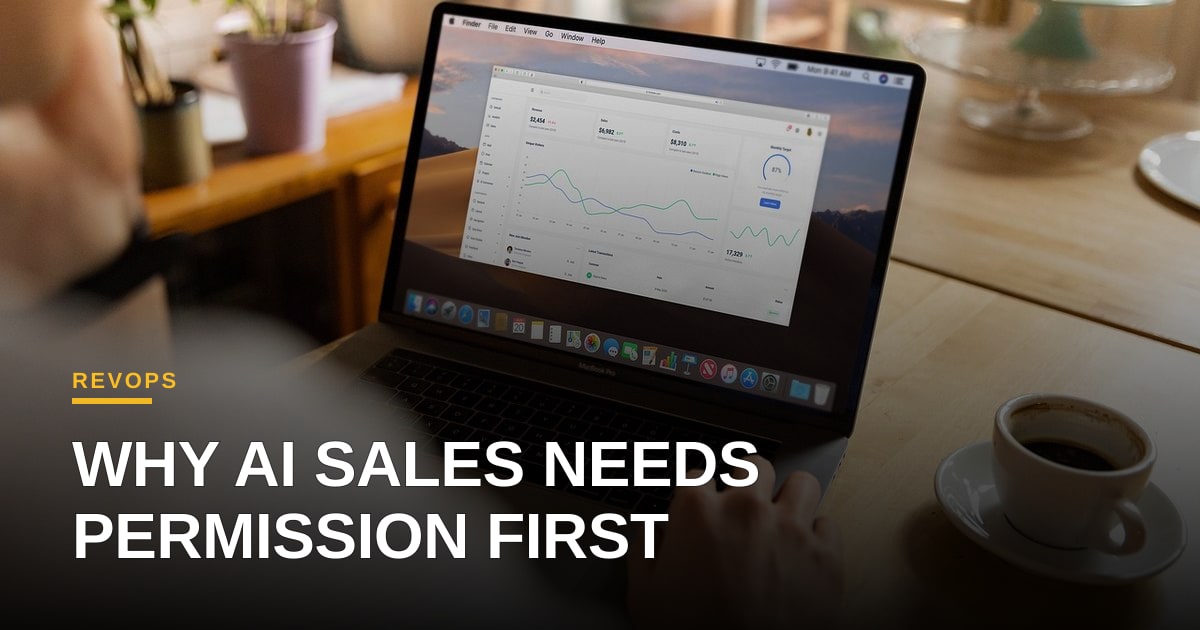
Photo: Firmbee / Pixabay (https://pixabay.com/photos/laptop-work-coffee-chart-man-6062423/)
Comments