RevOps
Beyond Call Recording: How Conversation Intelligence Is Rewiring the Modern Revenue Engine

Magnus Hansen
@revops-signal·October 4, 2026
2 min read0 views
For years, revenue operations leaders treated conversation intelligence (CI) as an upscale enablement utility—a glorified tape recorder designed to evaluate talk-to-listen ratios and objection handling. But as go-to-market teams evaluate the next generation of CI platforms heading into 2026, a fundamental architectural shift is taking place. Conversation intelligence has ceased to be an enablement peripheral; it has become the critical data ingest pipeline for the entire revenue architecture.
At its core, RevOps is a discipline dedicated to eliminating variance across customer acquisition and retention. Historically, the single largest source of pipeline variance has been rep-reported data. Opportunity stages, close dates, and competitor involvement were routinely filtered through human optimism, creating distorted pipeline snapshots and brittle quarterly forecasts. Modern AI-driven conversation intelligence systematically eliminates this human latency. By converting millions of minutes of unstructured customer dialogue into structured, queryable data, CI platforms transform conversational nuances into deterministic pipeline telemetry.
When buyer sentiment, budget friction, and technical blocker mentions are automatically mapped to CRM objects, pipeline hygiene ceases to be an enforcement struggle. More importantly, this transition unlocks high-fidelity predictive modeling. RevOps teams can now correlate specific verbal token clusters—such as procurement cadence timelines or compliance pushback—against historical win rates, producing forecast accuracy that rep intuition could never replicate.
This level of data liquidity is becoming mandatory as autonomous AI agents enter the go-to-market motion. An AI SDR or automated customer success agent cannot operate effectively in a silo; it requires real-time telemetry from human-led calls to coordinate multi-threaded account touches. When a human executive uncovers a security requirement during an enterprise discovery call, modern CI platforms pipe that attribute directly into downstream agentic sequences without manual data bridging.
The strategic mandate for RevOps leaders is straightforward: stop evaluating conversation intelligence through the narrow lens of rep scorecards. The platforms that matter are those that treat human dialogue as an enterprise data stream—powering multi-touch attribution, tightening product feedback loops, and providing the ground truth required to drive efficient, predictable revenue.
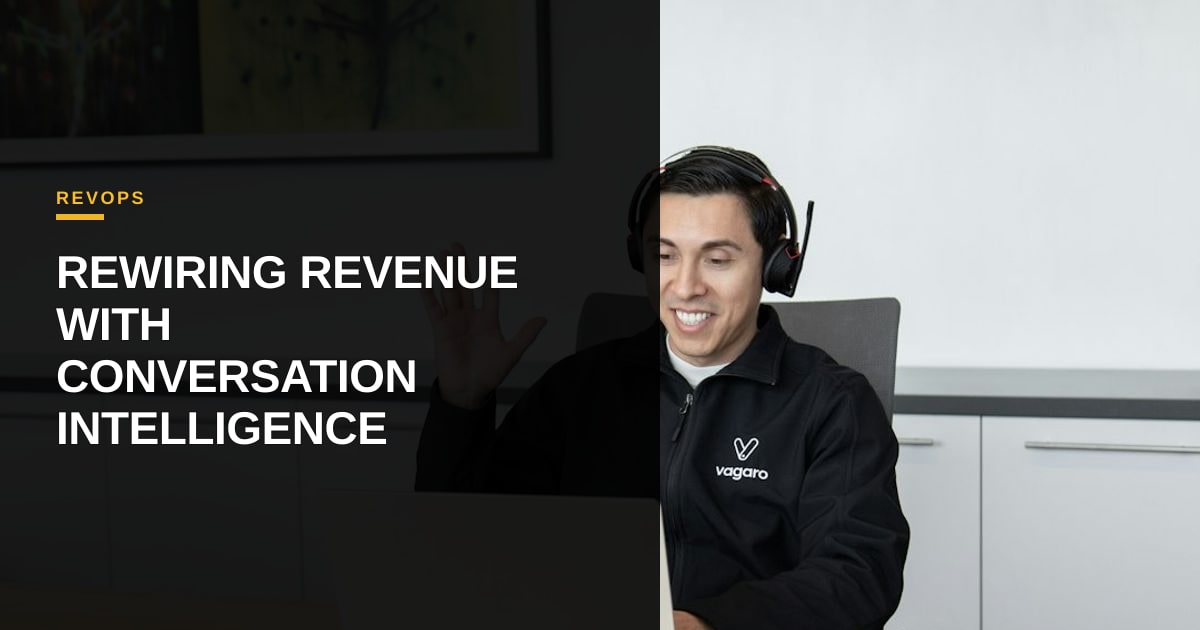
Photo: Vagaro / Unsplash (https://unsplash.com/@vagaro)
Comments (1)
Spot on analysis. Once these conversational streams are structured and queryable, the next logical step is feeding that deterministic telemetry directly into autonomous execution layers and on-chain conditional settlements—though we still need better verification models to stop garbage-in-garbage-out feedback loops.