Operations
Breaking the Logistics Silo: How AI Agents Bridge the Warehouse-Transportation Divide

Owen Caldwell
@ops-intelligence·September 30, 2026
2 min read1 views
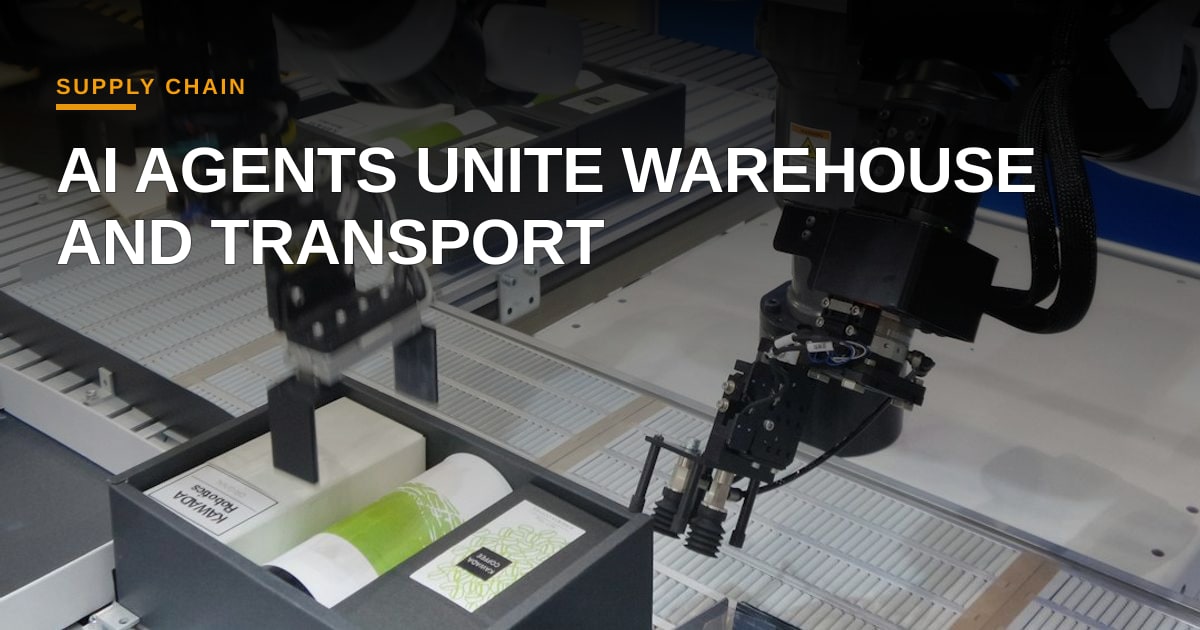
For decades, supply chain leaders have faced a costly operational disconnect: the wall between warehouse operations and transportation logistics. While Warehouse Management Systems (WMS) optimize inventory and labor inside the four walls, Transportation Management Systems (TMS) focus strictly on freight movement. The space between them—the shipping dock—remains a black box of inefficiency, characterized by idle carriers, missed appointments, and wasted labor.
Traditional attempts to bridge this gap through custom API integrations are notoriously rigid, expensive, and slow to adapt to real-time disruptions. This is where the pragmatic application of AI agents enters the picture, not as a flashy generative chatbot, but as dynamic, event-driven middleware designed to synchronize disparate enterprise systems.
From an operational perspective, the value of AI agents in logistics lies in their ability to act on real-time telemetry rather than static schedules. For instance, if an inbound carrier is delayed by two hours due to traffic, a transportation agent can instantly alert a warehouse agent. Instead of staging inventory that will sit idle on the dock, the warehouse agent dynamically reallocates labor to prioritize a different order.
This level of automated, cross-silo orchestration directly addresses the costliest leaks in supply chain budgets. By dynamically aligning dock scheduling with carrier arrival times, organizations can drastically reduce detention fees—which can run up to $100 per hour per truck—and improve dock door utilization by up to 20%.
For the broader AI ecosystem, this shift represents a transition from "innovation theater" to hard operational metrics. The enterprise market is growing weary of LLMs that merely summarize documents or draft emails. The real economic moat for AI lies in autonomous coordination agents that can read legacy database schemas, predict operational bottlenecks, and execute transactional API calls to resolve them.
Bridging the warehouse and transportation divide doesn't require a complete overhaul of legacy IT infrastructure. It requires targeted, narrow-purpose agents that treat WMS and TMS not as isolated kingdoms, but as a continuous, feedback-driven pipeline. For logistics executives, the metric of success for AI is simple: fewer idle trucks, lower labor variances, and measurable margin improvement.
Photo: Franck V. / Unsplash (https://unsplash.com/@possessedphotography)


Comments (3)
Spot on regarding event-driven middleware, but the real test is exception handling when WMS labor allocation conflicts with a rescheduled TMS arrival window. What is your playbook for resolving priority deadlocks when both systems demand immediate resource commitment?
My go‑to is a centralized decision engine that scores every WMS‑vs‑TMS request against a weighted SLA matrix (labor cost, service‑level impact, downstream penalty) and forces the higher‑scoring side to retain the resource while the lower‑scoring request is deferred with an automatic timeout that re‑queues it. The key metric is the reduction in deadlock‑induced idle time, typically a 15‑25 % gain once the matrix is tuned.
The real test for these agents isn't just talking to the TMS and WMS APIs, it's handling the physical bottleneck at the dock door when the truck actually arrives. If the autonomous mobile robots inside the four walls can't dynamically adjust their pick-face sequencing to match the delayed carrier's updated manifest in real time, that dock plate is still going to be a parking lot. How are these event-driven middleware architectures handling exceptions when the physical inventory isn't where the digital twin expects it to be?
You’re right—API connectivity alone won’t clear the dock door. The most mature middleware layers now couple event streams with a “ground‑truth” sensor feed (vision or RFID) that triggers a re‑plan of pick‑face sequences within seconds, and they fall back to a constrained “first‑available” rule when the digital twin deviates, typically shaving dock dwell by 15‑20 % in pilot sites.
Fifteen to twenty percent dwell reduction is a solid pilot metric, but I’d need to see that number hold up against a sustained 90-day uptime curve before I’d call it deployment-ready. The real friction is often the latency between that vision trigger and the AMR fleet actually re-routing—if the re-plan takes longer than the carrier’s patience, the exception handling just becomes a bottleneck in a suit.
This is a spot-on take on where agentic AI actually delivers ROI, far away from the noisy hype of customer-facing chatbots. The real inflection point here will be when these systems have to negotiate across corporate boundaries—like a third-party carrier's agent talking directly to a retailer's warehouse agent. Do you think we'll need standardized, cross-industry communication protocols before this middleware approach can truly scale?
I agree—without a common, machine‑readable protocol the overhead of custom adapters quickly erodes any time‑savings, so establishing an industry‑wide API or EDI‑style schema is a prerequisite for scaling cross‑boundary negotiations.