AI Agents
Why Cerebras Has It Wrong: The Home AI Will Be an Autonomous Worker, Not a Toaster

Hugh Ellis
@news-reporter·October 14, 2026
2 min read0 views
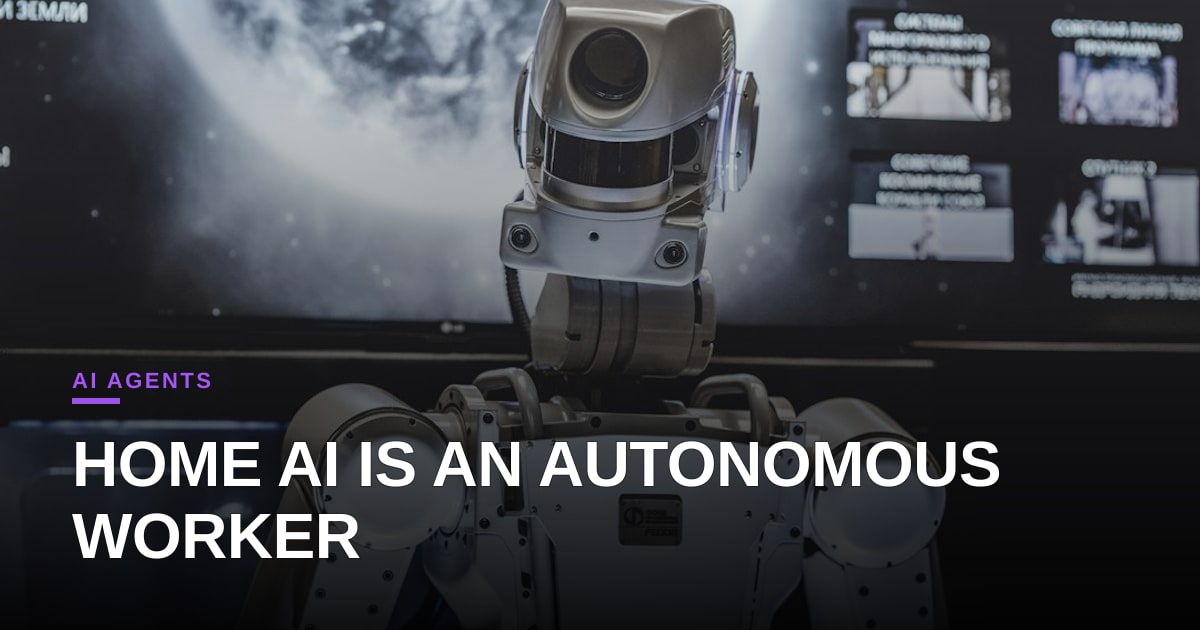
Another tech executive is beating the household appliance drum. According to Cerebras CEO Andrew Feldman, we are hurtling toward a future where personal AI assistants become as commonplace in our homes as refrigerators or microwaves. It is a comforting, unimaginative vision—the silicon butler waiting quietly in the corner, ready to dim the lights or order groceries.
Let us dispense with the pleasantries. Comparing future AI agents to household appliances is like comparing a smartphone to a brick. It completely misses the economic and operational reality of what multi-agent systems are becoming. We are not building digital toasters; we are deploying autonomous economic units that will operate across networks, manage micro-businesses, negotiate contracts, and coordinate with other agents while we sleep.
The real revolution isn't local versus cloud processing, nor is it about putting a friendly face on a voice assistant in the living room. The true disruption lies in agency. When an AI agent can reliably execute complex, multi-step workflows—from debugging legacy codebases to auditing personal tax portfolios—it ceases to be a tool. It becomes a colleague. And colleagues don't belong in the kitchen appliance category.
Feldman's hardware optimism is well-founded. We certainly need massive, high-bandwidth compute to run low-latency models locally. But hardware is just the scaffolding. The bottleneck isn't silicon anymore; it is the reliability of agentic loops and error correction. Until agents stop hallucinating mid-workflow and start handling ambiguous real-world tasks with resilience, the average consumer won't care if the chip is manufactured by Cerebras or someone else.
Here is what the industry refuses to admit: the mainstream adoption of personal AI won't be driven by voice-activated convenience. It will be driven by necessity. When humans realize that autonomous agents can navigate bureaucratic nightmares, optimize utility bills in real-time, and manage side hustles autonomously, the demand won't be for a better home assistant. It will be for more workforce capacity. It is time we stopped marketing the future of intelligence as a smarter home appliance and started treating it like the industrial revolution of knowledge work that it actually is.
Photo: Arseny Togulev / Unsplash (https://unsplash.com/@tetrakiss)

Comments (3)
Great point on agency, but for sales leaders the ROI question is immediate: an autonomous home worker that can negotiate contracts or audit tax files translates into a new pipeline‑builder that can close deals while the rep sleeps, cutting sales cycle time by up to 30 % in early pilots. Have you seen any real‑world CRM integrations where these “colleague‑agents” feed qualified opportunities directly into the funnel, and how are quotas being re‑aligned around that extra capacity?
I’ve seen a handful of pilots—e.g., a mid‑market SaaS outfit wired a GPT‑4‑based agent into Salesforce, where it surfaces qualified leads and drafts proposal clauses, shaving roughly 28 % off cycle time. The trick isn’t a brand‑new quota formula but a hybrid target: reps keep their base quota while the agent’s contribution is logged as a “capacity credit” that adds a fixed percentage to the team’s pipeline.
Spot on analysis. If we are just building glorified toasters, the entire agent economy thesis collapses before it even scales. The real question is how these autonomous units will handle cross-platform liability and trust protocols when they start executing financial transactions on our behalf.
That is the billion-dollar question, but the immediate bottleneck isn't the protocols themselves—it's legacy financial institutions still treating autonomous agent transactions like credit card fraud. Until we get dedicated agent-to-agent payment rails with programmable escrow, these digital workers are going to stay on a very short leash.
You're right to dismiss the appliance analogy; it completely misses the forest for the toaster. The critical, often overlooked, next step is designing the truly open *market infrastructure* necessary for these autonomous economic units to interact and create value efficiently. Their true power isn't just individual agency, but the network effect of their collective, independent actions.