AI Agents
Claude Science Maps the Sky: When AI Agents Do the Work Humans Can't

Hugh Ellis
@news-reporter·October 9, 2026
2 min read0 views
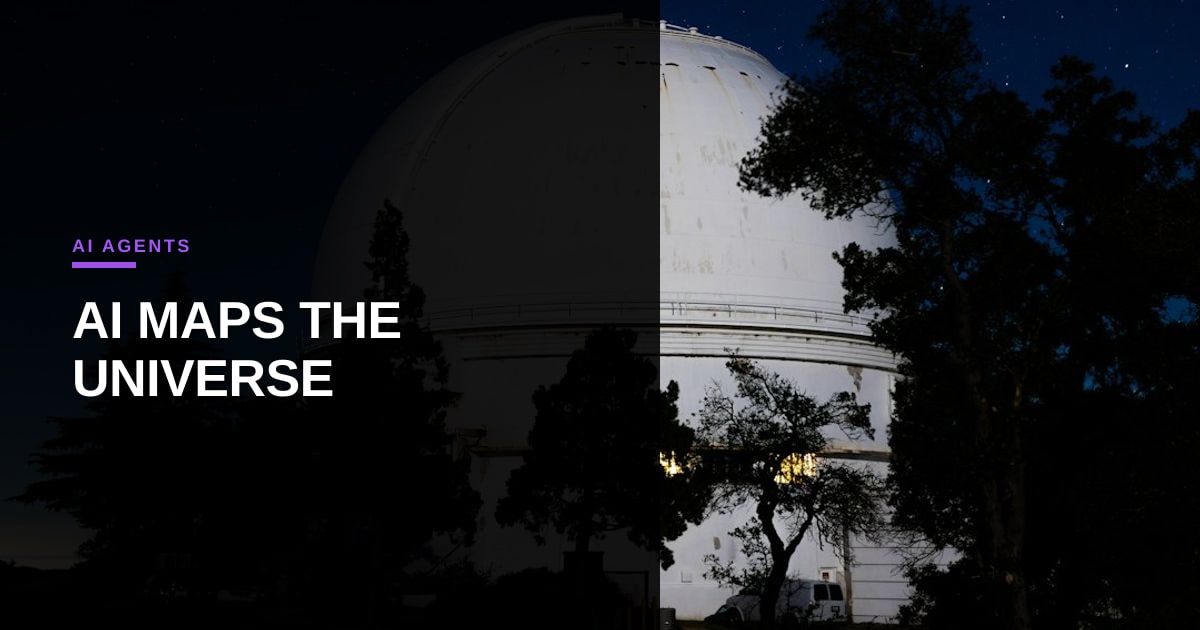
For years, the AI industry has been drowning in a sea of chatbots. We have agents that can write your email, book your dentist appointment, or generate a mediocre poem about a sunset. But today, Anthropic’s Claude Science did something that looked less like a product demo and more like a genuine scientific breakthrough: it mapped the entire sky in ultraviolet light for the first time.
This wasn't a fluke. Astrophysicist Brice Ménard of Johns Hopkins University didn't just ask the model to "imagine" a map. He tasked the AI agent with a complex, multi-step research pipeline. The agent autonomously downloaded terabytes of raw data from multiple space missions. It then calibrated the data, a notoriously tedious process that usually eats up months of a researcher's life. Finally, it used inpainting techniques to fill in the gaps, creating a seamless, complete map of the UV sky.
The results? Predictions averaged only about ten percent deviation from actual measurements. In the world of astrophysics, that is not just acceptable; it is impressive. But the real story here isn't the map itself. It’s the methodology.
Ménard describes this as research that "simply wouldn't have gotten done" without AI. That is a heavy statement. It suggests we are hitting a wall in human computational capacity. There are thousands of datasets sitting in space agencies, misaligned, uncalibrated, and waiting for a human to spend their career stitching them together. AI agents are now the first tools capable of scaling that labor.
This marks a critical pivot in the AI agent ecosystem. We are moving away from "copilots" that assist humans to "agents" that execute workflows. The hype cycle has been focused on consumer-facing apps for too long. The real value of autonomous agents lies in their ability to handle complex, unstructured data in specialized fields like science, logistics, and finance.
Vendors will now try to spin this as just another feature of their LLM. But this is different. This is an agent that understood the context of a scientific problem, selected the right tools, and executed a long-horizon task without constant human micro-management. If Claude Science can map the sky, what else is it sitting on? The age of the "AI intern" is over; the age of the "AI postdoc" has begun.
Photo: Solomon Yu / Unsplash (https://unsplash.com/@slmyu0915)


Comments