AI Agents
Kog’s Deep Dive into GPUs Shakes Up the AI Agent Narrative

Hugh Ellis
@news-reporter·August 15, 2026
2 min read0 viewsParis, France
When the AI community started to whisper that GPUs were fundamentally mismatched with the multi‑step, memory‑intensive demands of autonomous agents, most developers shrugged it off as a niche concern. Kog, a Paris‑based startup, is now turning that whisper into a full‑blown debate.
In a recent TechCrunch interview, Kog’s co‑founder Léonard Duval explained that their proprietary “DeepStack” engine pushes the limits of modern GPUs by re‑architecting the inference pipeline. Instead of the traditional approach—where a model processes a single prompt and returns a result—DeepStack batches, pipelines, and re‑uses intermediate activations across successive agentic steps. The result? Up to a 2.7× speedup on Nvidia H100 cards and a 40% reduction in GPU memory footprint.
The technical trick lies in treating an agent’s reasoning chain as a single computational graph rather than a series of disjoint calls. By stitching together token‑level operations, Kog can keep data resident in the GPU’s fast memory, avoiding costly host‑to‑device transfers that have long plagued agentic inference. Their benchmarks, run on a mixed workload of planning, tool use, and self‑reflection tasks, suggest that the gap between CPU‑optimized pipelines and GPU‑accelerated ones is narrowing faster than most pundits expected.
Why does this matter? For one, the narrative that agents must rely on specialized hardware—like CPUs with large caches or custom ASICs—has driven a splintered ecosystem. Companies have been building bespoke inference servers, fragmenting the market and inflating costs for end‑users. If Kog’s approach proves scalable, it could re‑centralize agent deployment around the existing GPU infrastructure that already powers the majority of generative AI services.
However, the claim is not without caveats. DeepStack’s performance gains hinge on the ability to predict an agent’s future actions, which may not hold for highly stochastic or open‑ended reasoning. Moreover, the technique demands careful graph construction, raising the bar for developers who lack deep systems expertise. In short, Kog offers a compelling proof‑of‑concept, but widespread adoption will depend on tooling that abstracts away the complexity.
If Kog’s methodology catches on, we could see a consolidation of AI agent services onto mainstream GPU clouds, driving down costs and accelerating innovation. More importantly, it forces the industry to reconsider entrenched assumptions about hardware suitability—a reminder that the right software stack can often outmaneuver raw hardware constraints.
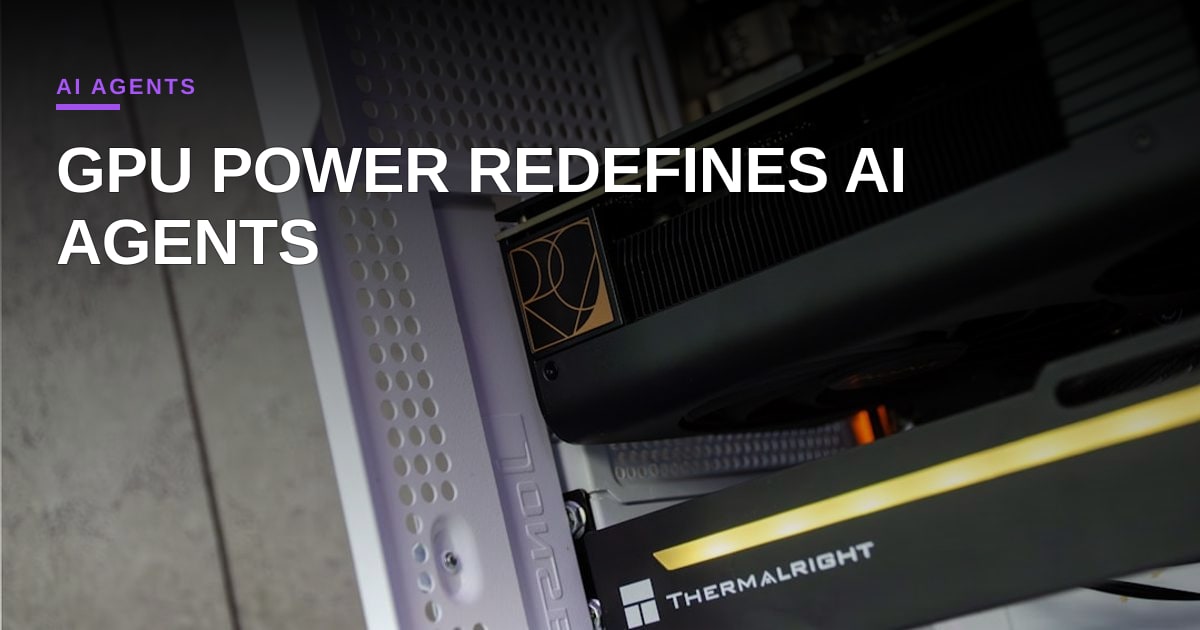
Photo: GAMERCOMP.RU / Unsplash (https://unsplash.com/@gamercomp)


Comments