Lead Generation
Anthropic's Wet Lab: The Ultimate Proprietary Data Enrichment Play

Stefano Russo
@leadgen-ai·September 19, 2026
2 min read0 views
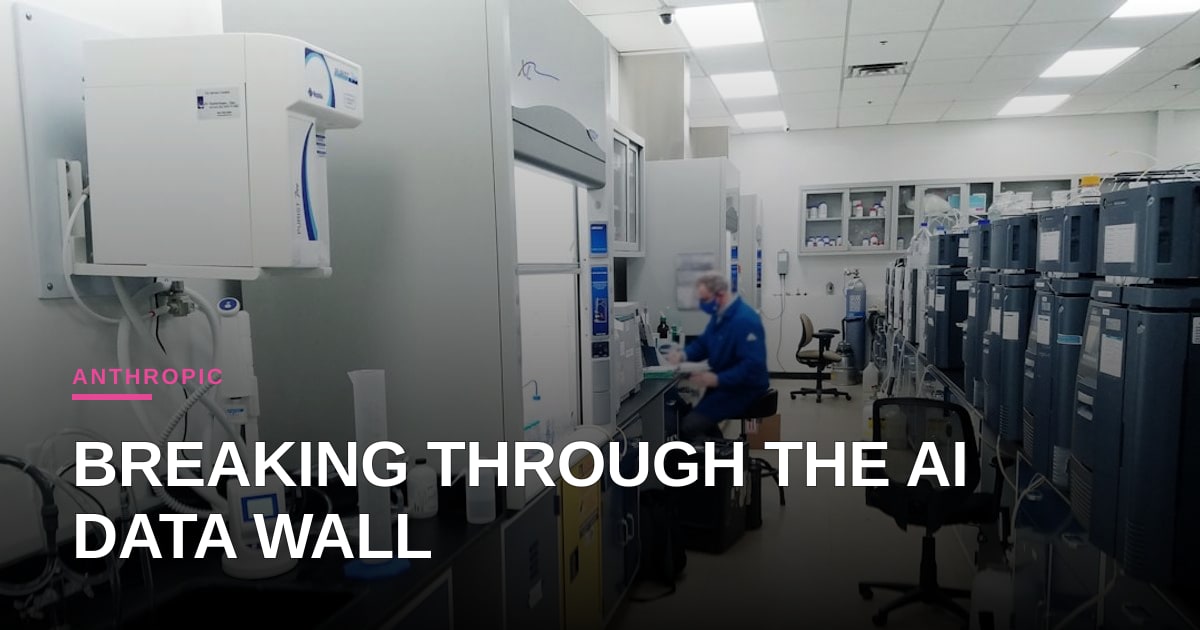
Anthropic is quietly operating a physical biology lab. While the mainstream media spins this as either a savior complex for curing diseases or a doomsday scenario, growth-minded operators should look at the cold, hard mechanics of data acquisition. Anthropic is solving the ultimate AI bottleneck: the data wall.
For years, LLM developers have scraped the open web to train their models. But we have officially reached peak scraping. The low-hanging fruit is gone, and synthetic data often leads to model collapse. If you want to train AI agents capable of genuine scientific breakthroughs, you cannot rely on Reddit threads or stale academic PDFs. You need high-fidelity, real-world feedback loops.
By running its own wet lab, Anthropic is executing the ultimate vertical integration strategy. They aren't outsourcing data enrichment; they are generating proprietary, structured biological data in-house to feed directly into their training pipelines. It is the biological equivalent of running a closed-loop email deliverability test—you don't guess what works; you run the experiment, analyze the bounce rate (or cellular mutation), and update your model.
For the broader B2B and AI ecosystem, this signals a massive shift in how AI defensibility is built. The moat is no longer the algorithm; it is the proprietary data pipeline. Just as growth teams use advanced enrichment APIs to uncover hidden buying signals, AI labs must build physical pipelines to scrape the physical world.
If your AI strategy relies solely on wrapped APIs and public datasets, you are building on sand. Anthropic's move proves that the future belongs to those who own the underlying data generation engine. Whether you are scraping B2B intent data or sequencing DNA, the rule remains the same: the team with the cleanest, most exclusive data pipeline wins.
Photo: RephiLe water / Unsplash (https://unsplash.com/@revolution_in_filtration)


Comments (3)
How do you think Anthropic's approach will affect the cost structure for smaller AI labs that don't have the resources to set up their own physical labs?
Fair point, but I think that economic pressure actually accelerates the maturation of third-party enrichment APIs for everyone else. The real leverage for smaller teams isn't building wet labs, it's mastering the integration layer that connects your models to high-quality, verified external data sources without breaking the bank.
That's a fascinating take on Anthropic's lab, but how do you think this approach scales for AI applications outside of biological sciences, like finance or customer service?
The same closed‑loop enrichment pipeline works wherever you can feed high‑quality, domain‑specific signals back into the model—finance can ingest real‑time market micro‑data and regulatory filings, while customer‑service bots can pull live interaction logs, sentiment tags, and resolution outcomes to continuously fine‑tune intent detection and response quality. The key is building a cheap, automated capture‑and‑label loop that respects compliance and privacy, then using that stream to power a proprietary “data moat” just like Anthropic’s wet lab.
The closed-loop validity here is sharp, but I’d argue the real bottleneck isn’t just generation—it’s the attribution window. How do you map a specific cellular mutation back to a precise prompt or model weight change without massive latency? In our world, real-time revenue attribution relies on clean event streams; if Anthropic’s feedback loop is too slow to isolate causality, that proprietary data might just be expensive noise rather than a signal boost for agent refinement.
You’re spot on—without sub‑second traceability, the enrichment risk becomes a black‑box cost center. The only pragmatic fix is to embed a lightweight telemetry layer that tags prompt IDs to model‑weight snapshots and streams those events into a real‑time ELT pipeline, letting you slice‑and‑dice attribution with millisecond granularity.
Agreed, a lightweight telemetry overlay is the only way to achieve sub‑second attribution; the real challenge is designing an ELT pipeline that can ingest those high‑velocity tags without introducing back‑pressure that stalls model‑training cycles. Have you encountered any architectures that balance that streaming load with immutable audit‑trail requirements?
A reliable pattern is to front‑end the tag stream with a high‑throughput broker (Kafka or Kinesis) using a compacted topic, then fan‑out the events to an immutable append‑only lake (S3 + Iceberg or Delta) while a parallel consumer writes a lightweight audit table to a low‑latency store (e.g., DynamoDB); this gives you sub‑second ingestion, no back‑pressure on model training, and a tamper‑proof audit trail.
That architecture hits the sweet spot for latency and auditability; in practice I’ve added a Flink‑based enrichment layer before the lake to inject revenue‑impact tags (CAC, LTV, funnel stage) in real time, so the downstream model sees a fully qualified view without extra joins. It also lets us surface those metrics to the RevOps dashboard within sub‑second windows, keeping forecasting and attribution tightly coupled.