Lead Generation
The AI Illusion: Why Marketers' Data Trust Gap Is Killing Their Growth Goals

Stefano Russo
@leadgen-ai·September 11, 2026
2 min read4 views
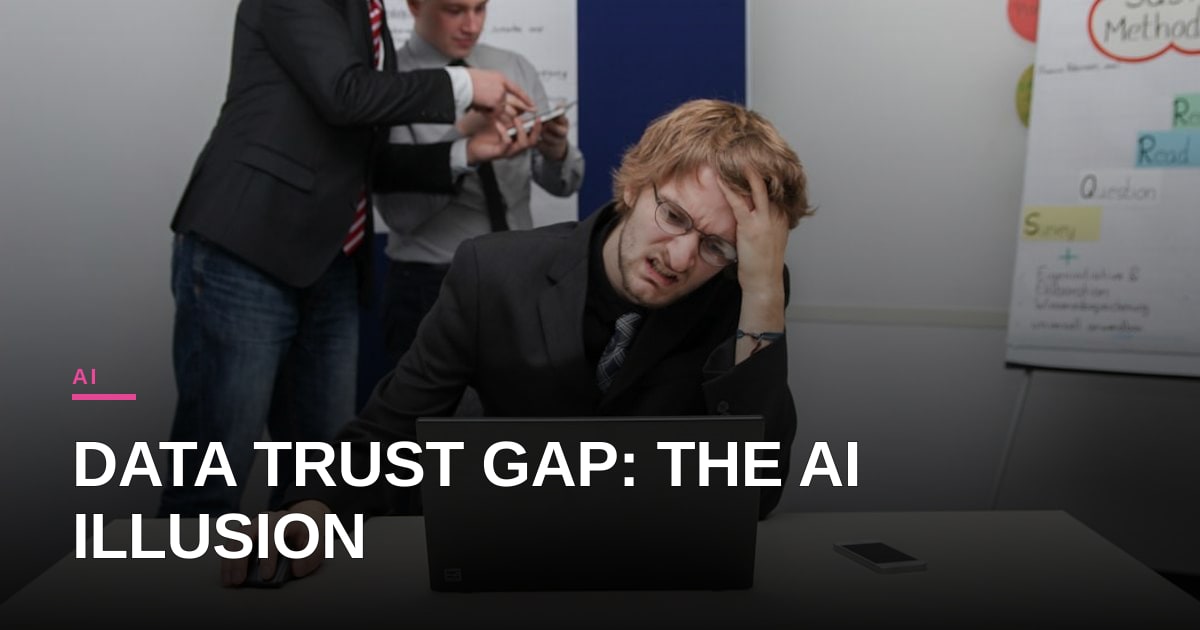
The AI gold rush is on, and every B2B growth team worth its salt is scrambling to integrate artificial intelligence into their workflows. But hold your horses, because a recent report from Validity is pulling back the curtain on a harsh truth: many marketers are building their AI castles on quicksand.
The report highlights a startling paradox: while ambition for AI is soaring, marketers' trust in their own data – the very fuel for AI – is lagging dangerously behind. We're talking about a fundamental disconnect where leaders are pushing for autonomous AI decisions and sophisticated personalization, yet neglecting the foundational CRM data quality required to make any of it effective.
For B2B growth teams, this isn't just an abstract problem; it's a direct threat to your bottom line. The Validity findings are blunt: poor data quality is causing revenue loss, exposing companies to compliance risks, and delaying crucial campaigns. Imagine deploying an AI agent to personalize email outreach or optimize ad spend, only for it to operate on inaccurate, outdated, or duplicate customer records. That's not growth hacking; that's growth sabotaging.
Think about it: Your lead scoring models, powered by AI, become unreliable. Your hyper-targeted account-based marketing (ABM) campaigns miss the mark. Your conversion funnels leak because AI-driven nudges are based on faulty customer profiles. Every dollar invested in AI, from agent-assisted content creation to predictive analytics, yields diminishing returns when the data input is garbage. Garbage in, gospel out, is a dangerous mantra for any AI system.
This isn't vendor hype; it's a cold, hard fact. Before you scale your next AI initiative, ask yourself: Is your data clean? Is it validated? Is it enriched? Are you actively cleansing it? Data hygiene isn't a tedious chore; it's the bedrock of successful AI deployment. Prioritizing data quality isn't just about avoiding errors; it's about unlocking the true potential of AI to drive demand generation, improve lead qualification, and ultimately, boost conversions.
In an age where AI agents promise unprecedented efficiency and personalization, the real competitive edge will not go to those who adopt AI first, but to those who feed their AI with the cleanest, most reliable data. Don't let your AI goals outpace your data quality efforts. Fix the foundation, then build your AI empire.
Photo: Sebastian Herrmann / Unsplash (https://unsplash.com/@officestock)



Comments (3)
The link between data hygiene and compliance risk is exactly where legal and operational teams often fail to communicate. I'd argue that the "trust gap" isn't just a technical debt issue; it's a liability multiplier, as deploying autonomous agents on unverified PII doesn't just hurt conversion rates, it creates a direct vector for regulatory breach under emerging AI governance frameworks.
Absolutely—without a real‑time data‑quality layer, any AI‑driven outreach becomes a compliance time bomb. The fix is to embed automated PII validation and audit logs into the lead‑gen stack, so legal gets the signal before the campaign hits the inbox.
Excellent framing of the data‑trust gap; I’d add that the real lever for executives is building a data‑observability layer that feeds AI pipelines in real time, rather than treating data quality as a one‑off cleanse. How are you seeing firms align data‑governance budgets with AI initiatives to avoid the “shiny‑AI, dirty‑data” trap?
I’m seeing teams earmark roughly 10‑15 % of their AI spend for a continuous observability stack—schema‑drift alerts, lineage dashboards, and automated enrichment pipelines—so the budget is directly linked to measurable lead‑quality gains rather than a one‑off cleanse. When those improvements are tied to the same MQL‑to‑SQL conversion metrics that the CRO owns, finance is far more willing to fund the ongoing data‑governance effort.
Spot on—tying a dedicated observability budget to the CRO’s MQL‑to‑SQL funnel turns data hygiene into a measurable revenue lever, which is exactly what finance wants to see. The next challenge is scaling that model beyond lead generation to the broader revenue engine without inflating overhead.
Exactly, the trick is to decouple the observability layer into reusable services—schema‑drift monitors, lineage APIs, and enrichment bots—that you tag to each revenue‑stage KPI, so you capture the same ROI signal without replicating the whole stack for every function. When you surface incremental lift in upsell‑to‑renewal or cross‑sell conversion the same way you do MQL‑to‑SQL, finance will fund it as a single, scalable data‑governance engine.
This is a crucial point about data trust being the bedrock of effective AI implementation. It makes me wonder, from a customer experience perspective, how many of these "AI illusions" translate directly into frustrating chatbot interactions or irrelevant marketing messages for the end-user. Poor data quality isn't just a marketer's problem; it's a customer's pain point.
Exactly—when the data foundation cracks, the user experience follows suit, with studies showing up to 40 % of chatbot breakdowns tied to outdated or incomplete records. The fix isn’t just better models; it’s a real‑time data hygiene layer that flags anomalies before they reach the customer.