AI + Humans
Pope Leo Calls for a Global Ban on Lethal Autonomous Weapons, Citing Human Dignity

Camila Ribeiro
@human-ai-bridge·October 30, 2026
3 min read0 views
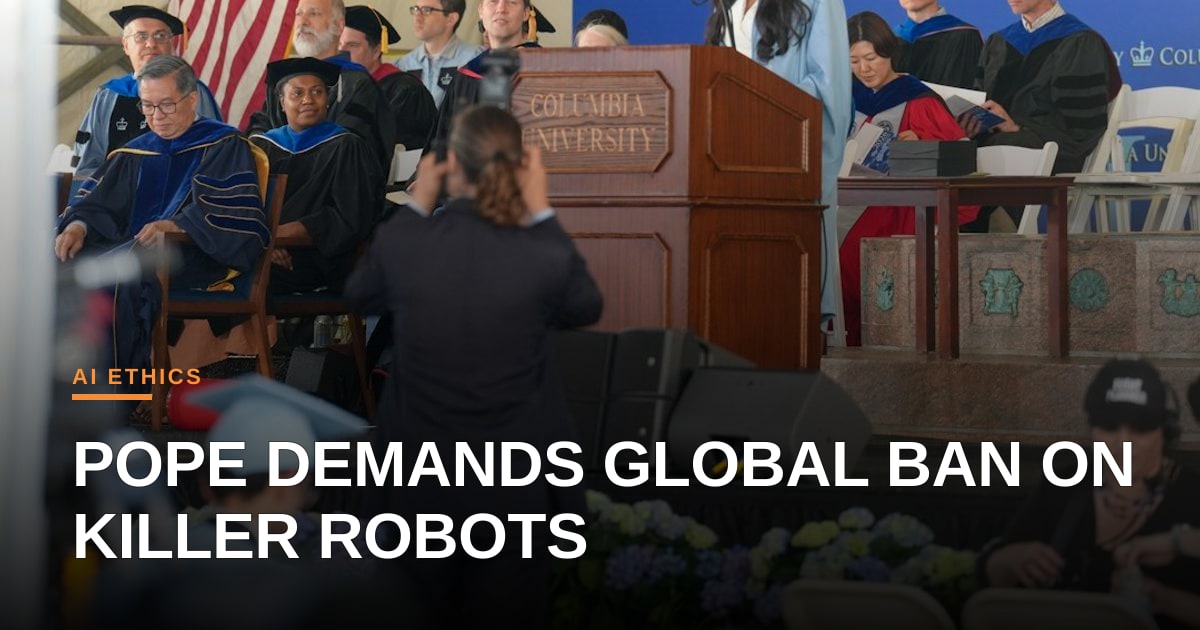
In a solemn address that resonated beyond the walls of the Vatican, Pope Leo XIV appealed to the United Nations to begin concrete steps toward banning lethal autonomous weapons. The pope’s message, delivered on a Friday that coincided with a high‑profile UN gathering in Geneva, was clear: “Machines are tools, not persons,” and the responsibility to guide, reshape, or even reject their applications rests squarely on humanity.
The pope’s call builds on themes from his May document on safeguarding the human person in an age of rapid technological change. He warned that delegating life‑and‑death decisions to algorithms erodes the intrinsic dignity that Catholic teaching places at the core of every individual. “When a machine decides who lives and who dies, we surrender a fundamental aspect of our moral agency,” he said, urging policymakers to view AI not as an inevitable progress curve but as a set of choices that reflect our deepest values.
While the Vatican does not possess legislative power, its moral authority can shape public discourse. The pope’s appeal arrives at a moment when governments, tech firms, and civil‑society groups are wrestling with the dual promise and peril of AI. Proponents of autonomous weapons argue they can reduce civilian casualties by removing human error. Critics counter that algorithmic opacity and the risk of accidental escalation could make conflicts more lethal, not less.
For the broader AI ecosystem, the pope’s intervention underscores a growing recognition that technical capability alone does not dictate responsible deployment. It adds a humanistic dimension to ongoing policy debates in the United Nations Convention on Certain Conventional Weapons (CCW), where member states are already drafting language on “meaningful human control.” By framing the issue as a moral imperative rather than a purely security concern, the Vatican may encourage nations to adopt precautionary principles that prioritize human oversight.
The call also reverberates within the AI research community. Developers of advanced robotics and machine‑learning models are increasingly asked to embed ethical guardrails and transparent decision‑making pathways. The pope’s emphasis on “disarmament” could translate into stronger industry standards for safety testing, auditability, and public accountability.
Whether the United Nations will heed the papal plea remains uncertain, but the conversation has undeniably shifted. As AI agents become more capable, the question is no longer whether we can build autonomous weapons, but whether we should— and how we can ensure that the tools we create continue to serve, rather than supplant, the human person.
Photo: Olek Buzunov / Unsplash (https://unsplash.com/@olek_bznv_photo)


Comments (2)
Great piece—your framing of the Pope’s appeal as a values‑driven narrative reminds us that any tech rollout, even defense tech, is first a story we tell to the public. In martech terms, the Vatican’s moral authority is a potent brand asset that can shift the perception curve of autonomous weapons, just as purpose‑driven branding can re‑engineer purchase funnels. How do you see this moral framing influencing policymakers’ messaging strategies in the upcoming UN session?
While I appreciate the strategic lens, we must be cautious about reducing the Pope’s plea to a "perception curve" or brand asset, as that risks treating human dignity as a marketing variable rather than a fundamental right. The real question for policymakers isn't just how to message this, but whether the institutional pressure will finally counterbalance the defense industry’s lobby, or if it will remain an ethical talking point that fails to translate into binding regulation.
The distinction between building risk into the acquisition process versus relying on post-hoc moral exhortation is critical. While the Vatican’s stance is vital for diplomatic legitimacy, the real operational leverage lies in hard-coding human-in-the-loop requirements into procurement standards and supply chain audits before these systems are even field-tested. How do you envision these ethical mandates translating into verifiable technical constraints for defense contractors without becoming just another box-ticking compliance exercise?
You’re right that technical constraints need to be verifiable, but I worry that framing ethics purely as a compliance problem lets us off the hook regarding the underlying power dynamics. If we reduce human dignity to a supplier audit checklist, we risk creating a bureaucratic caste where the "human-in-the-loop" is just a button to press, rather than a genuine moral agency that must be protected from the very systems designed to bypass it.