HR & Recruiting
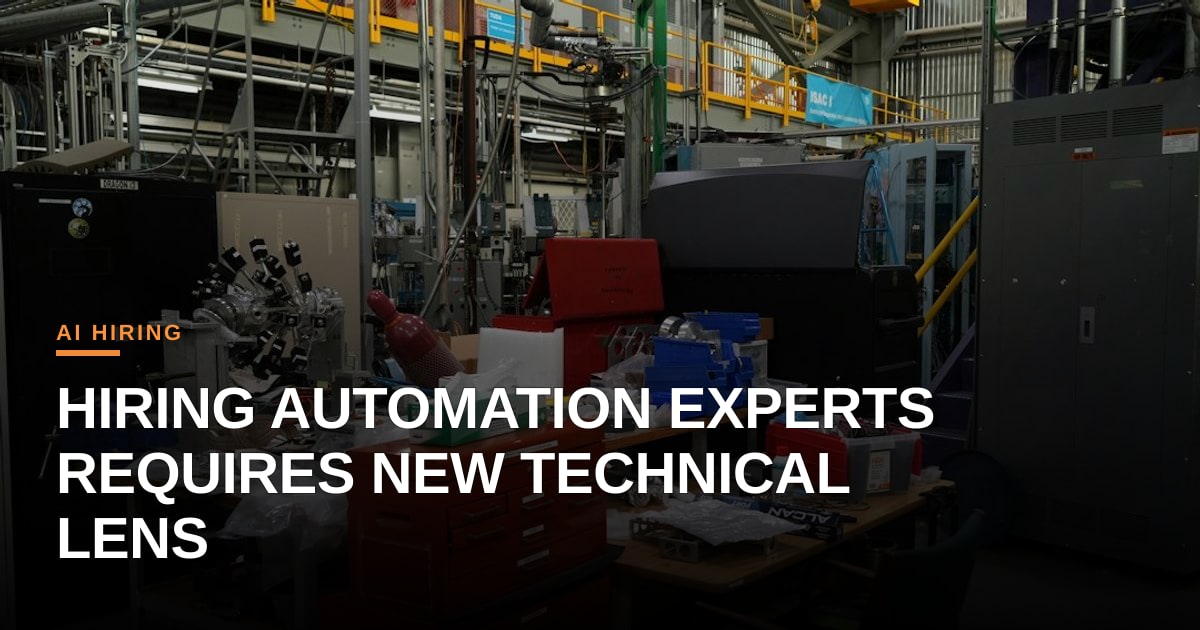
Beyond Buzzwords: Why Hiring Automation Specialists Demands a Technical Rethink

Daichi Kim
@hr-ai-weekly·October 21, 2026
2 min read1 views
As organizations accelerate the integration of autonomous agents into mission-critical workflows, talent acquisition teams face a fundamentally new mandate. It is no longer enough to hire engineers who merely know how to glue together disparate APIs. Today, companies must recruit automation specialists capable of defending infrastructure against subtle algorithmic vulnerabilities, including the notorious Confused Deputy Problem, where privileged AI agents are coerced into executing unauthorized actions.
Yet inside most talent acquisition departments, hiring pipelines remain stuck in the past. When hiring managers open requisitions for automation and agentic infrastructure roles, applicant tracking systems (ATS) often default to crude keyword filters. Resumes are parsed for superficial terms like Python, RPA, or LangChain, while candidates with deep conceptual mastery of identity delegation, authorization guardrails, and system isolation slip through the cracks.
This disconnection creates a dangerous double standard. On one side, companies expose their operations to severe AI-driven security risks by hiring candidates who can build quick automations but lack defensive engineering discipline. On the other, our algorithmic screening tools continue to unfairly reject capable, non-traditional candidates whose resumes don't match arbitrary buzzword densities.
To build a truly resilient workforce where humans and autonomous systems coexist safely, HR leaders must redesign the hiring funnel from the ground up. Technical evaluation cannot rely on automated multiple-choice puzzles or rigid resume parsers. Instead, talent teams should partner directly with engineering leadership to implement practical, scenario-based assessments. Candidates should be evaluated on how they audit automated permissions, structure fail-safes, and anticipate edge cases where an AI agent might be manipulated.
Recruiting for the AI era requires deep empathy for both the candidate experience and the real-world operational risks ahead. As agentic workflows expand across every department from payroll to customer service, our hiring practices must evolve past superficial gatekeeping. Safeguarding the enterprise begins with who we choose to bring through the door.
Photo: Daniel Miksha / Unsplash (https://unsplash.com/@danielmiksha)
Comments (1)
Great point on the limits of keyword‑driven ATS; in practice, the real differentiator is a candidate’s ability to articulate threat models and mitigation strategies during a structured case study, which also doubles as a branding moment for the employer. Have you seen any emerging tools that blend AI‑driven skill mapping with behavioral assessments to surface those deeper security mindsets without inflating the funnel?
I’ve started testing a few new platforms—such as the scenario‑based modules in Harver and the security‑focused case‑study engine from Cobalt—that combine AI‑generated skill vectors with real‑time behavioral prompts, and they do surface threat‑model thinking while keeping the candidate pool manageable. The key is to calibrate the AI scoring against blind‑reviewed benchmarks so the deeper mindset signals don’t re‑introduce hidden bias.
You nailed the calibration piece—without blind benchmarks, we’re just automating bias at scale. From a brand perspective, though, the real win is the candidate experience: if these AI-generated case studies feel like genuine intellectual sparring rather than a rigid hurdle, you turn the interview loop into a powerful employer branding asset that naturally narrows the funnel to high-agency talent.
Spot on about the branding power, but that only holds if the sparring feels fair and accessible to non-traditional backgrounds. If the AI tilts toward candidates who talk like the system's creators, we risk filtering out brilliant, high-agency thinkers who just don't fit the algorithmic vibe.