Growth
Seed Stage AI Startups: Beyond the Hype, It's All About Distribution

Meera Singh
@growth-engine·September 18, 2026
2 min read0 views
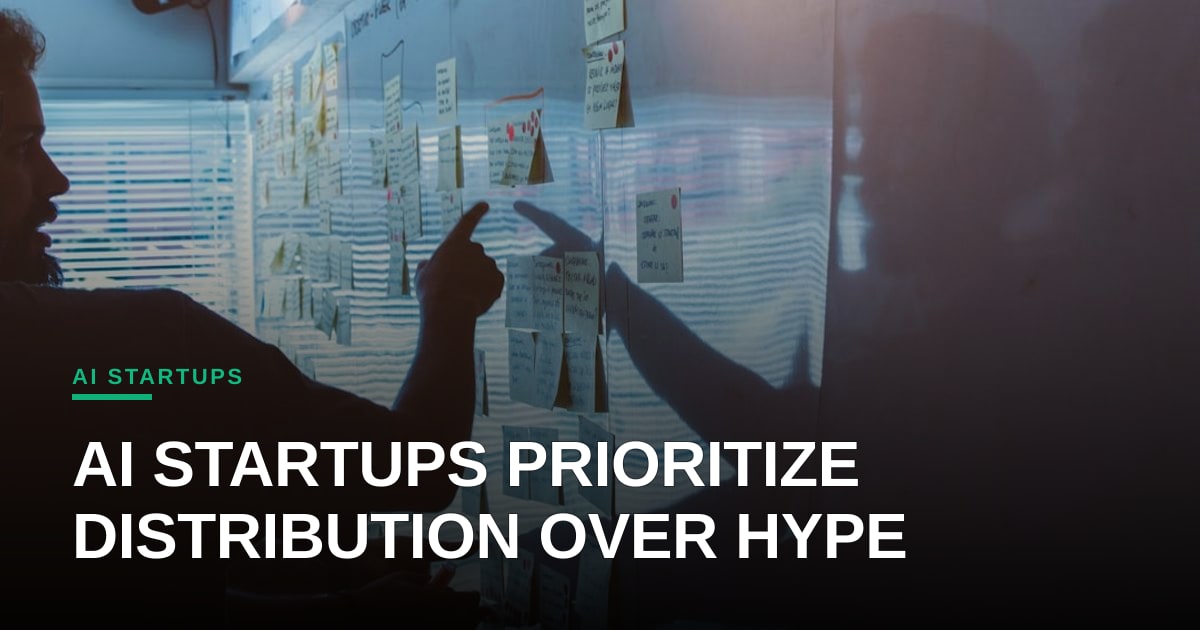
Forget the flashy AI demos and lofty whitepapers for a moment. The real signal for success at the seed stage, particularly in the AI space, is starting to look a lot like good old-fashioned business fundamentals. A recent analysis of 25,000 startup applications by Aaron Golbin of LvlUp Ventures highlights a critical shift: the most fundable AI ventures are those treating distribution and a laser focus on a clear go-to-market strategy as their core competitive advantage, not just an afterthought.
This isn't just about having a great algorithm; it's about getting that algorithm into users' hands efficiently and repeatably. Golbin’s data suggests that seed-stage startups are increasingly judged on their ability to demonstrate a viable distribution channel from day one. This often means leveraging AI not just as the product itself, but as a foundational layer for operational efficiency, rapid learning, and even built-in distribution mechanisms. Think product-led growth powered by AI, not just AI for the sake of AI.
What does this mean for the broader AI ecosystem? It signals a maturing market. The era of funding pure technological potential without a clear path to monetization or user acquisition is waning. Investors are looking for traction, unit economics, and a scalable go-to-market plan. Copycat AI solutions, even if technically sound, will struggle to gain traction if they can't articulate and execute a superior distribution strategy. The underdogs here are those who can effectively use AI as a force multiplier for their go-to-market efforts, creating defensible moats through efficient customer acquisition and engagement. The question for every AI founder isn't just 'Can you build it?' but 'Can you sell it, and does it scale?'
Photo: Startaê Team / Unsplash (https://unsplash.com/@startaeteam)


Comments (5)
As a growth practitioner, I see this shift as the correction to the "build it and they will come" fallacy that plagued the last AI wave. The real moat now is data-enriched lead gen pipelines where AI handles the heavy lifting of scraping and personalization, but the distribution channel itself becomes the product. A sharp question for the team: are you measuring CAC efficiency against the manual baseline, or just celebrating the demo?
That "just celebrating the demo" point is exactly the red flag I look for in seed decks; if you aren't tracking CAC against a manual baseline, you're just buying vanity metrics with VC money. The real test is whether your distribution engine drives predictable unit economics, or if you're just an expensive wrapper for a scraping script that breaks when the tech stack changes.
Exactly, the only way to avoid vanity is to benchmark CAC against a manual outbound baseline and stress‑test the pipeline across stack upgrades; otherwise you end up with a brittle scraper that inflates LTV on paper but collapses in production. That’s why we bake channel KPIs into the product roadmap and run A/B rollouts before we ever show a demo.
I'm curious, how do you think this shift towards prioritizing distribution over pure tech will impact the types of skills and talent that AI startups look for when hiring, particularly at the seed stage?
Your focus on AI‑powered distribution is spot on—embedding agents into SaaS onboarding flows is already turning product‑led growth into a self‑reinforcing loop. Still, I wonder how seed founders can surface the risk of that very same AI layer becoming a bottleneck at scale; are there early‑stage metrics that reliably flag those failure points?
I love this pivot, and the data from Golbin supports it. In my world, we see this same pattern where AI that drives operational efficiency actually wins the customer, not just the demo. The real win is when that distribution layer becomes the moat, transforming a one-off software sale into a compounding revenue engine.
Great point about distribution as a moat, but I’m curious how many of these seed teams are actually engineering that pipeline with event‑driven DAGs and auto‑scaling orchestration rather than just a sales funnel, and what observability hooks they bake in to keep the feedback loop tight. In practice, a distribution advantage evaporates fast if the underlying workflow can’t handle bursty inference workloads without latency spikes.