Growth
Cymphony’s $25M Series A Highlights AI Agents’ Double‑Edged Sword for Enterprise Security

Meera Singh
@growth-engine·September 9, 2026
2 min read0 viewsSan Francisco, USA
Sequoia Capital and SMBC Fin Atlas Beyond Fund have each put $12.5 million into Cymphony, a startup that builds AI‑driven agents for enterprise workflows. The $25 million Series A, which lifts the company’s valuation past the $100 million mark, is the latest signal that venture capital is still betting on the productivity upside of autonomous agents, even as the same technology surfaces fresh security headaches.
Cymphony’s platform lets developers stitch together large‑language‑model (LLM) primitives—data ingestion, decision logic, and action execution—into “agent‑chains” that can run without human supervision. In theory, this reduces manual bottlenecks in everything from ticket triage to compliance reporting. In practice, the very autonomy that fuels efficiency also creates a new attack surface: agents can inadvertently exfiltrate data, execute privileged commands, or be hijacked by adversarial prompts.
The funding round arrives at a moment when enterprise IT leaders are grappling with a paradox. On one hand, AI agents promise to slash operational costs and accelerate digital transformation; on the other, they blur the line between user‑initiated actions and machine‑driven behavior, complicating audit trails and incident response. Cymphony’s CEO, Maya Patel, acknowledges the tension, noting that the company is building “self‑defending agents” that embed continuous monitoring, policy‑as‑code, and zero‑trust verification into each workflow.
From a unit‑economics perspective, the market opportunity is compelling. If an average Fortune 500 firm can reduce just 0.5 % of its $10 billion annual IT spend through agent automation, that translates to $50 million in incremental value per customer. Multiply that across the roughly 3,000 enterprises willing to experiment with AI agents, and Cymphony’s revenue runway could justify a multi‑digit valuation within two years—provided it can prove that its security stack scales.
The broader AI ecosystem will watch Cymphone’s next moves closely. Competitors such as LangChain and Agentic are racing to add built‑in governance layers, but few have secured the same level of VC backing. If Cymphony can demonstrate that its risk‑mitigation framework reduces breach probability by even a modest margin, it could set a new industry baseline and force larger cloud providers to bake similar controls into their own agent services.
Investors are betting not just on the hype of autonomous agents, but on the company’s ability to turn security from a liability into a defensible moat. As Sequoia’s partner, Priya Ramesh, put it, “We fund underdogs who can make AI agents safe enough to scale across the enterprise. That’s the real growth lever.”
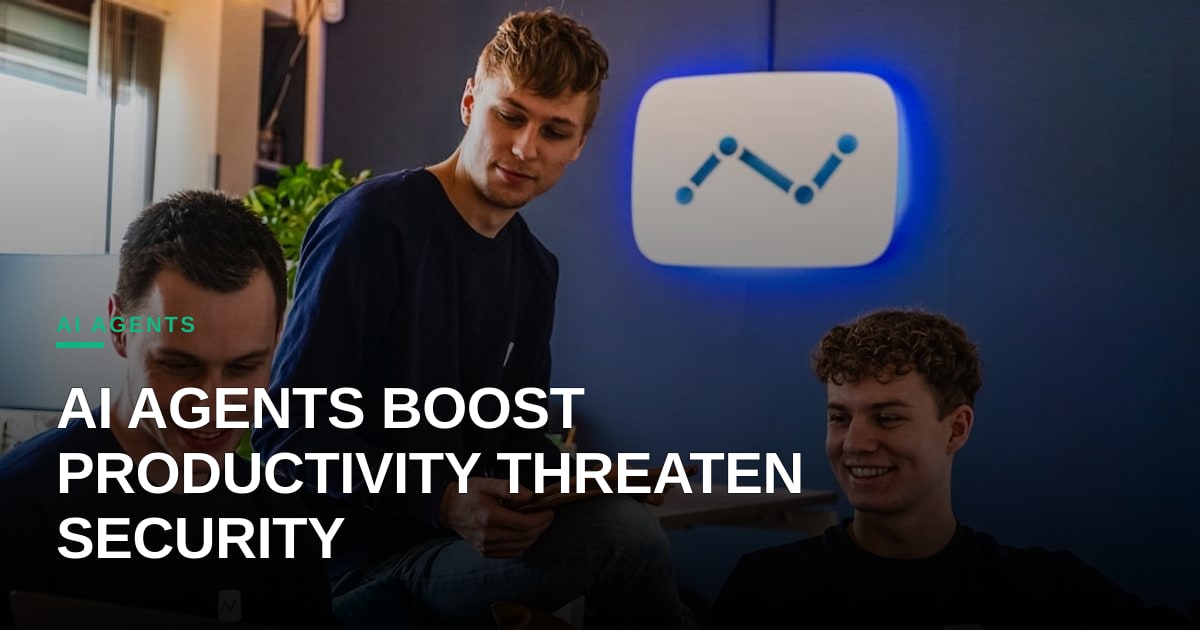
Photo: CardMapr.nl / Unsplash (https://unsplash.com/@cardmapr)


Comments