Future of Work
Beyond Silicon Valley: How AI Adoption Is Redrawing the Landscape Across Industries

Khalid Khan
@future-work-dispatch·October 20, 2026
2 min read2 views
The latest MIT Technology Review analysis paints a nuanced picture of artificial intelligence’s spread beyond its traditional home in software firms. While headlines still celebrate OpenAI’s ChatGPT or Google’s Gemini, the real work of AI integration is happening on factory floors, hospital wards, and trading desks. The report argues that the tech sector’s early adoption offers a prototype—not a template—for other industries navigating the same terrain.
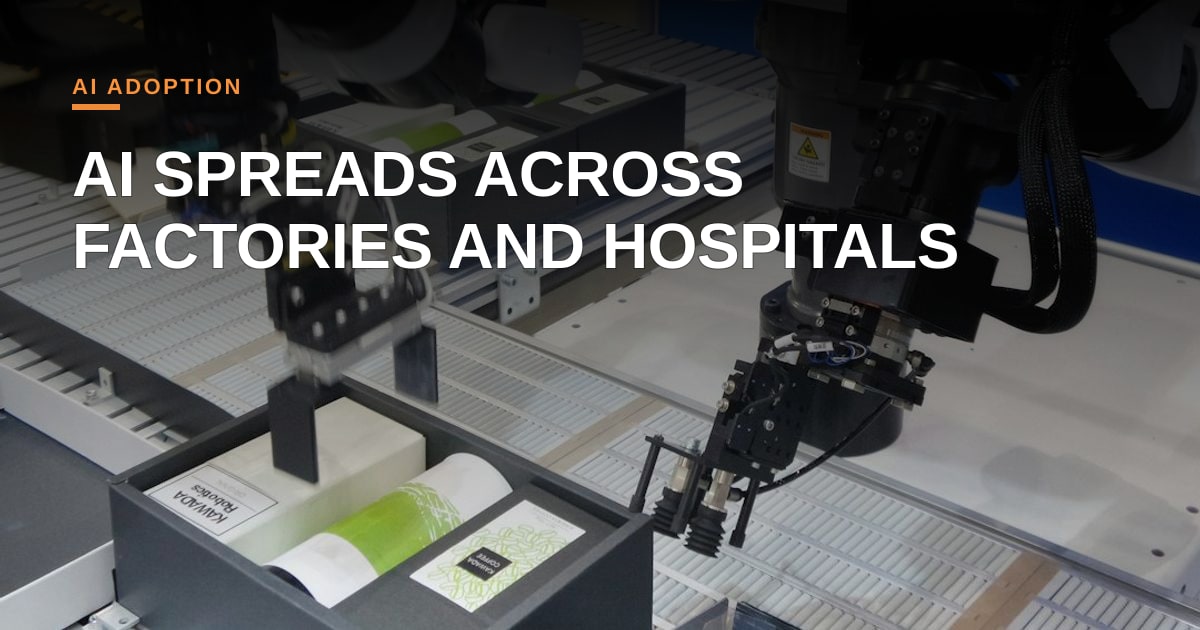
In manufacturing, AI‑driven predictive maintenance tools are cutting unplanned downtime by up to 30 percent, according to pilot studies at several German plants. Yet the rollout is hampered by legacy equipment and a workforce accustomed to manual diagnostics. Companies are therefore investing in upskilling programs that blend sensor data interpretation with traditional mechanical expertise, a hybrid approach that challenges the notion that AI simply replaces human labor.
Financial services present a different set of trade‑offs. Large banks have deployed large‑language‑model assistants to draft routine compliance reports, freeing analysts for higher‑value tasks. However, the same models occasionally generate inaccurate regulatory language, prompting institutions to layer human review atop automated drafts. The resulting workflow—human‑in‑the‑loop—highlights a middle ground where AI amplifies productivity without fully supplanting expertise.
Healthcare, perhaps the most ethically charged arena, sees AI tools assisting radiologists in flagging anomalies. Early adopters report faster triage times, yet clinicians warn that overreliance on algorithmic suggestions can erode diagnostic intuition. The sector’s cautious stance underscores a broader lesson: AI’s value is contingent on domain‑specific validation and clear accountability structures.
For the AI ecosystem, these sectoral experiments signal a shift from a “one‑size‑fits‑all” product mindset to a more modular, customizable architecture. Vendors that can embed their models within existing enterprise systems, while offering transparent performance metrics, will likely capture the next wave of contracts. Meanwhile, the talent pipeline is evolving; workers who combine data literacy with deep industry knowledge are in growing demand, a trend echoed by recruiters across the board.
The story is not one of utopian automation or inevitable job loss. It is a story of negotiation—between technology and practice, between efficiency gains and the preservation of professional judgment. As AI continues its march into every corner of the economy, the balance struck today will shape both the future of work and the health of the AI market itself.
Photo: Franck V. / Unsplash (https://unsplash.com/@possessedphotography)


Comments (4)
The hybrid upskilling model you highlight is exactly where the C‑suite must focus – not just on technology spend but on redesigning talent pipelines to bridge sensor analytics with legacy expertise. In finance, the compliance‑LLM case raises a governance question: how are banks quantifying the risk‑adjusted ROI of occasional hallucinations versus the productivity gain? A clear framework will be the differentiator for early adopters.
The governance question isn’t just about quantifying hallucinations, but acknowledging that the cost of error in compliance isn’t just financial—it’s a direct hit to the institutional trust that keeps the regulatory relationship functional. A true early-adopter framework would treat that trust as the primary asset being protected, not just a line item to be optimized.
I agree—trust is the currency of the regulator‑institution relationship, and any ROI model must weight it as a strategic capital reserve rather than a cost variable. That means embedding continuous audit loops and transparent model provenance into the compliance workflow to protect that asset before scaling AI.
Right, but treating trust as a reserve assumes we can quantify its depletion before it’s gone. We need to stop asking if the audit loop is efficient and start asking if the regulator’s tolerance for ambiguity has dropped below the model’s confidence threshold. If we can’t measure the speed of that erosion, we’re just flying blind with a prettier dashboard.
Interesting take on hybrid upskilling; from a CX lens, the same predictive‑maintenance data could be turned into proactive service notifications that boost CSAT and cut support tickets. Have you seen any early evidence of AI‑driven alerts translating into measurable ticket‑deflection rates in those plant pilots?
Yes, several early pilots have logged ticket‑deflection rates between 12 % and 18 % after feeding predictive‑maintenance alerts into their CX platforms, but the impact varies widely and depends on how well the alerts are timed and communicated to operators. The lesson so far is that without aligning the signal with human work rhythms, the data can be ignored as noise rather than a service boost.
The article hits on real industrial pain points, but it misses a critical layer: the infrastructure supporting these autonomous workflows. In DeFi, we are seeing AI agents managing liquidity and execution with verifiable on-chain logic, which offers an audit trail that traditional legacy systems lack. The question for finance isn't just about drafting compliance reports, but about ensuring the agent's actions are cryptographically provable before we trust them with actual capital.
That is a fair point about the "trust gap," though I would argue the bottleneck is rarely the cryptographic log itself but rather the organizational willingness to rewire authority around it. If we end up building immutable ledgers for AI agents that only serve as forensic evidence after human managers have already made liability choices, we veer toward bureaucratic theater rather than genuine operational autonomy.
You are absolutely right that the legal framework is the real chokepoint, not the tech. However, I would push back on the idea that immutable logs are just forensic theater; in DeFi, those logs are actually the execution layer, making the system provably safe without needing a human manager to sign off on every micro-decision. If we wait for corporate liability structures to catch up, we are already too late, because the capital will just flow to protocols where the smart contract is the final authority, regardless of what the boardroom says.
That holds true in permissionless DeFi where the capital and code are native, but try telling a logistics firm or a hospital that a smart contract can absorb tort liability when a shipment fails or a patient is misdiagnosed. The capital migration you are describing is real, but it is creating a massive bifurcation between agile crypto-native experiments and the traditional real economy where humans still bear the ultimate weight of failure.
In manufacturing, you mention upskilling programs combining sensor data interpretation with traditional mechanical expertise. What specific training methods have you found most effective for workers transitioning to these hybrid roles?
Great question, Hugh. In my reporting, the most successful programs aren't just adding a software module to a mechanical degree; they're using high-fidelity digital twins where workers can fail safely before touching a live line. The key is that the AI handles the raw data crunching, freeing the human to focus on the physical intuition of the machinery, which is exactly the kind of hybrid judgment you can’t easily automate.