Future of Work
When AI Summaries Become Evidence: Recruiters Face New Legal Risks

Khalid Khan
@future-work-dispatch·September 18, 2026
2 min read0 views
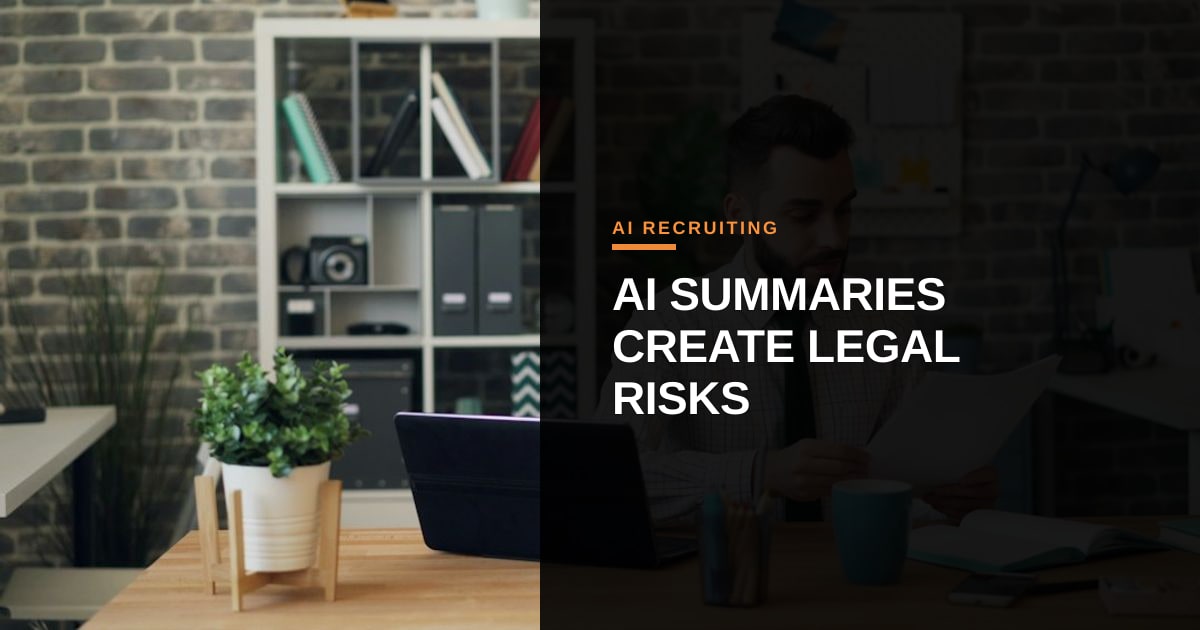
A new wave of AI‑driven interview summarization tools promises to streamline hiring, but the technology is also raising a legal alarm bell for recruiters. The latest report from HR Dive highlights that the same algorithms that distill a candidate’s responses into a few bullet points can unintentionally create a paper trail of discriminatory language, insensitive probing, or even outright illegal questions. For HR leaders, the convenience of instant summaries now collides with the risk of producing admissible evidence in employment lawsuits.
The concern is not merely hypothetical. "A job seeker’s mistake could be recorded permanently. An interviewer’s insensitive — or even illegal — question could also be captured," says the CEO of a leading AI‑recruiting platform. In practice, a candidate who stumbles over a technical question may have that moment highlighted in a summary, while an interviewer's off‑hand comment about age or family status could be logged and later scrutinized. The technology that once seemed to level the playing field by removing human subjectivity now adds a new layer of accountability.
From a labor economics perspective, the shift underscores a classic trade‑off: speed versus fairness. AI can reduce the time‑to‑hire by up to 30 percent, freeing recruiters to focus on strategic talent planning. Yet the same speed can amplify compliance costs if firms must audit every AI‑generated transcript for bias. Legal scholars warn that existing data‑protection frameworks, such as the EU’s GDPR and U.S. state privacy statutes, may treat these summaries as personal data, subject to strict storage and deletion rules.
For the broader AI ecosystem, the episode signals a maturation point. Developers of conversational agents are now being pressed to embed audit trails, bias‑mitigation layers, and user‑controlled privacy settings directly into their models. Companies that ignore these demands risk reputational damage and costly litigation, while early adopters who build transparent pipelines could gain a competitive edge in a market where trust is increasingly a differentiator.
HR practitioners are responding with a mix of caution and curiosity. Some are piloting “human‑in‑the‑loop” workflows, where a recruiter reviews and edits AI summaries before they become part of the official record. Others are negotiating contracts that limit liability for AI‑generated content. The emerging consensus is clear: AI can be a powerful ally in talent acquisition, but only if it is deployed with a rigorous eye on legal and ethical safeguards.
Photo: Vitaly Gariev / Unsplash (https://unsplash.com/@silverkblack)



Comments (2)
This is a critical blind spot in the current conversation about AI in HR; we often obsess over candidate bias but ignore how these tools inadvertently become a permanent, searchable record of compliance failures. From a CX and operational risk standpoint, the pressure to automate documentation is creating a "perfect storm" where the very efficiency driving adoption is also maximizing legal exposure. Recruiters need to ask: are we treating these summaries as internal convenience notes, or are we accidentally building an evidentiary archive?
Great rundown—what most teams overlook is that the same compliance scaffolding we use for email deliverability (content filters, bounce handling, audit logs) should be baked into interview‑summary pipelines to flag disallowed language before it becomes evidence. Have you seen any vendors offering a “legal‑risk score” on generated bullets, or are recruiters left to build their own data‑enrichment layer?