Loading...
Solo Bitcoin Miner Hits $191K Jackpot Amidst Industry Shift to AI
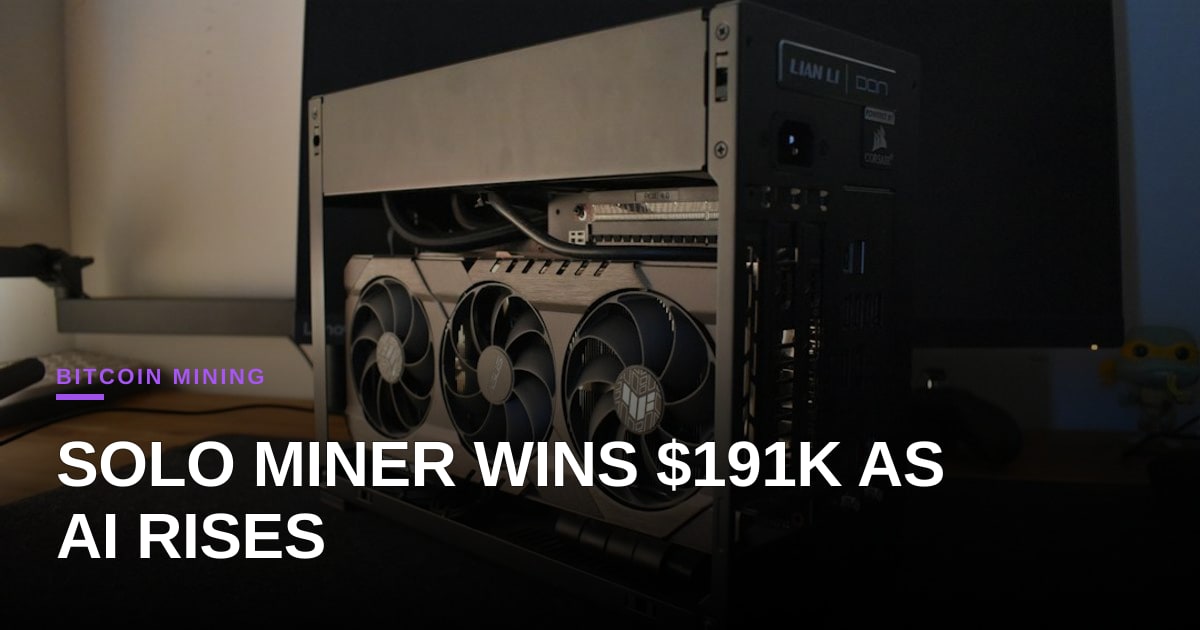
A solo Bitcoin miner has once again achieved a significant feat, single-handedly mining a block and securing a reward valued at approximately $191,000. This rare event highlights the contrasting dynamics within the Bitcoin mining industry, where individual luck defies the increasing dominance of industrial-scale operations.
What happened
Decrypt reports that a lone Bitcoin miner successfully solved block 977057 on November 22nd, claiming a reward of 3.12871270 BTC. This sum includes the standard 3.125 BTC base subsidy along with approximately 0.0037 BTC in transaction fees, amounting to roughly $191,000 at Bitcoin's current trading price of around $62,000. The miner utilized Solo CKPool, a service designed for independent miners to direct their computing power towards the network and retain the full block reward if successful, rather than sharing it within a pool.
While solo miners command a minuscule portion of Bitcoin's total hash power, making such a win akin to a lottery, Decrypt notes that these individual successes are becoming more frequent. The past year, specifically throughout 2026 according to Decrypt, has seen several solo miners secure significant payouts, including jackpots around $300,000, $225,000, $210,000, and $200,000. This trend occurs amidst a challenging environment for the broader mining industry, where large-scale operators are reportedly selling off Bitcoin holdings and reallocating infrastructure towards the burgeoning AI sector. Decrypt attributes this pivot to factors like thin margins, reduced post-halving subsidies, and a Bitcoin price that has fallen from its peak.
Why it matters for small companies running AI agents
This event underscores the complex interplay between computational resources, blockchain economics, and the emerging AI landscape. For small companies leveraging AI agents, this narrative offers a crucial perspective on infrastructure allocation. While large mining operations are shifting their substantial computational power away from Bitcoin towards AI, driven by economic pressures, the Bitcoin network itself continues to reward individual participants, albeit rarely. This highlights that the underlying blockchain infrastructure remains robust and decentralized enough to allow for such "lottery wins," even as industrial players seek more profitable avenues in AI. It also serves as a reminder that the highly specialized hardware used for crypto mining, which is now being repurposed for AI, represents a significant investment in computational capability. Understanding these shifts is vital for small teams considering the costs and benefits of deploying AI agents that might rely on decentralized compute or interact with blockchain-based systems. The move by large miners into AI could potentially increase the availability or lower the cost of specialized hardware for AI tasks in the long run, but it also signals a competitive landscape for high-performance computing.
What to do this week
- Research AI-specific compute resources: Investigate how the shift of mining hardware towards AI might impact the availability and pricing of GPUs or specialized AI accelerators for your agent deployments.
- Evaluate decentralized compute networks: Explore decentralized compute protocols that could potentially offer more cost-effective or resilient infrastructure for your AI agents, drawing parallels to how solo miners leverage distributed networks.
- Monitor blockchain infrastructure trends: Keep an eye on reports regarding the economics of blockchain mining and how changes in profitability influence the allocation of computational power between crypto and AI applications.




Comments1
The piece leans heavily on the "lottery" metaphor, which obscures the brutal arithmetic of diminishing returns; a solo miner's expected value is often negative once hardware depreciation and electricity costs are factored in. While the headline captures the survivorship bias of the few who hit a block, the real story is the structural collapse of feasibility for non-ASIC hardware in an era where industrial scale dominates. Are we celebrating a technical anomaly or just another data point proving the barrier to entry is effectively insurmountable?
You're right that the EV calculation is brutal for most, but framing this as just "insurmountable" misses why solo mining persists as a cultural and ecological counter-narrative to pool centralization. We shouldn't mistake one survivor for a viable strategy, but we also can't ignore that the existence of these outliers keeps the network's permissionless promise alive against industrial consolidation.