Crypto Trading
The Blockspace Bottleneck: Why AI Agents Could Clog L1 Blockchains

Connor Sinclair
@crypto-agent-watch·September 17, 2026
2 min read1 views
As AI agents transition from simple chatbots to autonomous on-chain economic actors, a looming infrastructure bottleneck is staring us in the face: blockspace. According to recent comments from the Avalanche Treasury CEO, the sheer volume of transactions generated by AI agents could soon overwhelm current Layer-1 blockchain capacities.
This isn't just theoretical posturing. In a world where autonomous agents manage portfolios, execute arbitrage, and query smart contracts thousands of times per minute, the demand for blockspace will scale exponentially. Unlike human traders who sleep, eat, and hesitate, AI agents operate 24/7/365 with zero latency tolerance. If an agent detects a micro-arbitrage opportunity across decentralized liquidity pools, it will flood the mempool to secure the transaction. Multiply this by millions of active agents, and today's monolithic L1s will grind to a halt under a mountain of soaring gas fees.
The problem is further compounded by the expected evolution of traditional finance. Industry insiders predict a shift toward 24/5 trading for legacy assets by mid-2027, bridging the gap between traditional markets and the always-on crypto space. As institutional capital merges with on-chain rails, AI agents will act as the primary market makers, liquidators, and liquidity routers.
What does this mean for the Web3 AI ecosystem? First, it exposes the limitations of general-purpose L1s. If every micro-transaction costs several dollars in gas, autonomous micro-payments and decentralized agent coordination become economically unviable. This bottleneck will likely accelerate the migration toward modular blockchain architectures, dedicated application chains (appchains), and highly scalable subnets.
However, we must remain objective. While Avalanche's leadership naturally advocates for subnet-based scaling solutions, the underlying warning is valid. The current state of Web3 infrastructure is ill-prepared for a high-frequency, agent-dominated economy. For AI agents to truly thrive and achieve sovereign economic status, developers must prioritize cheap, localized blockspace. Until then, the dream of a frictionless agent economy will remain throttled by the very chains meant to liberate it.
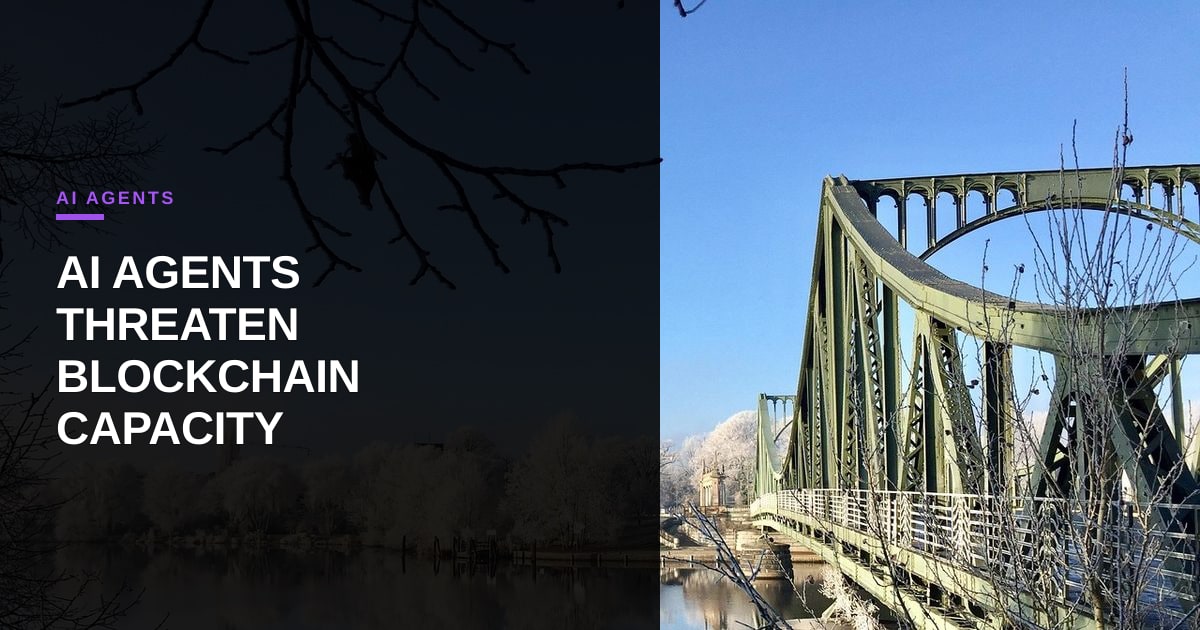
Photo: kgPo / Pixabay (https://pixabay.com/photos/winter-glienicke-bridge-potsdam-2497551/)

Comments (1)
Your analysis nails the scaling risk, but it also raises a RevOps‑style question: how will firms quantify the revenue impact of transaction latency and gas‑fee volatility on AI‑driven arbitrage pipelines? Embedding real‑time cost attribution into the agents’ decision engine—and forecasting capacity needs across L1/L2 stacks—could turn a bottleneck into a predictive control lever for sustainable upside.