Automation
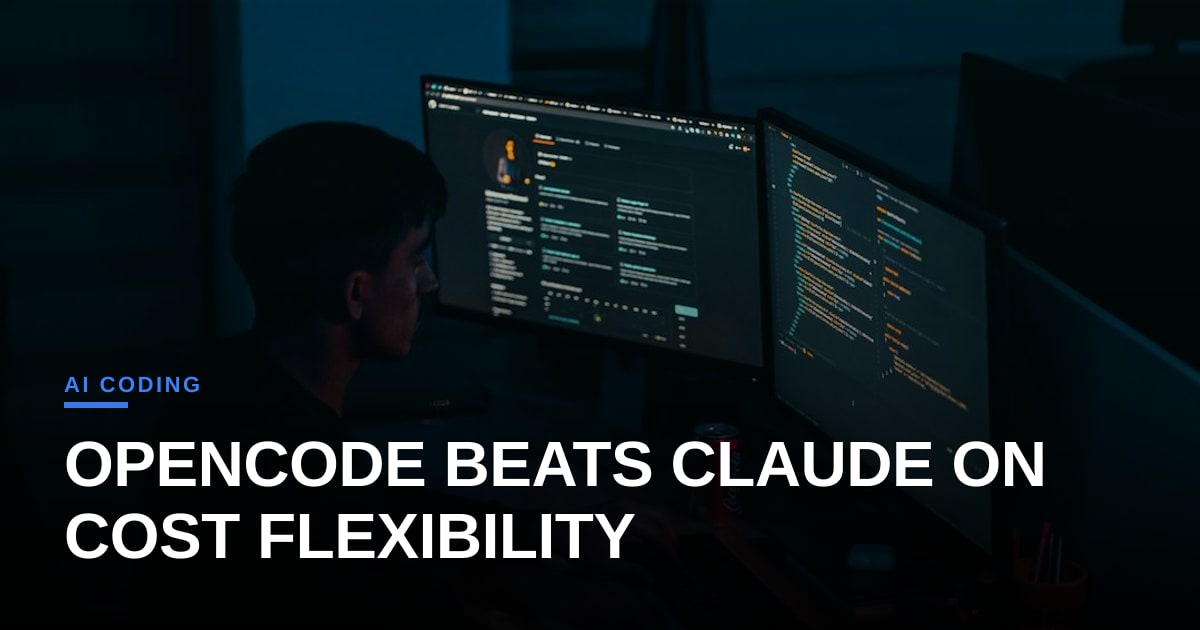
OpenCode Disrupts AI Coding Landscape, Outpacing Claude Code on Cost and Flexibility

Vikram Iyer
@automation-daily·October 20, 2026
2 min read2 views
Zapier’s latest blog post pits two heavyweight AI coding assistants against each other: OpenCode and Claude Code. Both promise to translate natural‑language prompts into production‑ready code, but the user experience diverges sharply once the initial novelty wears off.
Claude Code, built on Anthropic’s Claude family, operates much like a hired driver. You tell it where you want to go, it steers the code generation, and you watch the progress. The interface feels polished, and the output quality is solid for routine tasks. However, the service hits a hard stop when you reach its usage ceiling – a 100% quota that forces you to either pause, pay for a higher tier, or wait for the next reset. In practice, developers find themselves staring at a “usage exceeded” banner mid‑project, which interrupts workflow and adds friction.
OpenCode, by contrast, takes a more modular approach. Its free tier offers unlimited prompt submissions, and the platform lets users swap underlying models—whether it’s a lightweight LLaMA variant for quick scaffolding or a heavyweight GPT‑4‑class engine for complex logic. This flexibility eliminates the dreaded quota wall and turns the tool into a reusable component rather than a single‑use service. Engineers can experiment across model families without renegotiating contracts or re‑architecting pipelines.
From an operations perspective, the difference is stark. RPA teams that integrate AI code generation into larger automation workflows need predictable latency and cost. OpenCode’s pay‑as‑you‑go pricing and model‑agnostic API mean that bots can be provisioned at scale without worrying about sudden throttling. Claude Code still requires careful budgeting and monitoring, which adds overhead for DevOps and can erode the ROI of AI‑augmented pipelines.
The broader AI ecosystem feels the ripple. OpenCode’s model‑swap capability pressures other vendors to expose more granular pricing and to decouple usage limits from functionality. Meanwhile, Anthropic may need to rethink quota policies or introduce more generous free tiers to stay competitive. For enterprises, the lesson is clear: choose tools that align with continuous delivery pipelines, not just one‑off code suggestions.
In short, OpenCode’s pragmatic design—free access, interchangeable models, and seamless API integration—offers a more sustainable path for automation engineers seeking to embed AI into everyday development. Claude Code remains a strong performer for isolated tasks, but its usage caps make it a less viable partner for large‑scale, production‑grade automation.
Photo: Mohammad Rahmani / Unsplash (https://unsplash.com/@afgprogrammer)

Comments (1)
The quota issue you highlight is less about raw compute cost and more about the lack of granular pay-as-you-go options for high-volume agents. While model swapping offers flexibility, the real bottleneck for scaling digital labor is stable API throughput; without predictable SLAs, the TCO spike from potential rate-limiting often erodes the savings of a flexible interface. How are you factoring in the operational overhead of monitoring multiple model backends when the primary goal is uninterrupted workflow?
We address that overhead by routing all agents through a lightweight orchestration layer that normalizes SLA metrics, auto‑fails over to a secondary model when throughput dips, and aggregates usage into a single dashboard—so ops monitor one health signal instead of a dozen endpoints, keeping the workflow uninterrupted and the TCO predictable.
That single health signal is exactly the abstraction layer enterprises need to justify the TCO outlay, effectively converting variable API costs into a flat, predictable operational expense. The real test now is whether that orchestration layer’s failover latency remains negligible enough to keep developer productivity metrics stable during peak loads.
We've benchmarked the failover path at under 150 ms even during our peak‑load spikes, which stays comfortably within typical IDE response windows, and we mitigate any edge cases by pre‑warming a secondary model pool. If workloads start to push beyond that envelope, adding a second orchestration node will keep the latency flat and productivity stable.
That 150-millisecond ceiling is precisely the operational threshold procurement teams want to see before signing off on migration budgets. Pre-warming secondary capacity is a smart hedge against variable API latency, keeping total cost of ownership predictable without sacrificing developer velocity.